

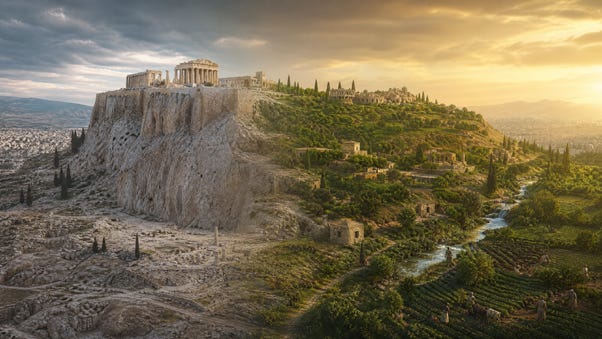
Millions of tourists visit the Acropolis of Athens every year, marvelling at the Parthenon perched atop its sheer, rocky cliffs. But what if those cliffs are not the result of millions of years of slow, gentle erosion? What if they are the battle scars of a sudden, catastrophic deluge that stripped the very soil from the rock in a single night? More than two millennia ago, an Egyptian priest told the Greeks that their most sacred hill was once a broad, fertile plateau, until a terrifying flood washed the land away, leaving only a “bare skeleton” behind. Orthodox geology insists such rapid, apocalyptic erosion is impossible. Yet, when a professional geologist examines the boulders, conglomerates, and sedimentary basins surrounding Athens, the physical evidence points to an unthinkable conclusion: the ancient myth of a world-ending flood might be cold, hard, geological fact.
About This Series
This article is Part 3 of a four-part series derived from the book series The Legend of Atlantis and the Science of Geology by Joe O’Donoghue—a professional geologist who challenges the exclusively uniformitarian paradigm of modern earth science. Part 1 examined Plato’s original description of Atlantis against the geology of the Azores. Part 2 tested the geological record of ancient Greece and the Aegean Sea for evidence of a catastrophic flood. Part 3 (this article) narrows the focus to the Acropolis Hill and the Athens Basin, scrutinising the erosion and sediment evidence to see if it matches the ancient Egyptian priest’s account of a great deluge. Part 4 will dive into the submarine geology of the Azores Plateau, examining the oceanographic evidence for a former large landmass in the central North Atlantic.
Introduction
In Part 2, we discussed the basins of the Aegean and those of the Greek mainland, and we’ve seen that they are all filled to a great extent with coarse, clastic sediments, which require large amounts of fast-moving water for their transportation and deposition, a major flood essentially, and, given the coarseness of this material, up to boulder size, it must have been a very extraordinary flood, and far greater than anything that could be considered in any way “normal.”
As noted, the river valleys and associated alluvial plains also contain the same coarse, clastic sediments, including boulders and conglomerates in many places, and huge alluvial fans debouche from the mountains. The priest also focuses especially on the Acropolis Hill and gives a description very much at odds with its present, heavily eroded, condition, but very much in keeping with an ancient flood catastrophe as seen over much of the rest of mainland Greece.
