

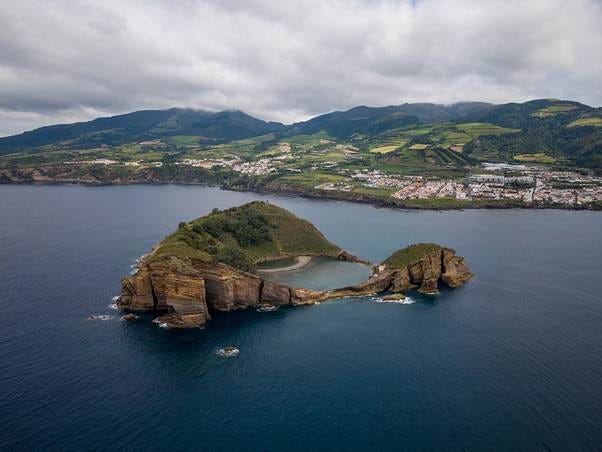
Roughly halfway between Europe and North America, nine volcanic islands rise from the middle of the Atlantic Ocean. They sit atop a vast submerged plateau, a triangular mass of thickened crust straddling the Mid-Atlantic Ridge, that geologists have never fully explained. The islands are lush, geothermally active, and fertile beyond what their oceanic setting should allow. They grow two crops a year. Their soils are red, black, and white. They have hot springs. And they sit precisely where an ancient Egyptian priest, speaking to the Athenian statesman Solon more than 2,500 years ago, said a great island civilisation once stood, before the ocean swallowed it whole. This is not a story about myth. It is a story about geology.
About This Series
This article is Part 1 of a four-part series by Joe O’Donoghue, a professional geologist who challenges the exclusively uniformitarian paradigm of modern earth science, arguing that the physical evidence, when examined without ideological constraint, points toward a very different geological history of our world. Each part investigates a distinct but interconnected line of evidence, building toward a comprehensive geological case for the existence of Atlantis. Part 1 (this article) examines Plato’s original description of Atlantis against the real geography and geology of the Azores and the Mid-Atlantic Ridge. Part 2 turns to the geological record of ancient Greece and the Aegean Sea to test whether the catastrophe described by the Egyptian priest left any physical trace. Part 3 focuses on the Acropolis Hill and the Athens Basin, scrutinising the erosion and sediment evidence for a catastrophic flood. Part 4 dives into the submarine geology of the Azores Plateau and the Atlantic seafloor itself, examining the oceanographic evidence for a former large landmass in the central North Atlantic.
As is well-known, orthodox geology considers the Atlantis legend, and all other such legends including the Great Flood, to be little more than hyper-imaginative exaggerations of relatively ordinary events by our relatively primitive and superstitious forebears. It is widely claimed that there is no evidentiary basis in the science of geology for lost continents, global catastrophes, or overwhelming floods. However, these claims are, by uniformitarian necessity, pre-imposed on any and all evidence that might be presented. Hence, and despite what much of the physical evidence itself might suggest, catastrophism is dismissed a priori, which is no way to treat any evidence or theory, whatever they might be.
Introduction: Lost Atlantis!
Over the years and decades, possible locations for Atlantis have left few areas of the planet unmentioned. Suggestions have varied from the North Sea to the Mediterranean, and from the Sahara to Antarctica (and almost everywhere in-between). However, little in the way of scientific evidence has been provided to support many of these proposed locations, not to mention the fact that many of them are on continental landmasses, which is an odd place to find an island. Despite the suggestive name Atlantis, and the historical focus on the Atlantic, in recent years few writers seem to consider the Atlantic as the likely candidate.
This is due, quite possibly and most likely, to the natural assumption that academia, with its plate tectonics theory, has the correct explanation and history of the Atlantic Ocean basin, as it so insistently claims. In which case, and if correct, there is no room in either science or history for the recent existence and catastrophic subsidence of a large landmass in the middle of the North Atlantic, at least not according to mainstream academia. This article, however, dares to question plate tectonics theory, along with many other orthodox theories, which, for some reason, never seem to attain the status of official, proven fact.
