


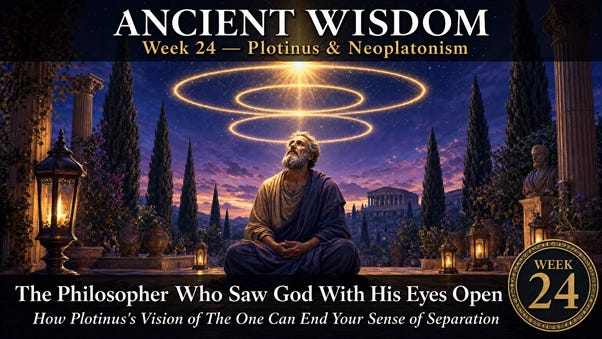
The Roman Empire underwent a brutal period during the third century AD. The Crisis of the Third Century is now known to historians as a time of civil war, economic decay, plague, and barbarian invasion. There was widespread chaos and horrible violence, and most people had no hope of any safety.
In contrast, there were many other philosophers in the world, including Plotinus, who taught a completely different view of reality. While the emperors were at odds with one another over the few remaining areas they still controlled, Plotinus was teaching his students to close their eyes and find the center of their own being where there was an infinite and unbroken peace.
Plotinus was from Egypt and was a humble man. He placed no importance on wealth, power, politics, or even his own body. He did not want anyone to paint his image because he thought that one’s true image could only be seen through one’s actions and thoughts.
He believed that the world we see and live in is just a reflection of the true world beyond, which is one source of pure light and goodness.
This week we look into the deep mysticism that Plotinus represented, as well as the philosophy of Neoplatonism that he developed. We will learn how Plotinus’ “cosmological map” can assist you in overcoming the illusion of separation and also how his concept of henosis (connection) can lead to deep inner peace.
Who Was Plotinus?
Plotinus, born in Egypt in 204 AD, was interested in philosophy from a young age. In his late twenties, he relocated to Alexandria to pursue his study of philosophy under the tutelage of Ammonius Saccas, who Plotinus found so compelling that he studied with him for eleven years. Eager to expand his philosophical knowledge by learning from the Indian and Persian cultures, Plotinus participated in an unsuccessful military campaign to the East, in which he narrowly survived and eventually made his way to Rome, where he founded a School of Philosophy, which attracted senators, politicians, and the Emperor Gallienus.
Plotinus did not think of himself as an innovator but rather as an interpreter of Plato (who we covered in Week 8) and in doing so, he created an entirely new system of thought - a mystical framework for understanding the universe, which would have an enormous influence on the development of Christian, Islamic, and Jewish theology over the next thousand years. He was eventually compiled by his student Porphyry into the Enneads.
The Map of Reality: The Three Hypostases
Plotinus believed Reality to be a unified Whole rather than an amorphous, disconnected collection of things. The entirety of existence emanates (overflows) from a singular source of perfection just as light radiates from the sun. Plotinus divided reality into three levels or hypostases.
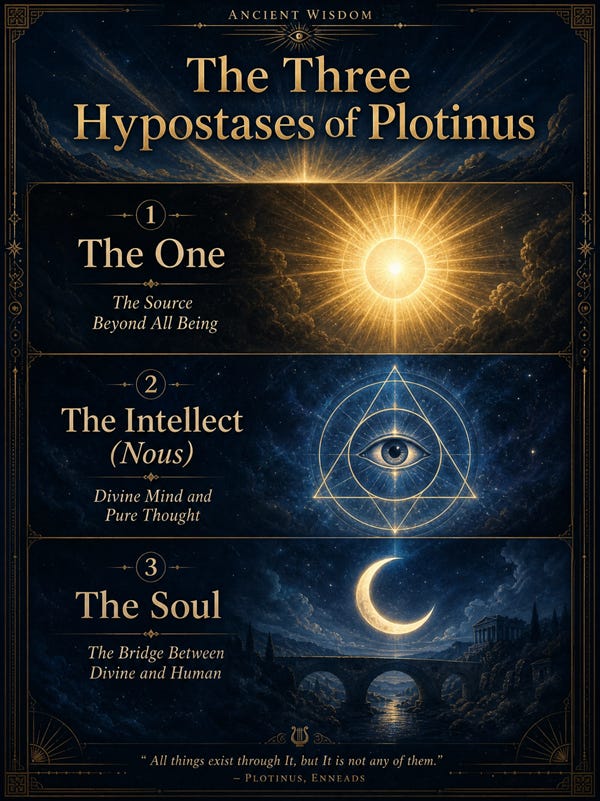
1. The One (or Source)
The One is at the centre of the universe; it is Indivisible and Infinite. It cannot be adequately described by us since we cannot limit its infinite. The One isn’t a being in the sense that we think of a “Deity”, it simply is all that is pure Goodness and purity. The One represents Absolute Potentiality, thus providing all that is.
2. The Intellect (Nous)
The Intellect is Plotinus’ first overflow from The One that is also a direct result of the Perfection of The One. The Intellect is to The One as the sun’s light is to the sun. The Intellect represents Divine Mind; it is the state of being fully aware of yourself, which is why we refer to it now as the Intellect.
3. The Soul From the Intellect overflows the Soul.
The Soul serves as an intermediary between two separate and distinct/divine realities. The Soul’s upper half is fully aware of the Creator through Intellect, while its lower half creates and gives life to the universe. Humans are part of the Soul; our bodies are physical, but our true Essence is eternally connected through the Soul to the Creator and The One.
The issue at the center of modernity is, ultimately, separateness. We are separate from nature and one another, and separated from an understanding of life beyond the material. Our fear of the unknown results in an anxious, competitive atmosphere and an obsession with controlling our environment.
For those who are struggling with anxiety related to separation, Plotinus presents a radical approach to resolving it. The root cause of separation and therefore anxiety is that it is an illusion. Your isolation from other beings is not real; you are part of The One and your essence is composed of The One’s Light.
When you accept this truth, the work on controlling your surroundings will no longer be as necessary as it once was. Instead, you will learn to accept that you are not meant to live amid outward chaos and uncertainty; your true self resides at a still and unwavering core, as does every other being.
How to Practice the Wisdom of Plotinus
As recorded by his pupil, Porphyry, Plotinus did not only theorize and teach; he practiced what he believed in and lived as a mystic. Porphyry recounts four times in their time together where Plotinus achieved henosis, complete, ecstatic union with The One (God).
So, here’s how you can apply his teachings:
1. The Practice of Going Inward.
Plotinus taught that you will find divinity by turning away from the outside. He said, “Withdraw into yourself and look.” The moment you feel disconnected from yourself due to the external world, take some time to close your eyes for 5-10 minutes and cut off your attention from your senses. Go below your thoughts and feelings until you reach the stillness that is underneath them. When you have found this stillness, you are connected to the Divine Mind.
2. The Sculptor’s Chisel.
If you look within yourself and cannot find anything beautiful, Plotinus suggests that you become a sculptor. He says, “Cut away everything extra, straighten everything that is not straight, and bring light to everything that is dark... never stop chiseling your statue.” That means you can identify your behaviors, grudges, distractions, and anything else that does not align with your true self and remove them.
3. The Flight of the Alone to the Alone.
Plotinus has defined the highest spiritual journey as “the flight of the alone to the Alone.” The flight of the alone does not necessarily mean that you will be physically alone; however, it does mean that you recognize that you are already complete in the deepest part of your being. There is nothing outside of you that you need to complete yourself. All you need to do is remember your origin.
The Light Never Leaves You
In a world that was falling apart, Plotinus found a peace that could not be broken. He did not do it by escaping reality, but by seeing through it.
This should remind us that no matter how chaotic our lives become, the connection to the Source is never severed, in the same way that the sun never stops shining, even when the clouds are thick. All we have to do is close our eyes, turn inward, and remember the light. Things will change as long as your focus is the light.
By Dr Ioannis Syrigos
Recommended Reading
The Enneads by Plotinus (translated by John Dillon)
A Note from Dr. Syrigos
For 24 weeks, we have explored the maps of reality drawn by the greatest minds in human history. But a map is only useful if you actually walk the territory.
When I return from a brief trip, I will be making a major announcement about the future of this community. We are building something that will allow you to take these ancient teachings off the page and turn them into lived experience.
Keep an eye on your inbox. The journey is just beginning.
The seeking of this cosmic knowledge which is the next step above our present self conciousness dates far back in the early stages of human development. It has been suppressed by religions as each came into power and as each passed. Replaced by another that opposed this knowledge ,resisted those who sought it; even imprisoning and killing those who sought it or had obtained it. It is still repudiated by most as a cult or even dangerous to our civilization as we know it. Fact is, it has been known by those who sought for thousands of years.