


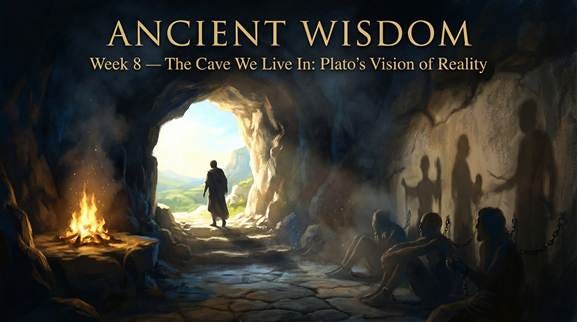
Western Civilization has wrestled with the haunting story of the Allegory of the Cave for over 2,000 years. This story depicts people chained inside of a cave, who believe that what they see (the shadows on the wall) is reality. Today, social media, virtual reality, and an algorithm-driven news feed are creating a new set of challenges for us. The ancient message of the Allegory of the Cave is one of the most relevant messages today. We need to ask ourselves the difficult question: What if the reality that we experience on a daily basis is just a reflection of that shadow on the wall?
Today we are diving into Plato’s Philosophy, and looking at the Allegory of the Cave and how he developed the Theory of Forms, as well as how he gives us the tools for wisdom that we need to escape from these modern-day caves that we live in.
The Prisoners in the Cave: Plato’s Vision of Reality
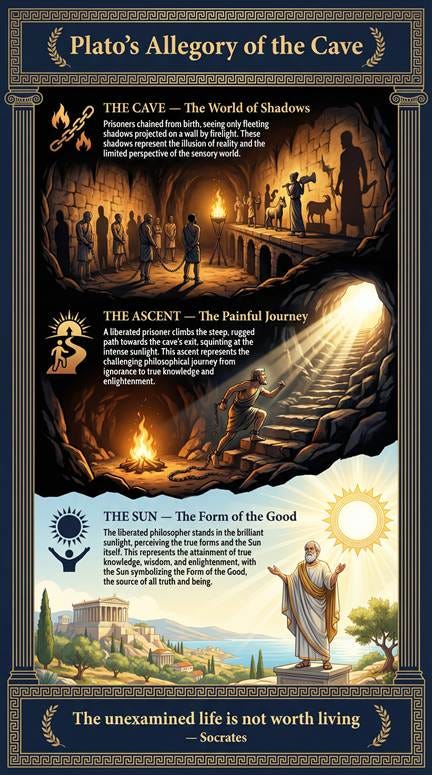
According to Plato’s Republic, Book VII, imagine the following situation: you are a person living in a cave, chained, with hundreds of others all with their backs to the light source, facing a wall with no windows to see through. Behind you, however, is a large fire. Puppeteers walk on top of walls above you, carrying objects that cast shadows on the wall. You can’t look behind you or know where these shadows come from; you can only see the shadows and hear the echoing sounds. Although this is an illusion, for the prisoners, it is the only reality.
“To them,” Socrates says, “the truth would be literally nothing but the shadows of the images.”
Plato believes that this is the human condition. When we are brought into the world, we have created for ourselves our own cave of senses; in doing so, we mistake the flickering shadows of the material world for true reality. We see beautiful things, but not Beauty itself. We see just actions, but not Justice itself. We are prisoners of our own perceptions, unaware that a higher, more real world exists beyond our limited view.
The Escape: The Painful Journey to Enlightenment
The Allegory of the Cave gives us a way of thinking about the importance of philosophy and the process of obtaining a better understanding of the world around us. A prisoner is brought out of the Cave by an individual who had already acquired knowledge (a philosopher or teacher). When the prisoner was brought outside of the Cave, he was forced to turn around. The first thing he saw were shadows being cast by the fire inside the Cave and when he saw them, they were very painful to him. He was confused; he had no way of knowing what was the cause of his pain and confusion and wanted to go back to being comfortable in the Cave where he had been used to living.
But then the philosopher or teacher grabbed him and dragged him up the steep and rugged path out of the Cave into the light of the sun. The sunlight was so blinding to him, he could not see anything. The more he worked at adjusting to the bright light, the more he became angry and hurt because of it. Eventually, after giving time to his ability to see better, he was able to look at shadows, see reflections in the water, and finally to see the objects themselves. Finally, when he was able to see the stars, moon, and sun, he understood that all the light and reality originated in the Form of the Good.
This journey represents the painful process of philosophical education to reach enlightenment. It is not easy. This path forces one to question one’s most deeply held beliefs and to endure a period of intense doubt and discomfort. The goal is for one’s mind to see beyond the shadows of the physical world and to attain the true knowledge of reality. According to Plato, the way to acquire knowledge is through active engagement by turning the soul from darkness to light, rather than through passive reception of information.
The Theory of Forms: The World Beyond the Cave
The prisoner in the allegory awakens to the “world of sunlight” that Plato refers to as his Theory of Forms. Plato believes that the world as it is perceived by our five senses and experienced through our physical bodies, is nothing more than an imperfect and ever changing duplicate of an original. The true world of the Forms is a perfect, unlimited and completely stable reality.
For example, when we look around us, there are many beds, but only one Form of “Bed.” There are many beautiful objects, but only one Form of “Beauty.” The Forms are the only true reality, and everything in the physical world only exists as a reflection or “shadow” of the Forms. The sun, as described in the allegory, represents the ultimate Form of Good, or the Form of the Good, which provides brightness to and helps give existence to all other Forms.
Plato uses the distinction between the world we see and the world of the Intelligible - a distinction that represents the largest part of his philosophy - to show how a philosopher should rationally examine the world that he knows through his five senses in order to rise from the “cave” of his senses to the world of the Forms.
The Return: The Philosopher’s Burden
Realizing the truth, the liberated prisoner has sympathy for his fellow prisoners and feels an overwhelming urge to go back to the cave and assist his fellow prisoners. However, when he returns to the cave, he finds that the light has changed his vision and thus, as a result of this change in his vision, he finds it difficult to see in the darkness of the cave and is viewed as being foolish by other prisoners. They interpret his temporary inability to see in the dark as confirmation of the fact that the outside world is extremely dangerous and therefore should never be ventured into.
“And if they were to capture the individual who was attempting to lead them upwards and free them, they would certainly kill him.”
This portion of the Allegory clearly refers specifically to the execution of Socrates at the hands of the state of Athens for his continual questioning of the established beliefs of the people and for attempting to lead the people out of their intellectual bondage. The allegory is a powerful warning about the resistance we face when we try to share uncomfortable truths. Humanity tends to be more comfortable living with its illusions than with the potentially arduous process of being enlightened.
Three Platonic Practices for Modern Life
1. The Cave Audit
Consciously identify the “shadows” in your life over a one-week period. Write out all your assumptions, beliefs, and stories which you have accepted without questioning or scrutinizing. Identify the sources for these beliefs and assumptions. Are these primarily from one source (i.e. a single news outlet), or are they curated through social media, or limited to a certain group of friends? Write down all the “caves” where you may be residing, and actively seek out information and ways of viewing the world other than those which you have been exposed to.
2. Platonic Contemplation
Choose a concept that you feel you have an understanding of, such as “justice,” “love,” or “success.” Take 30 minutes to write down everything that you can think of regarding that concept, starting with the numerous examples (the many) and then developing the universal principle (the one). What do all just actions have in common? What is the Form of Justice? This process exercises the intellect to transition from the tangible world of examples to the abstract world of principles.
3. The Philosopher’s Walk
Arrange a discussion with someone who has a fundamentally different worldview than your own. The purpose of this discussion is not to argue or persuade, but to learn. To practice Socratic questioning, ask genuine questions that are open-ended and allow the opportunity for the other person to share their beliefs with you. Through this process, you will develop humility in your own thinking and begin to see through the lens of your own limitations.
Conclusion: The Unending Journey
In Plato’s Allegory of the Cave, Plato provides a timeless insight into how we are often “prisoners” of our mind, in that we are born into a world of “shadows”, which we confuse with reality. Wisdom requires us to leave behind the “darkness” of our “illusions” and to ascend toward the “truth”.
Pursuing wisdom may be arduous, but it is worth the effort. By questioning our assumptions, examining our beliefs, and daring to face the blinding light of truth, we can begin to break free from our chains. The cave is comfortable, but the world of sunlight is where true life begins. The question is not whether the cave exists, but whether we have the courage to leave it.
By Dr Ioannis Syrigos
Suggested Books
Meno by Plato
The Republic by Plato
The job of the Media is to ensure no one escapes from the Cave.
Plato's Cave would be the smartphone of today... https://www.truthandprosperity.com/p/allegory-of-the-smart-phone?r=71ga9g