

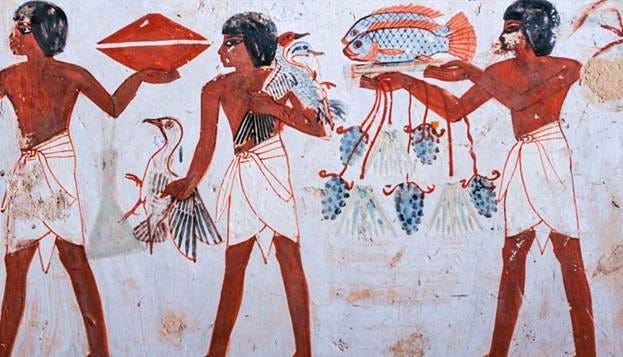
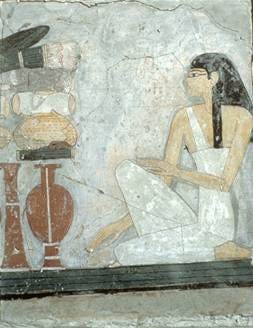
Walk into every Egyptian temple or tomb and on each wall, over and over, you will see the same image: of a person offering something. Typically, you’ll see an image of a person making an offering of bread, beer, cattle, birds, linen, incense, jars of wine and oil to a God or seated figure. You may think this is simply a decorative image that appears everywhere in Egyptian Art, to the point where it becomes hard to recognize.
There is much more to the Egyptian’s use of this image than you probably realize. When looking at the monumental scale of the pyramids built by the Egyptians, along with their ability to align the pyramids with the four corners of the earth to within one fraction of a degree, and their ability to maintain a cohesive religious belief and organized government for 3,000 years, it is clear that the Egyptians performed this offering repeatedly (in fact, repeatedly every day) over 1,000 years, at thousands of temple sites, for longer than the time that separates us from the Egyptians.
It is no small matter to imagine that the Egyptians had a clearer understanding of the meaning of these repeated offerings to God(s) than we do. Considering the fact that we do not comprehend how these repeated offerings fit into the Arab view of the world as nothing but matter, there is much to consider regarding the nature of offering to God(s) and whether or not they serve a functional role within a model or concept of the universe.
What the Texts Actually Say
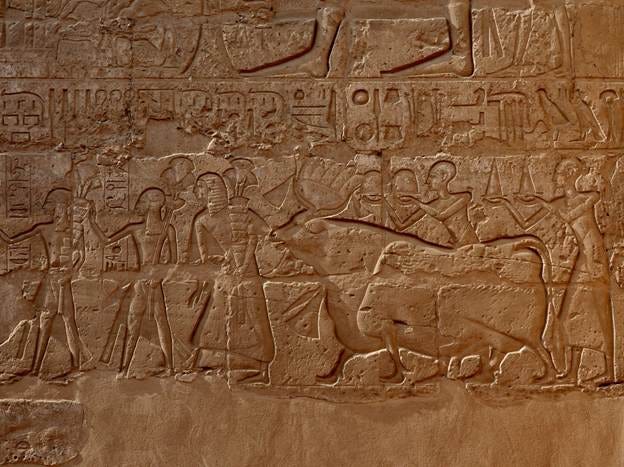
Because they often expressed themselves so clearly through their writing on monuments, many Egyptologists start with what the ancient Egyptians wrote in order to prove the existence of a ka for the deceased, which is a belief that the Egyptians believed existed until a person’s body decomposed and turned back to dust and was no longer actually there. In addition, in many of the ancient inscriptions in Egypt there’s a common theme called the ḥtp-dỉ-nsw formula that contains a standard formula for offering to the deceased. In English, we often translate this as “an offering which the king gives”. This is also one of the most common texts of the Middle Egyptian period. The formulation of this phrase is important because any offering given to a deceased person (even for the lowest class of people) was always under the name of the king because the king’s role was that of the spokesperson for every individual person before the gods. In other words, the offerings being made to the gods were actually through the king (the intermediary) who is seen as the connection between the human realm and the divine realm.
The request of the formula also conveys a significant amount of relevant information regarding what was to be offered to the gods. The request itself is an invocation (or what the Egyptians called “a voice offering”) to the gods, so that the gods would provide to the deceased a gift of food and drink, such as bread, beer, oxen, fowls, alabaster, linen, as well as everything else that was considered to be good and pure, representing the needs of the deceased for their ka. There are two key points to note. First, the intended recipient of the food and drink is not meant to feed the physical body of the deceased, but rather to supply their ka (spiritually). The ka was considered by the ancient Egyptians as the living force, or spirit, of a person, which was believed to need continuous nourishment in order to continue to exist. Second, the goods listed in the offering are described in terms of what the gods would “live upon” (i.e. through food and nourishment). Therefore, the essence of the offering was nutritional and could be consumed by a spirit.
When making an offering in a tomb, it was not necessary for the actual offerings to be present for them to have any effect. Egyptologists describe the activation of the ritual by using the actual images of the offerings (as depicted in the tomb decorations), which could be activated through a specific means of performing the ritual properly and thereby transferring the effects of the offering to the deceased’s ka. In effect, an image of a food item (like bread) would have the same effect as the actual item going into the tomb of the deceased, provided the image had been correctly activated by means of performing the proper rites. For the ancient Egyptians, images of food items did not represent some type of a symbolic decoration, they contained the actual powers of the food item to feed the ka.
The ancient Egyptians believed they were not giving food to a statue, but that they were transferring something from the physical realm into a form for the bodiless being (spirit) that it could take. Essentially, the ancient Egyptians were describing the method of transferring food to the bodiless being’s ka, and this is what is important to note from this information.
A Theory Worth Trying On
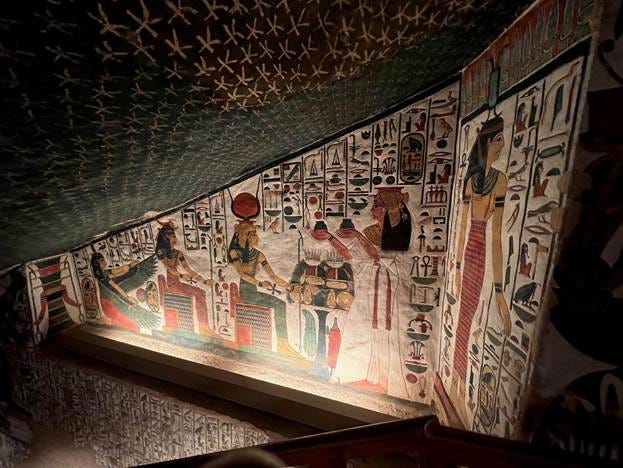
To make sense of that mechanism, I want to try looking at this through a different lens.
Rudolf Steiner, the early-twentieth-century founder of anthroposophy, described reality as layered, with a stratum beneath the finished physical world where nothing exists as a completed object. In that layer, things are continuously being formed, held in existence the way a flame is held in existence, held in existence more like a flame than an object. Stop the process and the flame doesn’t shrink; it ends. Steiner populated that formative layer with orders of intelligence, beings woven into the process of production rather than standing outside it. Itzhak Bentov, writing decades later from a background in biomedical engineering, reached for a structurally similar picture: reality as a field in which stable patterns form and then begin to act.
You do not have to accept their cosmology to see the usefulness of the idea. The idea is simply this: if some layer of reality is continuously produced rather than simply sitting there, then the interesting question about anything is not “what is it?” but “what sustains it?” A process needs throughput. A flame needs fuel.
Lay that frame over the Egyptian texts and they snap into unexpected focus. An offering, in this reading, is the voluntary introduction of dense physical substance into a higher formative process. The ritual loosens what is bound up in the matter, releases it from its fixed state into something subtler, so that an agency without a body can work with it. The Egyptians said the goods were “what a god lives on.” The theory says: of course, because the system isn’t eating bread. It’s drawing on what the bread is converted into.
Flow, Not Storage
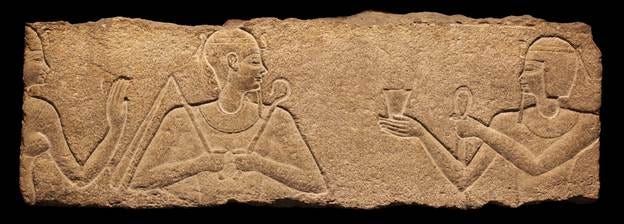
And that changes the nature of the ritual entirely. This kind of system cannot run on accumulation. You cannot stockpile offerings and walk away, any more than you can fill a fire with a year’s wood at once and expect it to keep itself lit. A formative process runs on flow, continuous throughput.
The ritual plugged the participant into an ongoing process. The daily Egyptian temple ritual, the priest breaking the seal on the shrine, purifying, presenting, withdrawing, was not nervous over-worship. If the model holds even partially, reality was not understood as a machine that runs by itself once switched on. It needed maintenance. Rhythm. Repetition sustained over centuries.
This also reframes the famous accusation that the Egyptians “worshipped the Nile.” The old accusation that the Egyptians merely “worshipped nature” starts to feel too shallow. The river was not just admired. It belonged to an order the Egyptians believed had to be continually maintained.
What Happens When the Circuit Opens
Next is the strangest turn of events:
When the temples closed (after they were closed by the Roman emperors, the old priesthoods slowly being choked, the last hieroglyph to be written on the walls of Philae in the latter part of the 4th century), people who were familiar with the Religion of the Egyptians did not regard the end of temple worship to be a “change of style,” but instead, a “breakage”. The electrical circuit had been broken, and the electric flow was interrupted.
If the Egyptian religion depended upon a continuous stream of offerings, what happens once the offerings stop? The religion does not simply collapse. The temples remain standing but are no longer “alive”. Trust has disappeared, the electrical wires are frayed, and the temples still exist, but do not work as intended. The meaning of the temples has been shattered; and the physical world is seen to be less “solid” and “dependable”, and is perceived to be “running on empty”.
You do not have to accept any of the above metaphysical descriptions to see that they can describe a great deal of what we are feeling today. Do what you wish with this understanding.
You Never Stopped
The real twist is that while we do/did not stop giving offerings, we stopped doing it intentionally.
Every tradition that has ever sought to define how this works has repeated one principle: wherever you put your attention, your energy, and your repetition will become more active, more present, and “real” in your real-world experience. Attention does not exist as a passive form of engagement. It is an input, and regardless of where it’s directed, it is being directed all day long.
Thus, you as an individual are still making offerings on a daily basis with your attention, your emotional input, and your continual repetition of the same feeds, the same grievances, and the same loops that you return to and re-engage with day after day like a dog licking a sore spot. You continue to feed the systems, stories and structures that you’ve continued putting energy into until they have become stronger as a result of your continued efforts.
The Egyptians clearly understood, at least according to the essence of this theory, exactly what they were directing their offerings to, and for 3,000 years did so with full intention. The only real difference in our situation today is the recognition of this principle. The act of giving continues to be performed. We are simply no longer aware of where our offerings are going or what they are sustaining.
A primary concern at this point may be no longer about asking ourselves if the Egyptians were correct, as much as asking each of us individually what we have continued to create with our rituals.
Top Image: Ancient Egyptian offering scene, c. 2700 BCE. Image via Wikimedia Commons. Public Domain. Or Sham El Nessim in Ancient Egypt.jpg, artist unknown, via Wikimedia Commons. Public Domain.
By Vanese Mc Neill
Further reading
James P. Allen, Middle Egyptian: An Introduction to the Language and Culture of Hieroglyphs — on the ḥtp-dỉ-nsw formula and the ka.
Detlef Franke, “The Middle Kingdom Offering Formulas — A Challenge,” Journal of Egyptian Archaeology 89 (2003).
Byron Esely Shafer (ed.), Temples of Ancient Egypt — on the daily temple cult and ritual.
Rudolf Steiner, Theosophy and An Outline of Esoteric Science — the layered cosmology referenced as interpretive frame.
Itzhak Bentov, Stalking the Wild Pendulum — reality as a field of forming patterns.