

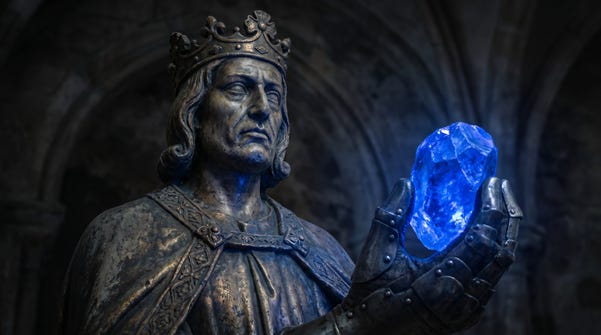
King John is usually remembered as the villain of Magna Carta, a ruler associated with failure, rebellion, and the collapse of royal authority. Yet behind that familiar image lies a stranger and far more intriguing story: John appears to have placed extraordinary value on jewels and gemstones, not simply as marks of wealth, but as objects bound up with protection, healing, kingship, and power.
That is what makes his treasure hoards so revealing. In the medieval world, precious stones were never merely decorative. They could carry political meaning, spiritual resonance, and, in some circles, very real protective or medicinal significance. Seen in that light, John’s fascination with gemstones was not just a royal indulgence. It was part of how he understood authority, security, and even survival.
Rethinking King John
1066 and All That, written by W.C. Sellar and R.J. Yeatsman brilliantly satirises the then still highly influential Victorian and Edwardian approach to the writing of history and the skewering of the popular conflation of history and memory. 1066 playfully exaggerates the conceits and conventions of the histories its authors read as schoolboys while somehow still capturing the soul of these works.

