


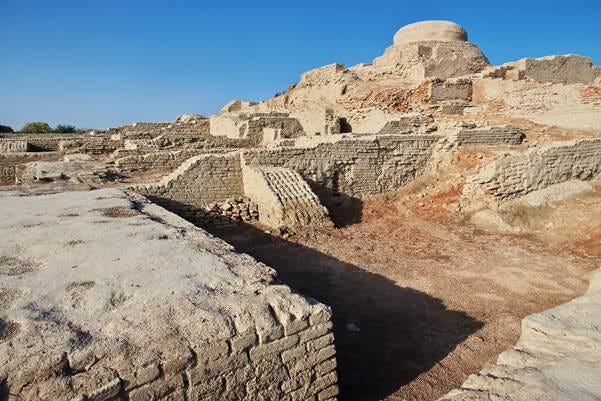
They called Mohenjo Daro, the Mound of the Dead.
For almost four thousand years the hills near the Indus River in modern-day Sindh, in Pakistan, kept their secrets. The local villagers avoided the place, they said anyone who climbed the highest mound at night would wake up the next morning with blue skin, a mark of the angry spirits that guarded the ruins. Children were warned never to play there. And even British surveyors in the 19th century marked the spot on their maps and moved on.
Then, in 1922, an Indian archaeologist named Rakhaldas Bandyopadhyay (later anglicised to Banerji), was brave enough to ignore the curse. So, he sank a trial trench into what the locals called Mohenjo Daro, “the Mound of the Dead Men”. Within days he pulled out square steatite seals bearing a horned figure seated in yoga posture and an unknown script. The objects were identical to those recently found 680 kilometres to the north-east, at Harappa.
Two forgotten metropolises. Both used the same bricks, the same weights, the same mysterious writing and the same sudden silence.
What Bandyopadhyay had stumbled upon was the largest and best-preserved urban centre of the Bronze Age Indus Valley Civilization (3300–1300 BC, mature phase 2600–1900 BC). He had found proof that a civilisation as sophisticated as Egypt or Mesopotamia had flourished in South Asia five thousand years ago and then vanished so completely that not even its name survived in later Indian tradition! Impressive, isn’t it?
However, Mohenjo Daro hides far more darker riddles.
Here are a few questions to ask…
Why does a city built with obsessive care, straight streets, covered brick drains, private bathrooms, standardised fired bricks, contain almost no temples, no palaces, and no royal tombs?
Who were the people who measured everything to the millimetre yet left no deciphered texts longer than seventeen signs? And what really happened to the forty-four men, women, and children whose broken skeletons were found sprawled in the streets as if frozen in the middle of screaming?
For decades the world was told a dramatic story: Indo-Aryan chariot warriors thundered down from the steppes and massacred the last inhabitants in a single night of fire and bronze. The same story is in textbooks and then Hollywood almost made it into a movie …
The truth, when it finally emerged, was far stranger and far more unsettling.
