

In 1872, British Museum curator George Smith made a discovery that would shake Victorian England’s understanding of biblical history. Working late into the London evening, surrounded by fragments of cuneiform tablets recovered from the ruins of Nineveh, Smith deciphered an ancient Mesopotamian account of a great flood—complete with an ark, animals saved in pairs, and a righteous man chosen to preserve life. But this wasn’t the biblical narrative he’d learned as a child. This was the Epic of Gilgamesh, written a thousand years before Genesis, describing events that supposedly occurred in an age “before the reign of kings” when “the gods walked among men” and beings of extraordinary stature built the first cities. Smith’s hands trembled as he realized the implications: the stories his culture considered uniquely biblical were echoes of far older traditions, preserved in multiple cultures, hinting at events in humanity’s deep past that predated written history itself.
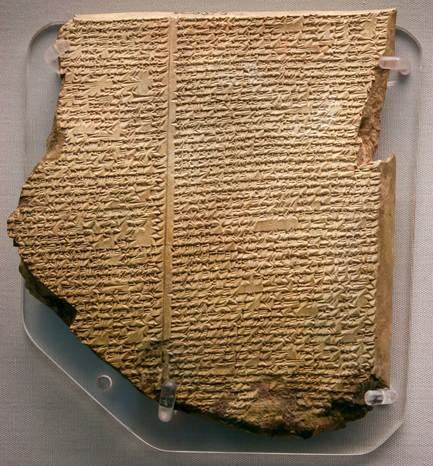
The Flood Tablet (Tablet XI of the Epic of Gilgamesh), British Museum, London — the cuneiform account of a great flood that predates the biblical narrative by a thousand years. Photo by Mike Peel, CC BY-SA 4.0, Wikimedia Commons.
What Smith couldn’t have known—what archaeologists wouldn’t discover for another century—was that beneath those ancient Mesopotamian cities lay even older settlements. Gobekli Tepe, not excavated until the 1990s, would eventually reveal massive stone temples built by hunter-gatherers around 9600 BCE, seven thousand years before Stonehenge, constructed with an astronomical precision and architectural sophistication that shouldn’t have existed in that “primitive” era according to conventional chronologies. The question that haunted Smith’s Victorian contemporaries haunts us still: Who built these monuments? What knowledge did they possess? And why do cultures separated by thousands of miles and thousands of years tell such similar stories about them?

