


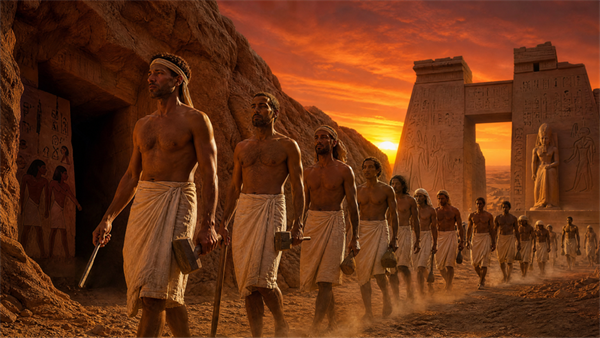
Worker procession at the Valley of the Kings, based on public-domain ostraca and tomb imagery
It is year 29 of the reign of Ramesses III. Somewhere around 1157 BCE. The sun is brutal and the limestone cliffs of the Valley of the Kings trap the heat like a furnace. In the village of Set Maat, the “Place of Truth,” known today as Deir el-Medina, the most elite craftsmen in the ancient world have put down their tools.
Why? Because they are starving and they have decided that a god-king’s empty granaries are not their problem to solve alone.
What follows is not myth, not speculation, and not a later embellishment. It is documented, in the workers’ own words, on a papyrus that still exists. It is the first labor strike in recorded human history and the people who staged it were not slaves. They were literate, skilled artisans who understood exactly what they were worth, and they used that knowledge as a weapon.
They marched out of their walled village, bypassed the necropolis guards, and occupied the sacred mortuary temples. They demanded to speak to the vizier. They accused the state of violating the cosmic order. And in doing so, they exposed the rotting foundations of the New Kingdom.
The story of the Deir el-Medina walkout is a masterclass in leverage, survival, and the breaking of the social contract. And the thousands of scrap notes they left behind reveal a community unravelling into corruption, scandal, and eventually, the very crime they were hired to prevent: tomb robbery.
The Village That History Forgot
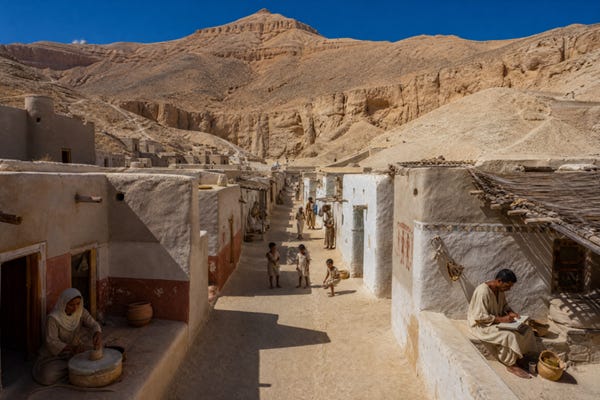
The walled village of Deir el-Medina, nestled between desert cliffs
To understand why this moment was so radical, you have to understand what Deir el-Medina actually was.
The village was purpose-built, probably during the reign of Thutmose I around 1500 BCE, and it housed the men and their families who carved, plastered, and painted the royal tombs in the Valley of the Kings. At its height, roughly sixty-eight houses lined a single narrow road, walled off from the wider world. The workers were called Servants in the Place of Truth, and the secrecy of their work was so paramount that the village was deliberately isolated from the fertile Nile floodplain.
This isolation had a profound consequence: unlike ordinary Egyptians, these men could not grow their own food. They were entirely dependent on the state. In exchange for their labor and their silence, the government supplied them with everything. Housing. Water, carried in by porters because there was no natural source nearby. And most critically, monthly rations of emmer wheat and barley, because in a society without coinage, grain was money. Grain was survival.
The workers were organized into two gangs, left and right, like the crew of a ship, each led by a foreman. They spent eight-day stretches working in the valley, sleeping in crude huts near the tomb entrances, then returned to the village on the ninth and tenth days. Their lives were recorded. We know when they were absent and why, surviving ostraca list reasons ranging from “embalming my brother” to “brewing beer” to “bitten by a scorpion”. One worker, Huynefer, was frequently noted as “suffering with his eye.”
These were not anonymous laborers. They had names, families, disputes, and opinions. Many were literate, and they used that literacy to write letters, file complaints, and record the events of their community with a frankness that is startling even now. Deir el-Medina has yielded more written records of ordinary life than almost any other site in the ancient world, thousands of papyri and ostraca that give us an unparalleled window into what it meant to be a working person in pharaonic Egypt.
The Breaking Point
The reign of Ramesses III was supposed to be a triumphant one. He had defeated the Sea Peoples in a famous naval battle in the Nile Delta, repelled multiple Libyan incursions, and presented himself as the last great warrior-pharaoh. The reliefs on his mortuary temple at Medinet Habu showed him as invincible, a living god crushing his enemies underfoot.
But wars are expensive. The campaigns had drained the treasury, depleted the workforce on Egypt’s farms, and disrupted the agricultural output that underpinned the entire redistributive economy. Grain prices were rising. The elaborate chain of officials who were paid first - soldiers, priests, high administrators - consumed what was available before it ever reached the artisans at the bottom of the queue.
The delays at Deir el-Medina had been building for years. There is evidence of late rations as far back as the 18th Dynasty, but the situation under Ramesses III deteriorated into something chronic. The workers had complained before, and the system had patched itself with emergency grain drawn from nearby temple storehouses. But by year 29, the patches were failing.
The scribe Amennakht, whose records form the backbone of what we know, noted the growing crisis. Early in the year, he had personally gone to the temple of Horemheb to procure 46 sacks of emmer as a stopgap. The workers accepted it, though it was less than they were owed. They returned to work but the problem did not go away.
Day Ten: They Pass the Walls
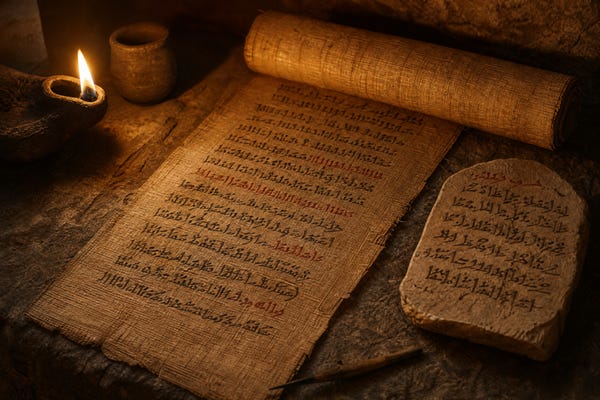
The Turin Strike Papyrus (P.Turin Cat. 1880), the primary record of the world’s first labor strike
On the tenth day of the second month of the growing season, the workers passed the five guard-posts of the necropolis. The guards could have stopped them but they did not, or could not. The entire crew walked out together, and their declaration, preserved verbatim by Amennakht in the Turin Strike Papyrus, was three words that would echo across three thousand years: “We are hungry.”
They had not been paid for eighteen days of the month. They marched down from the valley and settled at the rear of the mortuary temple of Thutmose III. It was a deliberate choice. Temples in ancient Egypt were sanctuaries of non-violence, no blood could be shed within or immediately adjacent to their walls. By occupying sacred ground, the workers made themselves untouchable.
The scribe of the tomb, the two foremen, the deputies, and the police chiefs came out and shouted at them to return. The workers refused and officials swore great oaths and promised that a message from Pharaoh was coming. The workers spent the night at the temple.
The next day, they moved again - to the Ramesseum, the vast mortuary complex of Ramesses II. There, they stated their full grievance to any official who would listen: “The prospect of hunger and thirst has driven us to this; there is no clothing, there is no ointment, there is no fish, there are no vegetables. Send to Pharaoh, our good lord, about it, and send to the vizier, our superior, that we may be supplied with provisions.”
The rations for the previous month were released to them that same day. The workers returned to the tombs and the crisis, it seemed, had been resolved, but it had not.
“Evil is Done in This Place”
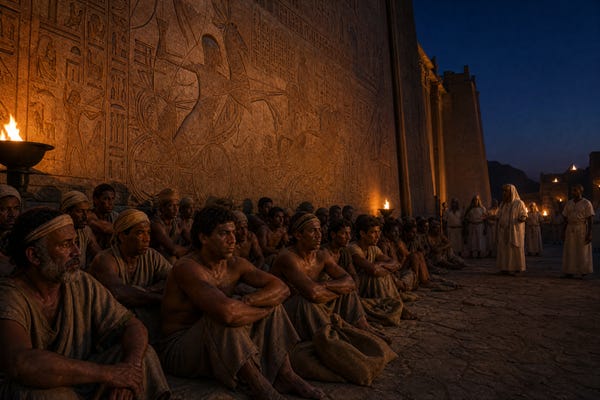
Workers occupying the temple wall at night
Within weeks, the rations were late again. The workers walked out a second time. Then a third. By the seventh month, something had shifted in the tone of the protests. Two workers, Kenena son of Ruta and Hay son of Huy, refused to return even when the foremen came to fetch them personally. Their statement, recorded in the papyrus, marks a turning point in the entire dispute:
“We will not come back. Tell your superiors. Truly, it was not because of hunger that we passed the walls. We have a serious charge to make. Truly, evil is done in this place of Pharaoh.”
They were no longer simply hungry, they were making a moral and political argument. The failure to pay them was a violation of maat, the sacred principle of cosmic order, justice, and truth that the pharaoh was divinely obligated to uphold. A pharaoh who could not feed his own workers was a pharaoh who had broken his covenant with the gods.
This was an extraordinary thing to say in a society built on the absolute authority of a living deity. And yet they said it, and Amennakht wrote it down.
The Vizier’s Empty Granaries
The strikes continued through the ninth month. The vizier eventually came in person - a significant concession, given that the vizier was the second most powerful person in Egypt. But even he could not conjure grain from nothing. His message to the workers was blunt: “It so happens that there is nothing in the granaries. But I shall give you what I have found.” And what he found was half a ration.
The workers accepted it, then threatened to take their grievances directly to Pharaoh through their own channels. They were given two sacks of emmer for the month, a fraction of what they were owed. They went on strike again on the thirteenth day.
The final entry in the strike records shows the workers sitting at the rear of the temple of Merenptah, shouting at the mayor of Thebes as he passed. A gardener named Meniufer, acting on behalf of the mayor, promised them fifty sacks of emmer as a stopgap “until Pharaoh gives you rations.” And there the papyrus ends, with another temporary fix, another promise, another patch on a system that was coming apart at the seams.
What the Ostraca Tell Us
The Turin Strike Papyrus is the central document, but it is far from the only voice from this community. The thousands of ostraca recovered from Deir el-Medina fill in the texture of daily life around the strikes with remarkable intimacy.
There are attendance records that read like modern HR documents, listing workers absent for reasons that feel startlingly human across the millennia. There are letters between family members, legal disputes over property, love poetry, and religious hymns. There are records of workers bartering surplus grain for furniture, clothing, and livestock. There are notes about tomb robberies, adultery, and corruption among the very officials who were supposed to protect the community.
One ostracon, now in Berlin, records the moment Amennakht first announced the crisis to the crew in year 29: “Twenty days have passed in the month, and rations have not been given to us!” He then went to the temple of Horemheb and procured the emergency grain himself. He was not just a scribe recording events, he was an active participant in managing the crisis, a community leader trying to hold things together.
The ostraca also reveal that the strikes were not the only form of resistance. Workers threatened to rob tombs and some apparently did. The breakdown of rations was directly connected to the later wave of tomb robberies that scandalized Thebes in the final years of the New Kingdom, a connection the papyri make explicit.
The Legacy of a Hungry Village
The strikes of year 29 were not the last. They recurred throughout the remainder of Ramesses III’s reign and with increasing frequency under his successors, Ramesses IX through XI. Each wave of strikes marked another step in the slow dissolution of New Kingdom Egypt. The palace’s inability to pay its workers was a symptom of a state in terminal decline - one that would eventually fragment into the chaos of the Third Intermediate Period.
But the legacy of Deir el-Medina is a story about what ordinary people do when the social contract fails them. The artisans of Set Maat did not have unions, labor laws, or political representation. They had grain, and the knowledge of what happened when they withheld their labor. They used that knowledge with precision, occupying sacred ground to protect themselves, escalating their demands through the chain of command, and framing their grievance not as rebellion but as a demand for justice.
They won, repeatedly, in the short term. They forced the vizier to negotiate and the mayor of Thebes to intervene. They extracted rations from temple storehouses that would otherwise have remained untouched. And they did it without violence, without weapons, and without any of the institutional frameworks we associate with labor organizing.
Three thousand years before the word “strike” was coined by English sailors in Sunderland, the tomb builders of the Place of Truth had already invented the concept and left us the paperwork to prove it.
By Aris Manus
References
“Deir el-Medina.” Wikipedia. https://en.wikipedia.org/wiki/Deir_el-Medina [2] Antoine, Jean-Christophe. “The Delay of the Grain Ration and its Social Consequences at Deir el-Medîna in the Twentieth Dynasty: A Statistical Analysis.” Journal of Egyptian Archaeology95 (2009): 223–234.
British Museum. Ostracon EA5634 (Attendance Register, Year 40 of Ramesses II).https://www.britishmuseum.org/collection/object/Y_EA5634
Osborne, James. “3,100 years ago, ancient Egyptian workers defeated a God-King — without using any weapons.” HistoryExtra, February 21, 2026. https://www.historyextra.com/period/ancient-history/egyptian-workers-defeated-a-god-king/
Cromwell, Jenny. “The First Recorded Strike in History.” Papyrus Stories, March 15, 2022. https://papyrus-stories.com/2022/03/15/the-first-recorded-strike-in-history/
Turin Strike Papyrus (P.Turin Cat. 1880). Translation via Libcom.org. https://libcom.org/article/records-strike-egypt-under-ramses-iii-c1157bce
Did only grainery workers strike? Did those in the village who engaged in other occupations for Pharaoh also strike?