


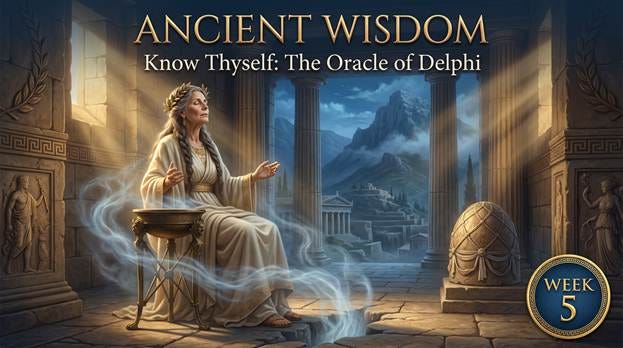
More than 1,000 years ago, many of the strongest leaders of the ancient world; kings, warriors, intellectuals, left their homes and travelled to a remote mountain location in Greece. They did not go to hear prophecies of what was going to happen in the future but rather to obtain something more valuable than a prophecy: a road map for living successfully.
The Temple of Apollo in Delphi contained maxims (commands) engraved on the walls. They reflected the oldest Greek philosophy and although people have read throughout history that the Oracle of Delphi provided mysterious, vague prophecies of the unknown, the real legacy of this location is this set of three maxims:
Know Yourself, Nothing in Excess, and Certainty Brings Destruction.
These three maxims encompass a complete system of philosophy for dealing with life’s many difficulties; we will explore the philosophy of these three maxims throughout this week’s course.
Maxim 1: Know Thyself (Gnothi Seauton)
The foundation of all Western philosophy is based on Socrates’ belief that we should strive for self-examination; he stated, “The unexamined life is not worth living.”
He concluded that by knowing ourselves in the true sense, we know our ignorance. That is what made him wise according to the Oracle when he was named wisest man in Athens.
Self-examination can be valuable in many ways. He suggests we ask ourselves difficult questions, such as:
What motivates me? What are my greatest fears and desires? Where do my blind spots exist?
To answer these questions requires honesty when examining your own character: strengths and weaknesses, virtues and vices. In today’s world, we use terms like self-awareness, emotional intelligence, and psychological insight to refer to what Socrates stated over 2,400 years ago. Without a solid foundation of knowledge and understanding of ourselves, we cannot attain true wisdom.
Maxim 2: Nothing in Excess (Meden Agan)
The Delphic maxim “Know Yourself” serves as a foundation for human existence, while the principle of “Do Nothing in Excess” serves as the framework for living in balance. Ancient Greek philosophers held that to be virtuous is to take the middle path - the “Golden Mean.” Aristotle later developed this idea into a systematic treatment of virtue in his Nicomachean Ethics, stating that:
For each of the many virtues there exists a “Golden Mean” between two vices that are opposite to one another.
· Courage is the mean between cowardice and recklessness.
· Generosity is the mean between stinginess and wastefulness.
· Confidence is the mean between self-deprecation and arrogance.
This maxim is a call to moderation in all things: pleasure, work, ambition, even knowledge itself. In a world that constantly pushes us toward extremes, such as extreme productivity, extreme consumption, extreme opinions, this Delphic call to balance is more radical and necessary than ever. It is the art of living harmoniously, avoiding the destructive pull of too much or too little.
Maxim 3: Certainty Brings Ruin (Eggua Para D’Ate)
This may be one of the most difficult and profound of the maxims. It advises against hubris, the arrogant pride produced by the belief that you have all of the answers.
Hubris was considered to be the greatest tragic flaw by the ancient Greeks and was responsible for the downfall of both kings and heroes alike.
“Certainty Causes Ruin” encourages us to exercise intellectual humility. It provides us with the understanding that our perspective is limited; that what we believe may be incorrect; and that what happens in this world is much more complicated than we can comprehend with our minds. It also encourages us to counteract dogmatism, fundamentalism, and rigidity of thought that prevents us from learning, and creates conflict.
In a world today that is experiencing information overload, and in an age of polarized echo chambers, this should serve as a reminder that we should hold our own beliefs loosely, that we should be willing to accept new evidence, and that we should value questioning as opposed to holding fast to our beliefs.
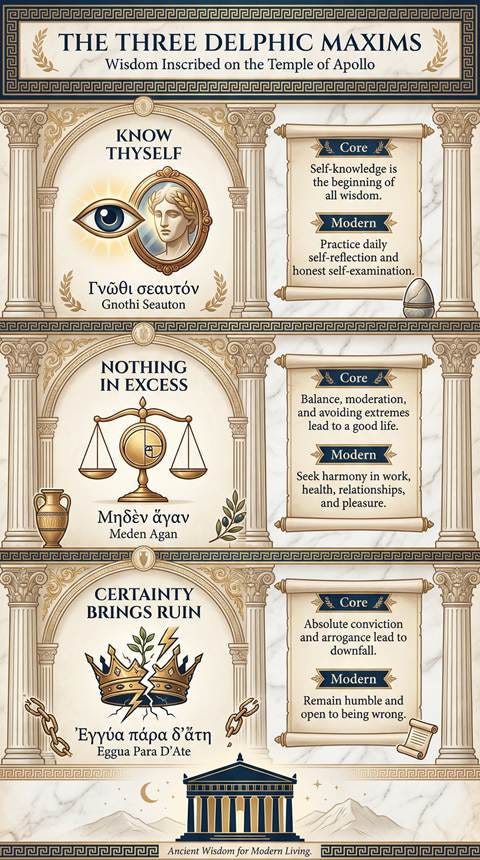
They were not merely prescriptive recommendations; rather, they represented a total philosophy. In order to “know thyself”, one needed to self-know one’s own limitations, practice moderation in all things and remain humble when encountering the unknowns. According to Ancient Greek Philosophy, following these principles leads to a virtuous life and a fulfilled existence.
Three Delphic Practices for Modern Seekers
These maxims are a call to action. Here are three practices to integrate Delphic wisdom into your daily life.
1. The Socratic Journal (Know Thyself)
The Socratic Journal is not simply a record of events but also a means of inquiry into one’s thoughts. You might ask yourself: “Why do I believe this? What is the evidence? What if the opposite were true?”. By doing this, you are creating a laboratory for self-exploration, allowing you to discover your own hidden beliefs and biases.
2. The Golden Mean Audit (Nothing in Excess)
Each week, conduct an audit of the major areas of your life (e.g., work, health, relationships, and leisure) to determine where you are leaning either towards deficiency or excess. As part of your audit, you will identify one concrete action that you will take in the upcoming week to move yourself closer to the Golden Mean (the desirable middle ground).
3. The Practice of Intellectual Humility (Certainty Brings Ruin)
Identify one belief that you are passionate about. Consider that belief for 10 minutes and then find the best argument against that belief and read through it thoroughly. While your goal is not to change your mind, your aim is to gain a thorough understanding of the opposing argument to the extent that you would be confident in arguing for the opposing side. The practice of this will lessen the hold of certainty on your life and develop the intellectual humility that is characteristic of true wisdom.
The Enduring Voice of Delphi
Delphi does not contain the treasures of a cryptic prophecy spoken through an oracle; its treasure is the clarity of timeless wisdom inscribed in the walls of the temple:
Know Thyself; Practice Moderation; Remain Humble.
Together these three keys provide access to virtuous, balanced and fulfilled living. Although the oracle’s voice is now silent, the ancient pattern for living well is just as relevant at the present time as it was 2,500 years ago.
By Dr Ioannis Syrigos
Suggested Books
Essays by Plutarch
The Apology of Socrates by Plato
I’m so glad I’m subscribed. There is so much wonderful knowledge to be found here.
Thank you. Much appreciated new education for me and applicable already.