

Between 800 and 200 B.C.E., while the great Vedas, the oldest texts of Indian thought, were still being produced, small groups of students began to gather in the forests of India to study under the guidance of their teacher and to ask the most profound questions imaginable about themselves, about the universe and about death, which had been shunned by most of society throughout history. What began as small gatherings went on to form an entire literary genre, and the composition of these writings was primarily through dialogue, song, poetry, and in-depth questions about philosophy. These writings are collectively known as the Upanishads.
The term “Upanishad” literally means “to sit close to” or “to sit together near.” A student who was physically close to their teacher to receive this knowledge gained access to some of the most radical ideas in the history of humanity, the culmination of the teachings in the Vedas, which in and of themselves were not just religious texts. They provided the foundation for an exploration of consciousness unmatched by any other civilization in the world.
So, what did the ancient sages living in the forests discover? They found that the deepest essence of every human being and the ultimate reality of the universe are not separate entities, but rather are, in essence, the same entity. By understanding that both are part of the same whole, the sages taught that this is the key to attaining liberation.
The Shift from Ritual to Reality
The Vedic Religion up until the time of the Upanishads, was mostly concerned with rituals that were performed for the purpose of pleasing the deities so that they may have successful harvests, and maintain the Cosmic Order through priestly sacrifices. The relationship between mortals and the deities was very much one of a transaction.
The sage or sages that created these Upanishads took this concept and turned it upside down. They realised that there was no amount of external ritual that would ever fix or cure the problems of suffering and ignorance that all humans have. Instead of looking to the heavens to be saved by a god (s), they began to look into themselves and their own consciousnesses. They shifted their interests from “doing” to “knowing” – from the performance of rituals to understanding what ‘is’ in reality.
Their shift in focus produced a scientific way of thinking thousands of years in advance of the current day and made predictions that current theories of Quantum Physics and Neurogenesis have not yet confirmed.
The Three Great Teachings of the Upanishads
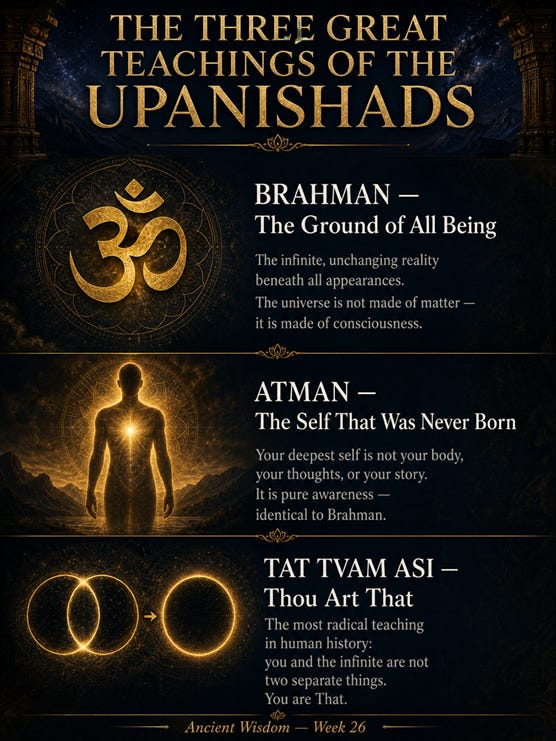
The profound wisdom of the Upanishads can be distilled into three central concepts that completely redefine how we understand ourselves and the universe.
1. Brahman: The Ground of All Being
When you look at the universe, it appears to consist of separate objects, such as trees and rocks, or people and clouds. The Upanishads, however, explain that this apparent separation is an illusion (Maya). In reality, all the impermanent forms that change and pass away have their origin in one single, infinite, unchanging reality. This ultimate reality is called Brahman. Brahman does not refer to a personal God on a throne; rather, It refers to the pure, formless consciousness from which all things manifest. Brahman is also likened to an ocean; all the ocean’s waves represent temporary manifestations of the ocean.
2. Atman: The Self That Was Never Born
Your true self was never born and will never die. When you say “I,” to whom or to what are you referring? Most of us identify our “self” with our body, thoughts, memories, and social roles (i.e., parent, child, employee, etc.). The Upanishads, however, emphasise the fact that everything (including your body) is constantly changing. For example, your physical body will eventually grow old and die; your thoughts will change from one moment to another; your memories may fade away entirely at some point. Thus, none of these things can define who you truly are. The Upanishads explain that underneath all these ever-changing levels of your personality exists a stillness/awareness within you that has never changed. This unchanging awareness is known as Atman.
3. Tat Tvam Asi: Thou Art That
Tat Tvam Asi is the ultimate knowledge revealed in the Upanishads, which is captured beautifully in the Chandogya Upanishad. The essential meaning of this phrase is that, at the deepest level of your being (Atman), you are identical to the ultimate reality (Brahman). You are not merely a tiny particle of consciousness floating around in a dead universe; instead, you are the entire universe experiencing itself. God is not something that exists outside of you for you to worship; rather, God exists within you; It is your true nature. Therefore, when the Chandogya Upanishad says “You Are That,” this means that you are identical to the ultimate reality (Brahman).
The Relevance Today
In the current climate, many people experience anxiety because of the relationship they have with themselves and the world around them. This anxiety stems from a feeling of being alone and not being a part of something larger than oneself, as taught in the Upanishads.
In today’s society, we are constantly bombarded with messages that tell us we need to compete against each other for limited resources. We must gain more possessions and status and create a better image of ourselves to feel good about who we are.
However, the Upanishads offer us a completely different perspective on this issue. They tell us that if we look for meaning outside of ourselves, we will never find it. If we want to be happy, we must look inside ourselves and understand that we are already complete and infinite. By understanding this, we realize that we are one with everything around us.
Three Ways to Practice Upanishadic Wisdom
Not only is the Upanishads a philosophy of abstract thought, it gives a way for human consciousness to become free. Here is how to use the wisdom of the Upanishads in your daily life.
1. The Practice of Neti Neti (Not This, Not That)
The ancient method of Neti Neti (Not This, Not That) can be used when one is overwhelmed by a very strong emotion or feeling of anxiety. When you feel those feelings, remind yourself; “I am not this feeling. I am not this emotion. I am the observer of this feeling”. By distinguishing yourself from the temporary thoughts and emotions, you become reconnected to the silent, unchanging, presence of the Atman.
2. See the Ocean, Not Just the Waves
Try to see the ocean (unity), instead of individual waves (the different people or objects in your life). When you are relating to someone else, remember that you, and the person you are using your consciousness to relate to, are all the same. Both you and that person have been animated by the same source of life. By recognising that both of you are animated by the same source, the idea of separation disappears, developing and fostering natural feelings of empathy and compassion.
3. Stop Searching, Start Realizing
Most of the activities of your life are spent attempting to be content through some future achievement or through acquiring something outside of yourself. The teachings of the Upanishads are that true contentment cannot be obtained; rather, it must be realised through the process of going deeper into the realisation that you already have everything that you need. By taking some time out of your day to simply relax and be aware of your consciousness, you can experience the realisation that you are already whole and complete.
The sages of the Upanishads did not ask us to believe their teachings on blind faith. They invited us to investigate our own minds and discover the truth for ourselves. They left us a map, but we must walk the territory.
We’ve got some exciting news to share with the community next week; stay tuned! We have a unique opportunity that will allow you to begin putting these ancient teachings into practice in your daily life.
Recommended Reading
The Upanishads translated by Eknath Easwaran
The Principal Upanishads translated by Sarvepalli Radhakrishnan
Truth in understandable form.