


Last week, we explored how Marcus Aurelius created an unyielding mental fortress as we made our way through ancient Rome. This week’s journey takes us to ancient China, where we meet a wise man who taught us about harmony and the importance of connecting to one another in ways that are timeless and continue to shape the world today.
Today’s world has become increasingly polarized with division between communities, political parties, and families. Relationships are like walking through a mine field; sometimes you don’t know what’s there until you step on it! You might worry if you can find something in common with another person (the answer is yes!) or if you’ll be able to establish a meaningful relationship with someone (again, the answer is yes!). Is it possible that all of this has happened because we are missing an ancient model of how to live harmoniously with each other that was created over 2500 years ago in ancient China?
Confucius (circa 551–479 B.C.E.) was a teacher, philosopher, and political theorist from ancient China. His teachings have influenced much of East Asia and continue to provide us with guidance on how to create positive and fulfilling relationships with others today.
The Wandering Sage of Lu
Confucius (or Kǒngzǐ, Master Kong) lived during China’s Spring and Autumn period, a time of significant social and political upheaval. He witnessed the degradation of the traditional values, rulers abusing their authority, and the breakdown of social harmony. Confucius thought he could provide a means to recover the past’s lost wisdom, and restore virtue and order to society.
Confucius was not like Marcus Aurelius who ruled from supreme power but instead was a humble scholar that spent much of his life traveling between various kingdoms searching for someone to implement his way of thinking. While he never found such a person during his lifetime, the Analects, a collection of Confucius’s sayings compiled by his students, has later become one of history’s most influential works.
The Confucian Toolkit: A Guide to Harmonious Living
At the heart of Confucianism is the belief that humans are inherently social creatures and the quality of our relationships determines our ability to grow and develop. Thus, through cultivating virtue within ourselves and understanding our social roles, we can create an effect of harmony extending from our families to all corners of the globe,
Ren (仁) - The Virtue of Humaneness
Ren is the most fundamental virtue and moral aspect of Confucianism; that encompasses the sense of compassion, kindness and caring towards all other people. It is derived from the principle of our joint humanity and so Confucius declared that ren should not be seen as some abstract notion, but should be endeavoured to be demonstrated every day through interactions with others.
The Master said, “Those who are clever in their words and pretentious in their appearance, yet are humane, are few indeed.”
Li (禮) - The Power of Propriety and Ritual
In contrast to inward, compassionate feelings represented by ren, the outward expressions of those feelings are found in li. Li refers to the rituals, niceties, and proper actions involved with social interactions. Li provides the framework within which a person shows their internal virtue and grows their outwardly expressed virtues to create a harmonious relationship with both the other person and society at large through many small ways. Even such basic actions as the way one greets another person, how a meal is served or the way a person speaks to their parents is an example of li being the method by which ren can be cultivated.
The Five Relationships (五倫)
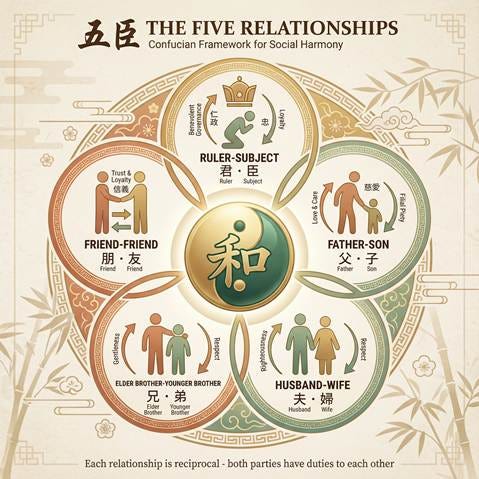
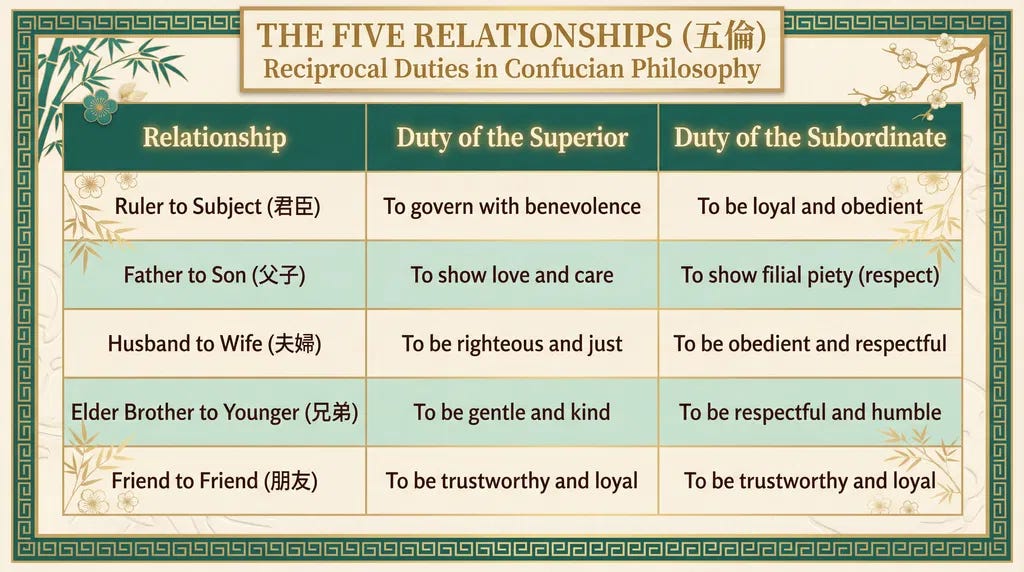
Confucius also created five essential relationships to form the structure of a society in harmony: The Relationships are hierarchical but mutually supportive and therefore create a society bonded by a series of mutual obligations and care.
This framework provides a clear guide for how to act in every social context, ensuring that our interactions are predictable, respectful, and harmonious.
Ancient Wisdom for Modern Problems
Although the philosophy of Confucius has its origins in ancient China, it also offers a very practical guide for dealing with some of the most challenging issues facing us today.
Healing a Divided World
In this very politically divided era where there is so much outrage expressed on social media and in traditional media, the teachings of Confucius remind us that achieving a harmonious social order begins with developing ourselves individually as virtuous humans. By practicing ren and li (benevolence towards others and maintaining proper behaviour) regularly, even in our interactions with those who may not share our values, we can begin to heal the divisions that currently exist in the communities we belong to.
Strengthening Family Bonds
Confucian teachings place the family as the central part of society. The first virtue coming from the principle of filial piety (孝 - xiao), which is to treat our parents and elders with respect and care, is at the core of all other virtues. In this age where families are often disconnected or not functioning correctly due to technology (i.e., smartphones), the teachings of Confucianism provide us with an excellent reminder about intergenerational care and connection.
Ethical Leadership in the Workplace
Confucius taught us that a leader must give moral direction or guidance, not through fear but by example. A manager who exhibits benevolence (ren) towards their employees and treats them fairly will earn their loyalty and respect more than one who rules through fear. This is a lesson that applies to all leaders, regardless of their specific industry.
Practical Confucian Exercises for Today
1. The Daily Practice of Ren
Make a conscious effort to do one small act of kindness each day, not for any personal benefit or recognition, but simply out of a desire to be kind. This could include taking time to listen to a co-worker, complimenting a friend for something they did well, or allowing someone to pass ahead of you in a long line. By making these daily acts of kindness part of your daily routine, you will also develop an emotional connection with the people around you.
2. The Five-Minute Relationship Reflection
Take Five Minutes before going to bed each night to reflect on the Five Relationships you have with people in your life. Think about whether or not you were true to your responsibilities in those relationships, acted according to the principles of ren and li as applicable in that situation. For example, as a daughter or son, were you respectful towards your parents? Were you trustworthy in your relationships with your friends?
3. The Rectification of Names Practice
Pick one role from your life, e.g. Manager, Parent, Friend. Identify what you believe it means to be a Manager, Parent or Friend and what qualities those roles require from you. After having done that, write down 1 specific action you will do the next day to act more like that role. So if you were identifying yourself as a friend, for example, you would be spending time with a friend who needs your support tomorrow.
The Teacher’s Enduring Wisdom
During the time of Confucius (551-479 BC), he never realized his dream of an idealized ordered society. However, through the pages of the Analects, which contain the teachings of Confucius, over two billion people have been influenced in their morals and social structure for more than two thousand years.
In a time where many people are surrounded by chaos and feel isolated, the teachings of Confucius provide a reminder of the importance of living in relationship with others and emphasizes that true contentment can be found not only in what we achieve for ourselves but also through living harmoniously with others.
What relationship do you plan to harmonize today?
By Dr Ioannis Syrigos
Suggested Books to read:
The Analects by Confucius
Trying Not to Try: The Ancient Art of Effortlessness and the Surprising Power of Spontaneity by Edward Slingerland
Thank you. Today was a perfect day to learn more about Confucius and his teachings. I’ll look for more.