

The late 12th century saw the youth of a boy from Andalusia, Spain, who began to have visions of God. The youth did not seek out these visions through fasting or decades of study, but they came to him naturally. He was struck with the feeling that God was everywhere. News of this boy’s visions was spread to Averroes, the renowned philosopher, and he wanted to meet the boy. When the two men met, Averroes asked the boy, “Do divine revelation and philosophical reason give rise to the same truth?” The boy answered, “Yes, but that answer also includes no, because spirits separate from bodies and heads from bodies.” After hearing this, Averroes turned white and realized that he was in the presence of a youth whose mind had exceeded human potential.
The boy, who would become known as Muhyiddin Ibn Arabi, was called “The Greatest Master” (al-Shaykh al-Akbar) throughout the Islamic world. Ibn Arabi wrote over 800 books, travelled extensively, and developed a system of reality that was radical and beautiful, which is still being studied and debated by scholars eight centuries later.
This week, we will have a close examination of the mystical nature of Ibn Arabi. We will discuss his philosophy concerning achieving Unity of Being, how the imagination can be used to contact God, and how his teachings can assist people in discovering the sacredness of ordinary experiences.
Who Was Ibn Arabi?
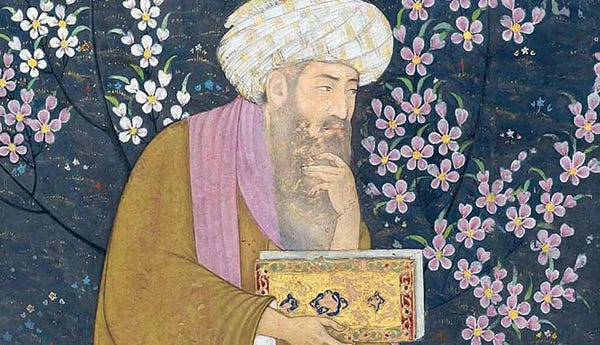
Ibn Arabi was born in the Spanish city of Murcia in 1165 to a historical period referred to as the Golden Age of Islamic Culture in the region called Al-Andalus: southern Spain. He experienced his initial awakening spiritually when he was young (we’ll call this spiritual awakening early). Afterward, Ibn Arabi spent the rest of his life studying under the Sufi Master’s guidance, of whom he felt close to two older women; famously, he documented how he learned the deepest insights and truths from them.
During his forties (this would also be after the end of his initial spiritual awakening), Ibn Arabi had a deep vision, indicating a divine command, and subsequently left Spain permanently to follow the path of spiritual enlightenment. His travels took him throughout North Africa, then on to Egypt, before traveling to Mecca and beyond into Anatolia before finally settling down in Damascus, Syria, where he died in 1240.
Ibn Arabi’s philosophical writings did not follow the traditional format of systematically laying out the reasoning and presenting his arguments sequentially. Rather, Ibn Arabi’s greatest works, such as the monumental Meccan Revelations, Bezels of Wisdom, and the many other books written by him are all considered to be dictated to him from God, and he claims to be a prophet of truth. Therefore, Ibn Arabi’s works, by design, were created not only as a source of knowledge but as channels through which people would receive divine messages and be transformed by the nature of his writing, not simply a collection of facts or ideas that are of arbitrary or academic interest
The Map of Reality: The Three Pillars
Ibn Arabi’s vision of the universe is vast and complex, but it rests on a few foundational pillars that completely reframe how we understand our relationship to the divine.
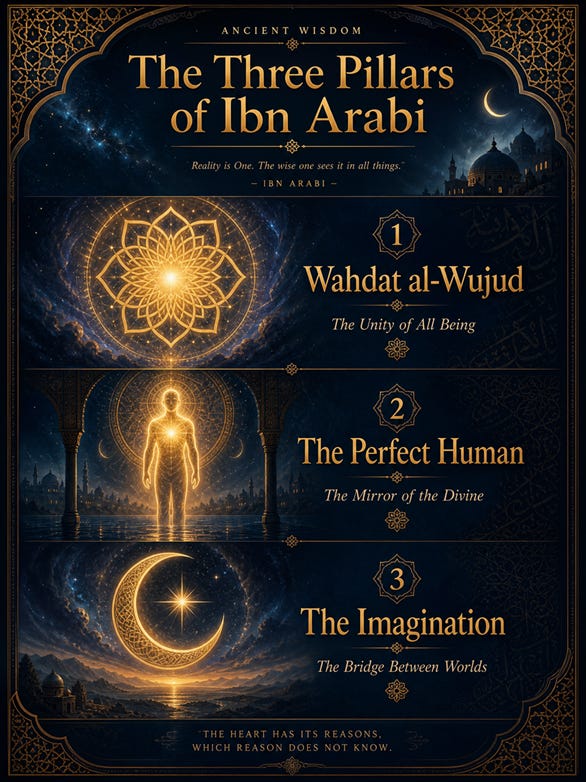
1. Wahdat al-Wujud (The Unity of Being)
The Unity of Existence is a term that Ibn Arabi has become synonymous with. This was not the term he would have used himself. This concept means that there is only one true being, who is God, and everything else we see around us, including your own body, is not a separate or independent thing. Rather, it is a manifestation of the Unity of Being. The entire universe functions as a series of mirrors that reflect the light of God.
2. The Perfect Human (Al-Insan al-Kamil)
If the universe is composed of multiple mirrors that depict the image of God, the Complete or Whole Person would be the most complete and clear of these reflections. Ibn Arabi explained that all of humanity is a microcosm of the Universe; Within every human are contained the divine attributes or names. The ultimate goal of one’s spiritual evolution is to create an image of one’s heart that is completely reflective of the Divine Light thus allowing oneself to function as a channel between Heaven and Earth.
3. The Imagination (Khayal)
In Ibn Arabi’s understanding of the human imagination (Khayal), it is not only a means to create fictional stories but is also a plane of reality. The ‘imaginative realm’ or Khayal is the realm where the spiritual world takes concrete physical form as well as the place where the physical world has been spiritualized. It is in the world of the Khayal that man’s active and clear imagination allows him to experience and perceive the Presence of the Divine in the physical world, and to gain deeper insight into the meaning of the content of his dreams and visions.
His Relevance Today
Our world places a constant emphasis on separation: us versus them, sacred versus secular, body versus mind, and many more. This view leads to separation, alienation and the belief that God is far away and watching us from a distance to judge us.
The writings of Ibn Arabi dispel this myth. Ibn Arabi states that God is not far away; he is what exists within creation. “The Divine Reality is One,” Ibn Arabi wrote, “and the wise see it in everything.”
This new perspective allows us to see the normal, mundane world as sacred. The one you are fighting with, the tree outside your window, the problems you are facing - all of them are evidence of God and the unity that exists within all of creation. You no longer look for God in the sky and will instead learn to find evidence of God in everyday situations.
How to Practice the Wisdom of Ibn Arabi
The teachings of Ibn Arabi are steeped in Mysticism, with their practice being a means of transforming our daily consciousness through actions we can apply to our lives.
1. The Practice of Seeing the Mirror
Each time you encounter a beautiful object, a challenge, or even mundane things in your daily life, stop and reflect on how they reflect the divine within. Instead of making a value judgement on something as “good or bad,” look for ways the experience represents a particular divine quality. Your feeling of anger will dissipate and you will be filled with tremendous awe.
2. Polishing the Heart
Ibn Arabi believed that the heart serves as our perception of the spirit and that it is clouded by ego, greed, and distraction. To polish your heart, perform acts of kindness, show humility, and practice letting go of needing to be right. Practice at least one act of selfless kindness or giving on a daily basis. It will help to “polish your mirror.”
3. Embracing Paradox
The rational mind desires to label everything as black or white, but Ibn Arabi said the divine exists in the realm of duality. “He is the First and the Last; He is the Witness and the Veiled.” Therefore, instead of trying to find a resolution for contradictions within your life, hold space for both sides to coexist within your awareness. In this space of “yes and no,” true wisdom can emerge.
The Ocean of Love
Ibn Arabi was posed the question, “What is your religion?”. As illustrated by the beauty of this response, we see that one of the greatest examples of universal spirituality exists in a time where so much division exists within religious sects.
“My heart has become capable of every form: it is a pasture for gazelles and a convent for Christian monks, and a temple for idols and the pilgrim’s Ka’ba, and the tables of the Torah and the book of the Quran. I follow the religion of Love: whatever way Love’s camels take, that is my religion and my faith.”
The map has already been created and drawn. The only remaining question is, “Are you ready to begin walking the territory?”
Recommended Reading
The Bezels of Wisdom by Ibn Arabi (translated by R.W.J. Austin)
Ibn ‘Arabi: Heir to the Prophets by William C. Chittick
A Note from Dr. Syrigos
We are approaching the end of our first season of Ancient Wisdom. Over the past 25 weeks, we have journeyed through the greatest mystical and philosophical traditions in human history.
Next week, in our Season 1 Finale, I will be making a major announcement. The Ancient Origins Academy is opening its doors. Get ready to take these teachings off the page and into your life.
Fabulous revelations! Within our conflicts lies both yes and no. The world is not an arena for strife with all is black and white. I use Cosmos instead of God but we are all one.
Another subject I knew nothing about. This piece was fascinating and illuminating. Thank you!