


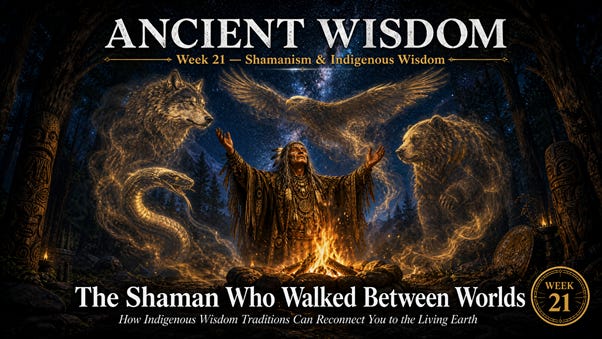
In Siberia’s taiga before recorded history there was a collective gathered around a fire waiting for their shaman, he wore animal skins and played a drum while dancing with rapid beats aligning with their hearts. To an outsider this may appear as lunacy, but to the community this was the most important work a person could perform:
the shaman would leave his physical body walking through both worlds, searching for health, information, and equilibrium from the natural spirit forces.
Shamanism is not a religion based on dogma, or belief systems; rather, it’s about experience, and is one of the most ancient spiritual practice of Earth.
For 20 weeks we have studied great thinkers, philosophers and sages who created intricate systems of understanding, however, this week we look back at the base: Shamanism and Native American traditions originated in many places independently, from South America to North America; all have a similar view of the Universe.
Shamanism and Native American trials in our present age of crisis, isolation through technology and disconnection from nature, are more than simple and unimportant; they are critical and after years of scientific research have shown us how we can live with our planet in balance.
The Illusion of Dead Matter
The modern worldview has, at its core, the concept of a dead universe. We are educated to see the Earth as simply a collection of resources for extraction, the animal kingdom as nothing more than biological machines, and that only human beings possess actual spirit and intelligence. The advancements in technology that this worldview has fostered, has come at the cost of a sense of belonging. The current world we live in consists of objects and, because of that, we find ourselves feeling completely isolated.
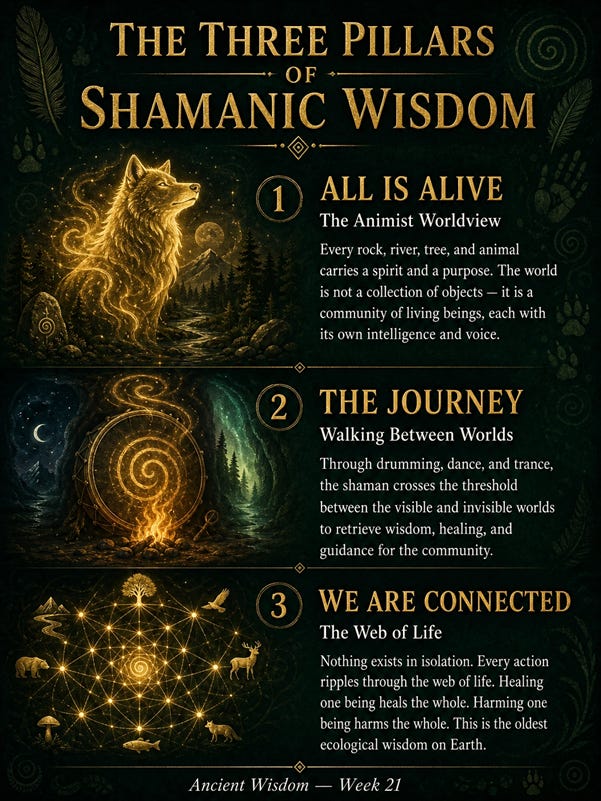
The Indigenous worldview provides us with an alternative vision of reality: Animism.
Animism provides an understanding that everything has its own life. The river is not just water flowing down a hill; it possesses voice and spirit and serves a purpose. A mountain is not just rock; it is considered an ancestor. The trees in a forest represent a community of conscious beings that communicate in ways we have lost the ability to understand. Human beings do not rule the Earth as the masters of creation, but, rather, we are the younger brothers/sisters of a vast and ancient family of all living things; therefore, our primary function or contribution to the world is to ensure harmony and respect amongst the members of our family.
The Role of the Shaman
Without a doubt, in today’s times, we all have illnesses and are experiencing unfortunate events caused by ecological collapse. Simply put, these hardships are not random; rather, they are all signs of a community having broken down. As much as there is a connection between the community of humanity, there is also a fragile and interdependent relationship between the entire community of living beings who make up the ecosystem of the Earth as a whole. When the balance has been disrupted, illness, misfortune, and ecological collapse will occur.
The shaman is a bridge between the human community and the natural world; he is an intermediary or messenger between these two worlds. The shaman’s name comes from the Tungus language of Siberia (North Russia/America) and is often translated as “he who knows,” or “he who sees in darkness.” Shamans train for many years, learning techniques for entering into the spirit world and becoming one with it; through the use of drumming, chanting, or using sacred plant medicines, they are able to access the spirit world.
Rather than preach or to take on the role of leader of the community, it is the shaman’s responsibility to provide spiritual healing. A shaman can achieve this through the retrieval of lost parts of a patient’s soul, negotiating with natural spirits to ensure successful hunting, and guiding the souls of the deceased to their rightful resting places. In essence, a shaman acts as the spiritual immune system for the community.
Is This Wisdom Applicable Today?
You do not need to go to the forest and drum or go into a trance state to gain the benefits of indigenous wisdom. Shamanism is a rich source of teachings that contain a powerful antidote for many of the stress factors of today.
The current pandemic of loneliness is because we have lost our ability to connect with the non-human population. When we go to a park and view it as “timber” and “landscaping,” we feel lonely; however, when we go there and acknowledge the fact that we are surrounded by living, breathing beings that are aware of our presence, we are no longer lonely.
The other issue we face today is that of environmental despair due to our perception of the planet as a machine. The indigenous way of viewing the world has taught us that we are all connected; thus, by harming the river, we are also harming ourselves. The shift towards understanding this relationship will be the only way to truly solve the ecological crisis we are encountering. Understanding our relationship with the environment from a position of obligation only creates political obligation. Understanding it as a position of love and care creates family ties throughout the world.
Three Practices to Reconnect
Three easy ways you can start to make the animist worldview part of your daily experience are:
1. The Practice of Acknowledgment Every time you step outside, acknowledge the living things around you by silently greeting everything that is alive. Say hello to the Sun, Wind, Trees, and Birds. You don’t have to say the words aloud; only acknowledge them silently inside. An internal ‘I recognize you’ gives you an awareness shift from seeing objects to recognizing subjects.
2. The Practice of the Sit Spot Find one specific place in Nature that resonates with you. It could be a bench in a park, under a tree, or even your balcony with a plant. Go to this place on a regular basis (every day, every other day, etc.) and sit for at least ten minutes without doing anything (no reading and no phone). Observe your surroundings and the subtle rhythms and communications of Nature. Over time as you repeatedly visit this location, you will begin to develop an understanding of the natural world around you.
3. The Practice of Reciprocity Part of the Indigenous World View is that you never take from Nature without first giving back something in return. If you harvest food from the garden, take water from a spring, or enjoy the shade from a tree, give something back. The gift can be something physical (a pinch of tobacco, a splash of water, etc.) or a silent prayer of thanks. The act of reciprocity keeps balance in the web.
The Fire Still Burns
The wisdom of the ancients understands the universe as a singular system of interconnections through ecological and quantum physics. For centuries, humanity has attempted to dominate the earth with success only to create an isolated, fearful existence within the confines of this world of our own design.
All indigenous wisdom asks is that we stop striving for control over each other and instead begin listening to one another. The flame of wisdom is still lit by our ancestors; they remain present and are waiting for us to remember.
Recommended Reading
Braiding Sweetgrass by Robin Wall Kimmerer
Shamanic Journeying: A Beginner’s Guide by Sandra Ingerman
I'm listening right now, for the second time, the audiobook of Robin Wall Kimmerer's "Braiding Sweetgrass" -- one of the most wonderful books of all time.