


In the snow-covered heights of the Himalayas, in the green valleys of tenth-century Kashmir, an internal spiritual transformation was taking place. The transformation was neither led by starving monks nor rigid priests that imposes unquestioned following of rules. Instead, genius thinkers and poets were analyzing the world and arriving at the conclusion that the universe is not a machine producing consciousness. It was, rather, consciousness itself set into motion with the Spirit.
This gave rise to the Kashmir Shaivism, which is among the most advanced and complex forms of the non-dualist teachings.
Many traditions among spiritual paths claim that our physical existence and experience is merely an illusion or a prison experience from which we should escape. The masters of Kashmir Shaivism led by the philosopher Abhinavagupta maintain the opposite. According to them, the physical world is reality at its best. It is in the ecstatic play of the Absolute Consciousness exploring itself through different forms. The supreme goal of human beings is not to escape but to realize their own divine identity in the physical world.
Who Was Abhinavagupta?
For those who want to understand Kashmir Shaivism, it is essential to know its greatest master, i.e. Abhinavagupta (c. 950–1016 CE). He was not just a philosopher, but an extraordinarily enlightened man. Abhinavagupta could be studied as a theologian, mystic, aesthetician, and tantra ritual master: he was a genius born in a family of scholars living in the valley of Kashmir and received education from no less than fifteen teachers in his life, mastering all philosophical and spiritual schools of his time.
Kashmir Shaivism existed long before the advent of Abhinavagupta, tracing its root to Shiva Sutras, which were revealed to sage Vasugupta in a dream a century ago. However, Abhinavagupta perfected this school of philosophy. The Tantraloka, which he wrote, is an essential teaching on philosophy of Kashmir Shaivism and one of the greatest spiritual texts ever written!
According to legend, at the end of his life, Abhinavagupta entered a cave in the Himalayas, accompanied by 1,200 disciples. As he recited a hymn dedicated to Shiva, he was never again seen, merging with pure consciousness that he had described all his life.
The Three Pillars of Kashmir Shaivism
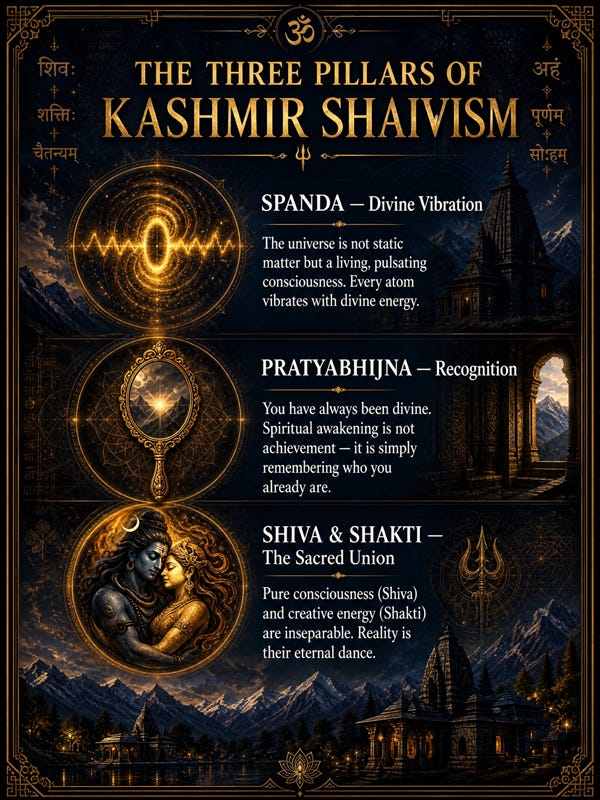
Kashmir Shaivism has a very complicated and deep philosophy; however, there are three main ideas that change the way we perceive reality and ourselves.
1. Shiva and Shakti, The Divine Union
According to the tradition, the highest reality is Parama Shiva (the Supreme Shiva), which means pure consciousness, infinite being, and undivided consciousness. Nevertheless, consciousness is not a static state, and there is an active creative force in the form of Shakti. Shiva is the silent witness and pure consciousness, while Shakti is energy. Shiva and Shakti are only two sides of the same one. The principle of Kashmir Shaivism states that “where there is no Shakti, there is no Shiva, and no life.” Thus, everything around us, including our feelings and thoughts, is an ecstatic play (Lila).
2. Spanda, The Cosmic Vibration
The first question arises: if everything consists of pure consciousness, how does it transform into what we see around? The answer is Spanda, cosmic vibration. The concept of Spanda explains that everything consists not of a dead matter but of living and vibrating energy. When we feel happy, or we experience some extraordinary moment in our life, we live in the state of vibration.
3. Pratyabhijna, Recognition
The main idea of this tradition is that we are already Parama Shiva and the main true consciousness; we have just forgotten about that truth. Enlightenment comes from understanding that you are already everything, as the divine plays choose its own hiding spots, and our role is to find it.
It’s Application
The concepts taught in Kashmir Shaivism are highly relevant today because they advocate a spirituality of inclusion. In today’s world, we often hear that in order to be spiritual we need to stay away from the busy lifestyles we lead, we need to be silent and detach from our desires. This creates a painful separation between our practical, everyday life and our spiritual practice.
Kashmir Shaivism unites these two worlds. It lets us know that all things are made up of divine consciousness and therefore, nothing must be rejected. Our relationships, art, work and whatever we do in our daily life becomes a manifestation of Shakti. The essence of it is not to empty the mind, but to understand that the mind itself is a manifestation of the divine. It is a philosophy that embraces our lives fully, and teaches us to find the divine not only in the silence of meditation.
Three Practices from the Tantric Masters
The Sages of Kashmir Shaivism created various techniques (upayas), so people may be in touch with the reality offered by Kashmir Shaivism philosophy.
Some of the most useful practices for everyone are:
1. Practice of Gap (Madhya)
The Vijnana Bhairava Tantra says that one can also perceive Divinity in the gaps. Try to focus on the gap between your inhalation and exhalation. Or observe the space between two thoughts. Or feel the silence that occurs just before falling asleep. Once you become aware of these gaps you attain a view on pure consciousness which exists beneath everything.
2. Surfing on an Emotional Wave
Kashmir Shaivism teaches us to take advantage of the emotion and not to suppress it. Instead of analyzing the reason for joy or sorrow in you, stop thinking and focus on the energy of the feeling itself. Identify the energy of your emotion and you will be able to fuse it back into consciousness.
3. Practice of Wonderment (Camatkara)
Abhinavagupta believes that aesthetic experience like the perception of beauty in music, painting, or landscape gives us the experience of divinity. Enjoy the state of Camatkara, or deep wonder where everything is perceived as a miracle.
The sages of Kashmir Shaivism posed a challenge to us: Stop seeking God beyond but seek Him right now in your own consciousness. The universe is no prison for us to escape from; it just shows us the infinite face of our own being.
By Dr Ioannis Syrigos
Recommended Reading
The Triadic Heart of Siva: Kaula Tantricism of Abhinavagupta in the Non-Dual Shaivism of Kashmir by Paul Eduardo Muller-Ortega
Kashmir Shaivism: The Secret Supreme by Swami Lakshmanjoo
P.S. We are approaching the end of Season 1. Next week, I will be making a major announcement. The Ancient Origins Academy is opening its doors, get ready to take these teachings off the page and into your life.