


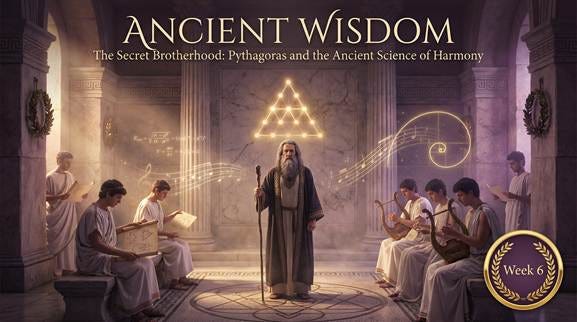
The Pythagorean Brotherhood, was formed in Southern Italy’s coastal regions around 580 BCE by a mystical teacher known as Pythagoras, who was said to possess mystical powers or extraordinary abilities (he had “a golden leg” and could be “two places at once”). This brotherhood pursued a radically different approach to life. The Pythagorean philosophy maintained that everything about the universe is based on numerical relationships; music heals the spirit, and there is celestial harmony created by the motion of the planets.
Although Pythagoras is best known for developing the theorem that bears his name, his influence and significance go far beyond his contributions in mathematics. He was not only a mathematician but also a spiritual leader, a mystic, and the head of an organization established to bring people into harmony with the Universe. This week we will examine some of the secrets of the Pythagorean Brotherhood and their science of Harmony.
The Pythagorean Brotherhood: A Community of Seekers
The Pythagorean Brotherhood originated in Croton as a religious and philosophical organization creating an environment for the spiritual cleansing of its members’ souls through community living.
To become an initiate, an individual had to endure a series of initiations and prove that he or she is worthy of entering into the inner circle. This process lasted for five years, during which the initiate swore to remain silent about all things related to the Pythagorean Brotherhood, which allowed the initiate to enter into the brotherhood’s close-knit group of members.
The community functioned on the basis of communal living; the brothers lived together and shared all of their possessions, while adhering to a strict moral code that was designed to foster ethical development and a harmonious relationship between the brotherhood and the universe’s divine order. Ultimately, the Pythagorean Brotherhood strived to attain arete (excellence) and live in harmony with the universe’s divine order.
The Three Pillars of Pythagorean Wisdom
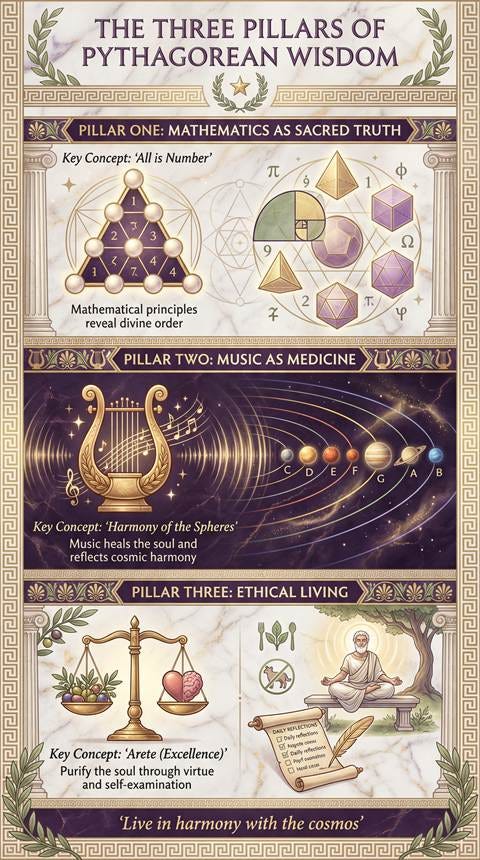
Pythagorean philosophy rested on three interconnected pillars, each revealing a different aspect of cosmic harmony.
Pillar 1: Mathematics as Sacred Truth
To the Pythagoreans, Mathematics was not simply an intellectually dry or abstract subject, but rather it was the language of God, or the Divine, as they believed. The foundational principle of the Pythagorean belief system is “All is Number“. They believed that mathematics is a fundamental principle that underlies all things in the Universe, from the spiral of a sea shell to the golden ratio, and the geometric pattern of a snowflake.
The most sacred symbol of the Pythagorean belief system is the Tetractys or Tetraktis, a triangular figure of 10 points, which represent the harmony and unity of the cosmos. They believed that through the study of mathematics, they were not just learning about the physical universe, but rather they are gaining a greater understanding of God or the divine mind.
Pillar 2: Music as Medicine
Pythagoras was the first person to identify the mathematical ratios that create musical intervals; for example, he found that consonance (e.g., the octave, fifth, fourth) was created by simple integer ratios.
The Pythagorean insight here was that music is not only a matter of personal taste, but rather that it is a musical expression of the mathematical order that exists in the universe. The Pythagoreans believed that as the planets move around the sun, they produced a “celestial music”, which they referred to as the “harmony of the spheres”.
The Pythagoreans believed that music was a form of medicine; i.e., they would consciously create and play certain melodies and tones in order to calm the passions, elevate the spirit, or heal the body, which was perceived by the Pythagoreans as a way of “tuning” the soul to the harmony of the cosmos.
Pillar 3: Ethical Living
The Pythagorean way of life was created as a means of purifying the soul and preparing it for eternity through its many reincarnations. The Pythagorean moral code contains the following tenets:
Vegetarianism: The belief in reincarnation mandated the respect of all living things (thus, the abstaining from eating of animal flesh);
Daily Self-Examination: Prior to going to sleep, all Pythagoreans would ask themselves the following three questions: “What did I do today, what did I not do, what should I have done?” This practice was viewed as essential for moral progress.
Silence and Contemplation: Initiates would practice long periods of silence in order to attain self-control and inner peace.
Moderation: In the same way as stated in the Delphic maxim, “Nothing in Excess”, balance and moderation in all things were valued by the Pythagoreans.
Three Pythagorean Practices for Modern Life
The wisdom of the Pythagorean Brotherhood is valid today as it was 2,500 years ago.
Here are three techniques you can incorporate into your daily life to assist you in achieving a greater sense of harmony with the universe.
1. The Pythagorean Evening Review
This technique played a significant role in the development of the Stoic philosophy, as well as others, and is one that can be used by anyone today. Each evening, reflect on your day for a few moments before going to sleep. Review what you did well, where you fell short, and what you learned. This will help you to develop self-awareness and enhance your personal growth.
2. Sacred Geometry Meditation
Take a walk in nature and intentionally look for patterns. For example, look for the Fibonacci sequence in a pine cone, the fractal branching of a tree, or the hexagonal cells of a honeycomb. Think about the natural world’s intelligence and underlying order. Remember that you are part of this beautiful and harmonious system. This experience will help you see the order in the cosmos rather than chaos.
3. Intentionally Use Music
Use music as the Pythagoreans did: as a means of promoting emotional and spiritual wellness. Create your playlists based upon your goals and intentions for each day. For example, use one playlist to wake you up in the morning, another to help you focus at work, and a third to help you relax before going to bed. Be mindful of the ways that various frequencies and harmonies affect you. By using these sounds intentionally, you will help to create harmony within yourself.
The Enduring Harmony
Pythagoras and his followers tried to build a society that represented the harmony of the universe. They felt that math, music, and ethics weren’t different things, but rather parts of one unified divine reality. They believed if they lived a just life, studied the language of numbers, and connected themselves to the music of the spheres, they could cleanse their souls and reconnect to the divine. Their secret brotherhood may no longer exist, but the call to align with the universe is still heard today; thus, we are encouraged to discover our place within the cosmic symphony.
By Dr Ioannis Syrigos
Suggested books for reading
The Pythagorean Sourcebook and Library by Pythagoras, Kenneth Sylvan Guthrie (Editor)
The Golden Ratio: The Story of PHI, the World’s Most Astonishing Number by Mario Livio
To the Pythagoreans, Mathematics was not simply an intellectually dry or abstract subject, but rather it was the language of God, or the Divine, as they believed. The foundational principle of the Pythagorean belief system is “All is Number“.
Such a beautiful idea. It's a shame that today "all is number" has been translated to "the bottom line."
In 2003 a set of six wooden pipes were recovered in an archaeological dig at Charlesland, Co. Wicklow. Carbon dating established their age at 4,150 years old. Ancient Music Ireland were asked to look at them and identified them as parts of a musical instrument. – Subsequently, professional fipples were designed by low whistle maker Ian Lambe. He used three D printing to make six new fipples. They were fitted to the pipes by uillean pipe maker Eugene Lambe. The results were astounding. These pipes which were made in Ireland over 4,000 years ago were playing a modern scale from G to E.What makes this most exciting and ground-breaking is that until now the accepted theory of the origin of European music is of Pythagoras writing down the mathematics of our modern scale circa 500 BC. Yet here is an Irish instrument with a similar scale some 1,700 years earlier. We know the approximate tuning of the complete originals, we know their age, location of deposit, what they are made of and how they were made. The possibility exists that the musical tradition at the time extended back into Neolithic culture and the great civilisation that built Newgrange.Now the question is posed; what is the origin of European Music? Is it Greece and Mesopotamia even earlier or perhaps the Western European Islands where complex melody was being played so long ago? We believe that the release of this amazing discovery may cause a great deal of interest and a radical rethink among scholars of the origins of Irish Music and its influences around the world.
https://www.ancientmusicireland.com/wp-content/uploads/2020/11/Holmes_Molloy_paper_Wicklow_Pipes.pdf