


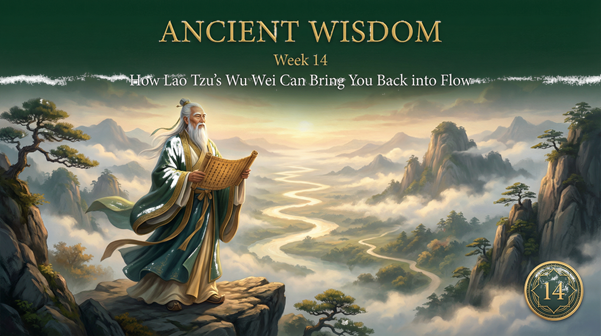
The modern world is overwhelming, and, unfortunately, that stress is being passed on to everyone. We all have moments where we feel like we are unable to do anything right, and when our goals seem unreachable, we give up. However, what many people do not realize is that when they are feeling this way, they are actually exerting themselves far more than they should. The reason is that many of us are trying so hard to achieve every outcome. We have developed an obsessive tendency to control the outcomes of our lives by forcing them into some sort of predetermined path. In fact, as most people find out very quickly at work, the more you push, the more resistance you will meet, and in the end, you will find yourself fighting against things that you should not have had to fight against in the first place.
The ancient Chinese philosopher Laozi could very well have been one of the first people in history to offer a new perspective to those who are struggling. Laozi was living at a time when the world was politically and intellectually unstable; however, he offered a very different perspective than anyone else of his time. Instead of continuing to fight against reality, and instead of believing that the only way to be productive is to force everything into a particular direction, he suggested that we should instead discover the art of alignment.
The way that he explained alignment was through the term “wu wei.” It is a term that has often been inaccurately translated as “non-action,” because the interpretation of that term has the potential to be extremely misleading. Laozi was not encouraging people to be lazy, apathetic, or disengaged from their own lives; he was attempting to encourage all people to open their eyes and see a completely different way to be successful; he was encouraging a different way of approaching and relating to the world. The art of alignment is about “going with the flow” of the universe; to be in complete harmony with the natural laws of the universe, to have focus, to be relaxed, to be effortless, to be powerful without being aggressive; it is about doing what is necessary to achieve a goal, in an intelligent manner.
This week’s Ancient Wisdom is about one of the most needed lessons of our age: not everything improves when you push harder.
Who Was Laozi?
In world history, Laozi has an intriguing and unique role. According to traditional Chinese history, he was possibly a contemporary of Confucius and may have been a wise sage who wrote a brief but valuable work known as Daodejing (or the Classic of the Way and Virtue). In modern times, scholars have varying opinions about him. Some see Laozi as at least partially legendary; others believe that many authors contributed over time to the work attributed to Laozi.
Regardless of whether Laozi was an individual or not, the teachings attributed to him hold great significance today. The Dao became one of the pivotal texts of Daoism, and for hundreds of years has influenced China’s religious and philosophical beliefs, ethical principles, and political philosophies.
At the core of Laozi’s teachings lies the Dao (or “the Way”). The Dao isn’t a straightforward definition and this ambiguity is actually part of the overall teaching. It is essentially the unifying structure, pattern, and path of reality. As summarized by the National Geographic, Daoism teaches “to help each person find and cultivate a connection with the universe.” Therefore, the Dao begins with Laozi’s premise that there is a “flow” in life. When we go against the flow or do not align with it, there tends to be a heightened level of suffering.
The Wisdom of Wu Wei
The Dao is a set of rules for living, and wu wei is the technique to move with the Dao. Wu wei does not mean do nothing. It means do not move with unnecessary force or effort. Wu wei also means not moving from a mindless place of fear; it helps remove the frantic compulsiveness that makes us clumsy, rigid, and blind.
According to the Stanford Encyclopedia of Philosophy, the Daodejing links virtue and naturalness and nonaction; thus, a way of being in which action emerges with less self-assertion and less friction.
Consider water (a classic image of Taoism). Water does not punch through all things that block it; rather, it flows around all rocks, crushes rocks down after many years, fills low places, and continues to be useful by being flexible. Water is gentle but not weak. Water submits and then persists.
Much of what we call strength is really panic that has armor on it; Laozi states that when we grip too tightly, it is because we fear. When we try to manage everything, it is because we have no trust. When we feel the need to speak before we know what we are going to say, it is because to wait and remain silent feels out of control. We work past wisdom because stopping feels irresponsible.
Wu wei presents the question: what if the problem is not your propensity to be passive but your propensity to use excessive force for things that would work just as well with increased alertness?
That is one reason why Laozi seems to mix so well with modern thought. Our current civilization has begun to gravitate toward rapidly increasing speed, that puts pressure on us to maximize production (productivity theatre) and continue to assert authority over ourselves.
We are socialized to think that when something doesn’t work, we need to apply more effort, exert more control, or increase the intensity in order to get it to work.
Occasionally, this is true; however, more often than not, we are not failing due to a lack of discipline but due to a lifestyle that imposes upon us a sense of internal resistance. We try to think about and solve our current exhaustion using the same mentality and resources that caused the exhaustion. We are approaching every challenge like a locked door that must be kicked open.
Laozi suggests that the image of mastery is rather different from how people view it in modern times. Often, real power is not highly visible; often, it appears rather calm, utilizing careful timing, patient attention, gentle application, and perceiving when using excessive force might exacerbate the problem.
In practical terms, wu wei defines the distinction between effort and friction; effort is necessary, whereas friction is created by the ego within us that adds struggle, drama, and compulsion to the a request of reality.
Force vs. Flow
The contrast at the centre of Taoism becomes clearer when translated into modern life.
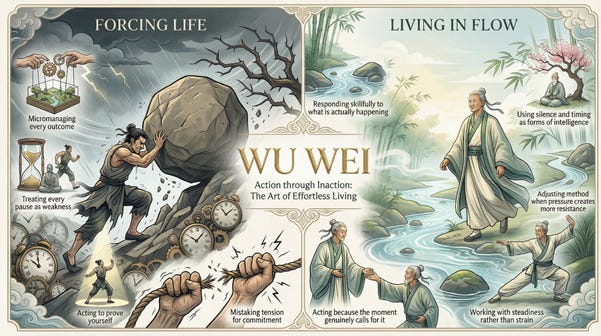
To become less active, most individuals do not have to drastically reduce their level of activity. What most people require is to reduce the level of internal conflict they experience. People must learn to recognize that all ordinary challenges are not a personal emergency.
That is the secret behind wu wei. It is not passivity but an unclenched effectiveness.
Three Taoist Practices for Living in Flow
The question raised by every article in the Ancient Wisdom series is:
What will you do with this teaching this week?
Laozi responds: Instead of escaping to the mountain top, focus on identifying areas of your life crowded with unnecessary energy and find ways to eliminate them. Below you will find three different ways to accomplish this task.
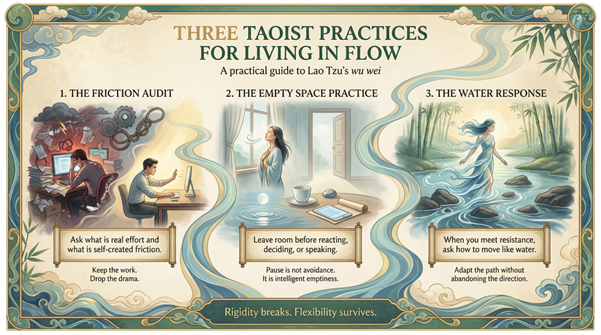
1. Conduct The Friction Audit
Choose an area in your life that feels too heavy, such as work, marriage or your health routine, and ask yourself:
What parts of the area are real efforts; what parts are self-created sources of friction?
A real effort is the work itself; self-created sources of friction arise from the anxiety, need for over-control, perfectionism, resentfulness, or wanting to dominate the results of an action you take.
Once you’ve completed your audit, it is common to find out that what you perceive to be the most difficult part of the area is not really the area itself but rather the way you brace for it.
For one week, focus on removing the unnecessary pressure you’ve added. Continue your work as usual, but eliminate the drama associated with it.
2. Practice The Empty Space Practice
Modern life distorts our responses. We respond too quickly, react too quickly, decide too quickly and speak too quickly. In Taoist terms, we do not create opportunity to allow the Dao to determine the path of the moment.
Therefore, practice creating “spaciousness”.
Before responding to an email, give yourself at least a few minutes to really think through your response. If you feel you need to immediately respond, stop, take a breath and give yourself a moment of silence. If you find yourself in a disagreement, allow yourself time to contemplate the direction of the conversation before taking it further. If someone asks for your assistance, take at least one hour before providing any response.
This is not an avoidance technique as much as it is an opportunity for thoughtful, and intelligent, “empty” space. An empty cup can be filled; a cup that is already full will overflow. Many times, the wise course of action presents itself after we stop rushing to produce any response.
3. Adapt to Resistance (Water Response)
When facing resistance this week, instead of immediately asking, “How can I exert more force?” ask yourself, “How can I work with this resistance as a stream of water would, and adapt without losing my direction?”
Water always follows its intended path; however, it is able to adjust when obstacles present themselves. In conversations, this “adaptability” may take the form of listening instead of insisting. In the case of work or tasks, it may look like simplifying an approach instead of intensifying it. In the case of personal change, it may consist of focusing on your consistency rather than your sporadic bursts of effort.
It is not about being “weak”; it is more of “being flexible”. Rigidity breaks, while flexibility lasts.
The Deeper Promise
The wisdom of Laozi is not a productivity tool; however, practicing his principles will result in greater effectiveness. More specifically, his teachings serve as spiritual guideposts in our lives.
Laozi’s teachings remind us that the challenge of life is not about laying one failure on top of another in an effort to conquer it. Rather, it is about the space that we create for certain things to come into existence – such as sleep, love, creativity, trust, insight, healing, authority, and peace.
When we attempt to grasp these things through force, they disappear; however, by creating space, they will come to us.
In many ways, the teachings of Laozi on wu wei would seem to be quite radical in our society today. Wu wei represents the idea that we do not have to rely solely on our own strength in order to accomplish all that we want. The mind that works tirelessly often finds itself providing an unreasonable level of pressure to itself by creating unrealistic timeframes, proving its worth to others, and creating an endless cycle of stress for itself. A person who is ambitious may also believe that one of the highest levels of mastery is simply to be able to let go of everything that they have imposed on themselves.
Laozi did not guarantee us that life would become easy. However, he did give us a greater level of understanding of the natural rhythm of our lives and how to live in harmony with it. The committed student of Laozi should seek to live with this greater understanding.
During the upcoming week, take note of yourself, where you find yourself clenching your muscles. Pay close attention to the places in your life where you are racing around, clenching tightly, trying to prove yourself, and pushing your way through life. Begin to release the pressure you are creating for yourself, even if you are only doing it slightly. Allow one of your actions to flow based on timing rather than tension. Use listening rather than control in one of your conversations. Approach one of your most difficult situations with flexibility rather than force.
That is how the process of flow begins.
By Dr Ioannis Syrigos
Recommended Reading
Tao Te Ching: An Illustrated Journey by Stephen Mitchell (Translator)
Brilliant! Thankyou so much 😘
Wonderful article, thank you! Wondering if you can expound on the distinction between Wu Wei and Wei Wu Wei and any specific guidance on practicing Wei Wu Wei?