


In the deep woods of Kerala, in 800 AD, an 8-year-old boy had a vision that would change the course of Eastern Philosophy forever. He did not possess wealth, have an army, nor any political power. However, over the course of the next 24 years, the boy walked barefoot across the Indian subcontinent, debating the greatest scholars of his time, establishing monasteries in each of the four corners of the land and reviving a spiritual philosophy which was almost lost to time.
His name was Adi Shankaracharya.
Unlike so many others who claimed to speak for a distant God or a distant Tradition, he came as a philosopher with a radical and uncompromising message. This message continues to challenge the way we understand the nature of reality today. His work did not talk about “the way to heaven” or “pleasing the Gods.” His message was about “waking up” to something which is as terrifying, as it is liberating.
What did this young monk teach that led to such a tremendous shift in human consciousness? What is it about his philosophy, Advaita Vedanta, which makes it one of the most potent antidotes to stress, loneliness and the relentless searching of modern society? The entire issue of this week’s edition of Ancient Wisdom is about answering those questions and an opportunity to look into the mirror and see who is looking back at you.
The Problem of Separation
The following assumptions about life can be termed as the belief of separation - an individual has a self; whereas, everything else exists outside of their individual self. Thus, an individual is a separate and individualised self; within an enormous and indifferent world, they must survive, discover their own meaning and eventually die. This sense of separation is the root of all human suffering. It creates fear, because the world is big and you are small. It creates desire, because you feel incomplete and need things outside yourself to feel whole.
At the time when Adi Shankara was living in India (8th century), the spiritual landscape of that country appeared to be, at that time, disassembled into a plethora of spiritual paths. The Vedic tradition had been bogged down by complex rituals and stereotypical behaviour patterns for many years and was in a lengthy process of becoming; Buddhism was deteriorating and was gradually losing supporters. People were searching for answers, but they were looking in the wrong places, in external ceremonies, in intellectual debates, or in the hope of a better afterlife.
Adi Shankara was able to show that while all of these behaviours were at fault for the present-day spiritual confusion of humanity, he also recognised that the assumptions associated with searching for divine enlightenment are misdirected. When an individual is searching for divine enlightenment, that individual will not be able to discover the divine unless that searcher becomes aware that the searcher is actually the source of the divine.
The Philosophy of Non-Duality
Advaita Vedanta was developed and systematised into its full presentation and comprehensive thought by Shankaracharya. Advaita often translates literally as “not-two” or “non-duality,” while based on the culmination of the Vedas, the oldest spiritual texts from India, notably the Upanishads.
At its essence, Advaita Vedanta may be expressed in a unique, concise idea: there is but one reality, and that is you.
To understand how Shankaracharya arrived at this conclusion, we must look at the three foundational pillars of his philosophy.
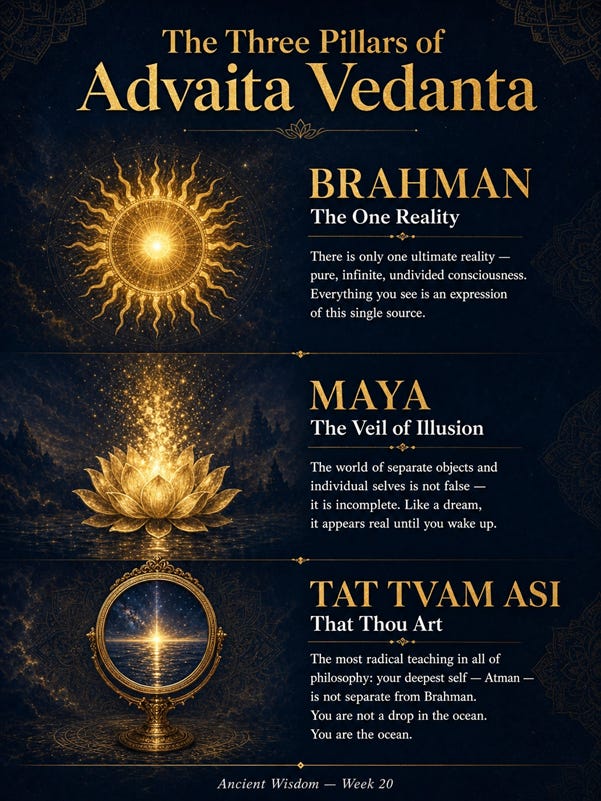
1. Brahman: The One Reality
Shankaracharya said that the only reality in the world is Brahman. However, Brahman cannot be pictured as having a personal nature, like being a God who is ruling from high in the sky, because Brahman is complete and unending consciousness that has no context or boundaries. It is the silent, unchanging background against which the entire drama of the universe plays out. It has no beginning, no end, no form, and no limits. It is the only thing that is truly real, because it is the only thing that never changes.
2. Maya: The Veil of Illusion
If Brahman is all there is to reality, then what is the “stuff” we see around us? What of the trees, cities, people, happiness, sadness?
Shankaracharya explained about all this through the term Maya, which is normally translated to mean “illusion,” but a better way to translate it would be “appearance”.
While the world is not false, it does not directly represent anything. Shankaracharya uses the famous analogy of the snake and the rope, where you may be on a dark road and see something coiled up on the ground, and you jump back in fear thinking it is a snake. You have become anxious, your pulse is racing and your palms are sweating because you thought it was a snake. Once you shine a light on it, you realize it is a piece of rope. There never was a snake; it was a projection of the idea of a snake over the reality of the rope. In the same way, the world of separate objects and individual selves is a projection superimposed on the single reality of Brahman.
3. Tat Tvam Asi: That Thou Art
This gives rise to the most liberating and radical perspective of Advaita Vedanta. If Brahman is the only reality, and the world appears as though there were separation among us humans, then what does it mean for you?
You are not the body because the body changes and dies. You are not the mind because the mind is constant with passing thoughts and feelings. Your true self, the pure awareness of your existence, the silent observer of everything you experience, the reader of these very words as you read them today, is your Atman. The ultimate revelation of Shankaracharya is that Atman and Brahman are the same thing.
His Ideas are Still relevant
In this fast-paced age of constant identity crisis and search for purpose, we work to create who we are through our careers, relationships, social media, and accomplishments. We will ultimately fail. No matter how much effort you put into building your identity, whatever you create on the ever-changing material plane is destined for destruction at some point in time.
Advita Vedanta offers a sense of peace and rest from all this hectic work. You don’t have to create yourself because you are already whole, unending, and perfect. You are not looking for meaning, as you create meaning. You are not afraid to die, as your true nature has never been born nor can it die.
Advaita Vedanta doesn’t teach us to disengage from our lives or be disconnected from the world. With full awareness, when you understand that the same consciousness that looks through your eyes also looks through the eyes of every person you encounter, your sense of compassion is no longer a social obligation; it’s simply a fact. You love your neighbour for no other reason than the fact that your neighbour is, in a literal sense, you!
Three Practices to Experience Non-Duality
Advaita Vedanta is more than just an idea; it is something you actually experience. The following describes three different ways to bring the principles of Advaita into your everyday life.
1. The Practice of Neti Neti (Not This, Not That)
This ancient technique is used to discover who you truly are by self-inquiry. When you identify strongly with a feeling, thought, or physical sensation, say out loud or internally: “I know this feeling exists, so I cannot be this feeling.” Continue to remove all observable items (the body, mind, roles, past) and observe what is left after everything that can be seen has been removed. What will remain after all these things are gone is the Silent Witness.
2. The Practice of the Silent Witness
Throughout your day, try to become the observer instead of being the actor. While you do something like walk, eat or do work, picture yourself watching these things on a screen. Notice how your mind constantly talks and judges; however, don’t engage it; just watch it. By developing the Silent Witness aspect of your own being, you will slowly leave behind the drama of Maya and connect with the peace of Atman.
3. The Practice of Seeing the One in the Many
When talking with another person, think to yourself: “The consciousness in them is the same consciousness in me.” By making this small change in your perspective, you will dissolve the illusion of separation and develop a deep sense of empathy and connectedness.
The End of the Search
The fire has been burning for thousands of years. The most important journey any human can take is to discover our true self, which lies just one millimeter away from our perceived self. We have devoted our lives to searching for God and peace and meaning in life. The Shankaracharya’s message is a simple one: quit looking around. Look at yourself, the one who is seeking. What you seek is within yourself.
By Dr Ioannis Syrigos
Recommended Reading
The Crest-Jewel of Discrimination (Vivekachudamani) attributed to Adi Shankaracharya
I Am That by Sri Nisargadatta Maharaj
Something big is coming for our community. Next week, we will be announcing a special opportunity to take these ancient teachings off the page and into your daily life. Keep an eye on your inbox.
Most have and still do envision the energies that we call God as a separate all powerful being. That has been the human inability to envision any other way to communicate the existence of the things we sense and observe. We are threatened with eternal punishment if we do not subscribe to the dictates of our leaders and so called theologians. Only when we receive the knowledge of all the energies that surround us and enable us to realize that they are us will we be able to cast off the belief that we are separate from the ALL THAT IS and be at one with it.
This lad was enabled at a very early time in life to know this. The normal time frame is from the 20s until 40s but Emanuel Swedenborg was 57. Armstrong and Mitchell were in the 40s and the astronaut that made the around the moon trip just now as I believe 40ish. Buddha was late 20s,Jesus was around late 20 or early thirty. It is known as Illumination or Cosmic Consciousness and is the next step above our Self Consciousness. Many have been elivated but not published or known because of religious ridicule.