


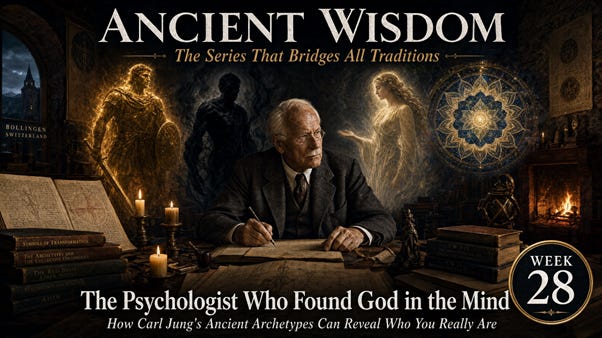
Nestled quietly in the small Swiss hamlet of Bollingen, sits a hand-crafted stone tower overlooking beautiful Lake Zurich. Inside the tower near the warmth of the fire, along with many alchemical texts, mandalas, and ancient texts, is a wise old gentleman with a snow-white mustache and intelligent piercing blue eyes. He is not a magician from medieval times nor a mystic practitioner of antiquity; he also happens to be one of the most important scientists of last century.
This gentleman has held on to a very big secret for many years - his secret journal bound in red leather with many detailed and beautiful drawings of a dark, terrifying and beautiful journey through the different layers of his mind. In this dark and terrible place within him, he did not discover the repressed sexual desires of his mentor Sigmund Freud, but instead he unearthed the gods, demons, wise elders and universal symbols that haunt humankind from the beginning of time.
The ancient wisdom systems studied throughout the last 27 weeks: the Hermeticists in Egypt, Shamans in Siberia, Kabbalists, Tantrics, etc. are more than just primitive superstitions; they form the road map for understanding the human Psyche.
His name was Carl Gustav Jung, and he proved that the divine is not just out there in the cosmos. It is inside of us.
Who Was Carl Jung?
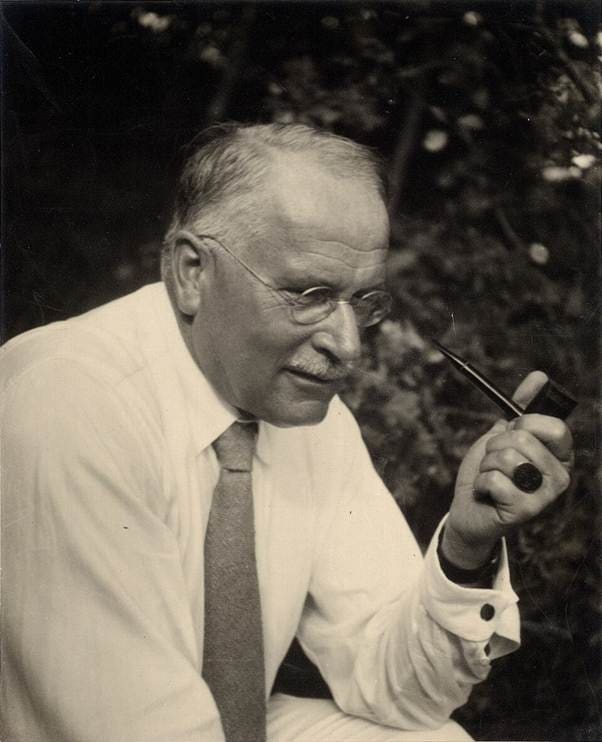
Carl Gustav Jung (Source: Wikipedia)
Carl Gustav Jung was born in 1875 in Kesswil, Switzerland. He was an analyst, psychiatrist, and was the founder of what has become known as Analytical Psychology. He began his professional career by working at the Burghölzli Hospital for the Mentally Ill in Zurich, Switzerland, where he quickly developed into one of the most creative and talented minds of his time.
During this time, Jung began to receive recognition from others in the field, including the founder of Psychoanalysis, Sigmund Freud. Freud believed that Jung would become his intellectual successor, and that he would take the new science of Psychoanalysis into the future. This relationship, however, did not last forever. Jung could not accept the insistence of Freud that all unconscious drives were sexual. Jung believed that there was something deeper than sexuality, there was a spiritual and collective subconscious that permeated human consciousness.
In 1913, Jung and Freud had a dramatic split that sent Jung into a personal crisis of epic proportions. He underwent what he termed a Confrontation with The Unconscious, where he forced himself into a trance-like state and brought forth images and ideas that were later compiled into his famous Red Book. Through this painful and transformative experience, Jung developed a new way of thinking and created a model that connected Ancient Mysticism and Modern Psychology.
The Architecture of the Soul
Jung’s genius lay in recognizing that the human mind is not a blank slate, nor is it only a repository for personal memories and traumas. He proposed a radically different architecture of the psyche, one that not surprisingly echoes the teachings of the ancients.
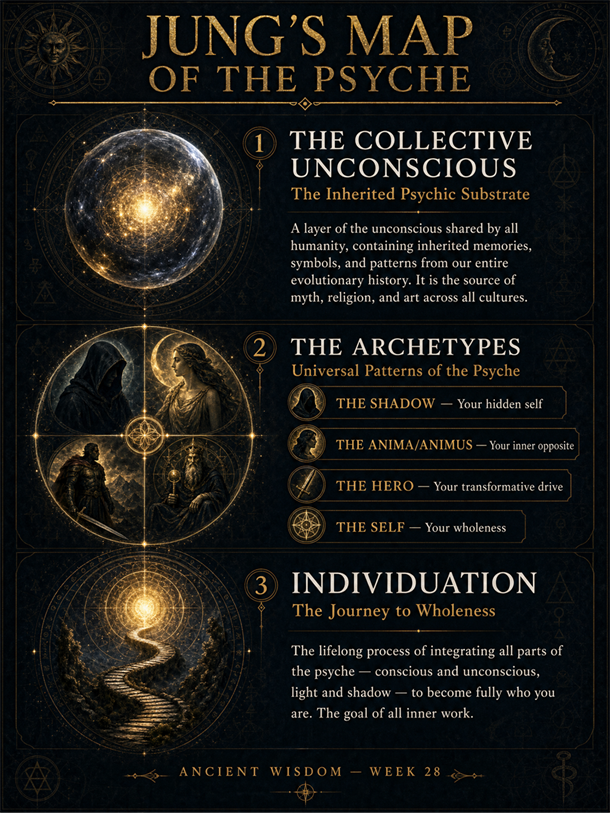
1. The Collective Unconscious
Underneath our personal unconscious lies our deeper layer; namely, the collective unconscious. This is a psychic layer that has been built up by generations of man and is therefore considered to be a form of psychic inheritance from our ancestors, and is believed to be the collective psyche of the human race. Just like our bodies inherit our physical traits from our parents, the universal patterns of thought and feeling have been passed down through generations. This gives us insights into why there are so many common myths, symbols and religious motifs found in the cultures of all the nations of the world. These symbols are called archetypes and are expressed through the collective unconsciousness.
2. The Archetypes
The collective unconscious expresses itself through archetypes, which are universal images or themes that occur repeatedly. These archetypes are not memories but rather tendencies for humans to experience the same events in a similar fashion. Here are some examples of key archetypes:
The Shadow: This archetype includes the darker aspects of our personalities that we do not acknowledge.
The Anima/Animus: The unconscious feminine side of the man and the unconscious masculine side of the woman.
The Hero: The drive to overcome, kill the dragon and bring about transformation.
The Self: This is the archetype that represents “wholeness.” It is the merger of the conscious mind with the unconscious mind.
3. Individuation
According to the theory of Carl Jung, achieving individuation is the primary purpose of humanity and that the process of individuation, in itself, is an ongoing effort to combine the conscious and unconscious aspects of our mind into one complete unit (i.e. the full realisation of who we are).
Individuation involves becoming aware of our unconscious thoughts, addressing our ‘shadow-self’, and unifying our ego with our ‘higher self’. Jung believed that individuation was the same as the modern day alchemist attempting to transmute (transform) base metals into precious metals or the mystical seeker seeking spiritual awakening (enlightenment).
Practical Applications: Navigating Your Inner World
Jung left society with not only theories, but practical exercises through which to explore the shadow realm within us.
1. Shadow Work
You must go through the darkness before you reach the light. Shadow Work is the practice of finding, accepting, and assimilating all of the things you refuse to acknowledge about yourself. This includes all of your anger, self-interest, hidden desires, etc. Whenever you project your shadow onto another, you create conflict with them. By absorbing and integrating your shadow; you reclaim your lost energy and become complete. A good way to identify your shadow is to consider what kind of people irritate You the most. The characteristics you find irritating can often be traced back to your own inner workings.
2. Active Imagination
Active Imagination is a method of actively engaging in the unconscious instead of passively observing it. The images, figures, and emotions rising in your mind can all be engaged directly. You can interact with any enlightened inner figure, as well as face down a scary monster. You can work with these unconscious images to form structures and negotiate with them through conversation, or even seeking their wisdom.
3. Dream Analysis
For Jung, dream content was not random electrical impulses nor the product of an individual’s mind; they are significant messages from the collective unconscious. Dreams have symbolic meanings and can provide insight, guidance, and warning about your conscious or waking life. Keeping a dream journal and identifying reoccurring themes or mythic motifs are ways of interpreting what your dreams are communicating to you about your process of individuation.
The Bridge to the Finale
Carl Jung offers a foundational connection between our study of classical sources of wisdom, like Hermeticism, Buddhism, Kabbalah and Jungian Psychology, and the modern scientific worldview. Through his work, he has shown that the alchemical, Gnostic, and shamanistic traditions speak not only about concrete external phenomena, but they document the transformative, internal evolution of the human psyche.
In our Season 1 Finale of Ancient Wisdoms next week, we will review and bring together all that we have learned over the past 28 weeks, including the interconnections of the Hermetic, Buddhist, Kabbalistic and Jungian traditions in order to arrive at a common understanding of the spiritual journey of humanity.
Next week I will also present to you my special gift for those of you willing to go beyond just reading and now actually begin to practise these traditions. The journey is just beginning!
By Dr Ioannis Syrigos
Recommended Reading
Memories, Dreams, Reflections by C.G. Jung
Man and His Symbols by C.G. Jung
Are you ready to take the next step on your journey? The Ancient Origins Academy is opening its doors soon. Prepare to transform ancient wisdom into lived experience.
Today; we who have sought this awakening call it Illumination or as Dr Bucke called it Cosmic Conciousness. It usually happens in the 20s up until early 40s. The oldest known was Emanuel Swedenborg who was 57. It believed to be when the brain is in a state of conciousness that it is able to and becomes of the universal conciousness that enables the Cosmos to become something that we can realize exists and can then be understood as multiple energies capable of producing all that we can and even can not detect or be aware of in our present state of development. It is the same state that was received by Socrates and others who received it and were thought of as being a danger to the governing Gods of their times. Usually exiled or killed.