


The most important people in religion could be named Jesus Christ, Muhammad, Moses or the Buddha. But there is an important religious thinker from a very remote time who appears to have had a profound influence on the fundamental beliefs of both the major western religions. This is Zarathustra (Zoroaster to the Greeks). He was a mystic, poet, and revolutionary living in ancient Persia (modern Iran) between 1500-1000 BC. When he lived there was much chaos in the world, with many gods (polytheism), and many sacrifices made to these gods as well as by humans due to the fate of existence being controlled by the god of fate. The world being created and controlled by many gods and randomness was not what Zoroaster was talking about, and he came up with an incredibly different view of the world.
He was able to describe a single Supreme God who had created everything, and Zoroaster offered the existence of a cosmic war between good and evil. He also discussed a place for the good in heaven and the bad in hell. He spoke about a future time when all mankind would be judged and punished for their actions, a messiah would come to save mankind, and there would be a resurrection from the dead.
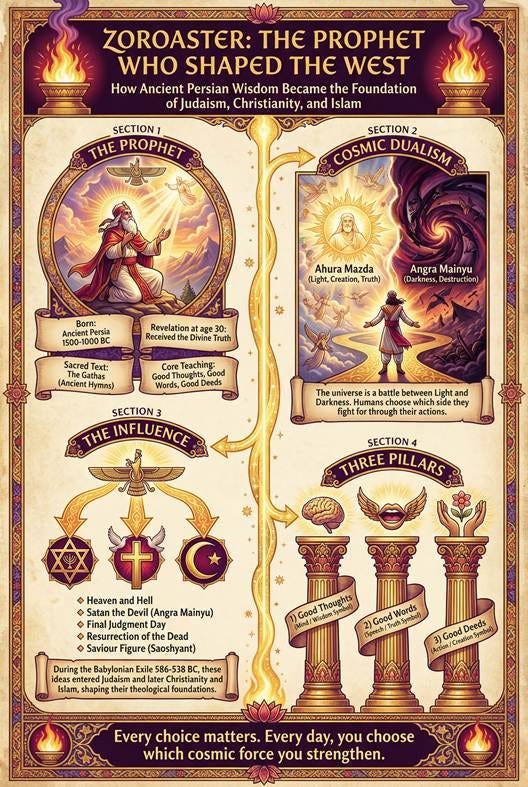
The ideas of Zoroaster had strong parallels to what were to become the core beliefs of Judaism, Christianity and Islam. The staggering number of similarities, which can be found in the Gathas (Zoroastrian hymns) and those that developed in the Abrahamic religions, illustrate the emergence of universal spiritual truths throughout time and across cultures.
This week you will leave Greece and travel to Persia, the home of the most powerful religious thinker of all time, to discover his revolutionary ideas. His central idea (the absolute requirement of personal moral responsibility) is a very viable practical philosophy and will be examined in detail this week.
The Vision of the One and the Two
Prior to Zoroaster’s time, the ancient Iranian religion was closely aligned with the Vedic religion found in India (that was discussed in Week 10). The ancient Iranian religion represented a world filled with gods (daevas), complex rituals, and a belief that the universe operated based solely on the forces of nature, rather than upon moral forces.
According to legend, at age 30 Zoroaster experienced a mystical experience when he was taken into the presence of Ahura Mazda, the “Lord of All Wisdom.” During this experience, Zoroaster came to understand that Ahura Mazda was not simply another god among many; rather, he was the only uncreated, ultimate Creator of the universe. He was completely good, completely just, and completely light-giving.
However, this led to another philosophical problem: If the Creator was wholly good, what is the origin of evil? Zoroaster’s response to this question was profound and revolutionary. He developed the idea of cosmic dualism. The opposite of Ahura Mazda, he taught, was an independent, destructive being called Angra Mainyu (later called Ahriman). Angra Mainyu was the catalyst behind darkness, decay, disease, and deception.
Thus, evil was born. For the first time in history, evil has been identified as an immensely intelligent force acting to destroy God’s creation, not just a natural force, nor just a manifestation of a whimsical god’s emotions.
The Cosmic Battle and the Power of Choice
According to Zoroaster’s vision, the universe as a whole is in a continuous battle between Light (Ahura Mazda) and Darkness (Angra Mainyu). But Zoroaster’s belief is that, since Ahura Mazda created us, we are not to be passive victims of this battle; rather, we are to be active partners with Ahura Mazda.
Zoroaster taught that all human beings possess free will and therefore are not beholden to predestined fate or to the whims of the gods. Every day, every hour, every minute, and every second, we are confronted with the choice to support either the forces of Light or the forces of Darkness. Simply stated, the most basic idea of Zoroastrianism is that we must always choose:
“Good Thoughts, Good Words, Good Deeds”
(Humata, Hukhta, Hvarshta)
By making positive moral decisions to choose truth over lies, construct kindness instead of cruelty, or create as opposed to destroy etc., you are giving power to the side of Light and aiding Ahura Mazda in winning the battle.
This creates an opportunity for humans to elevate their lives to a level of universal significance. Each human being’s choice is of great importance, as their moral choices are connected to their assistive participation in redeeming the universe.
The Babylonian Connection: A Convergence of Ideas
How was it possible for the teachings of an ancient Persian prophet to have so much in common with the teachings of both Judaism and Christianity? One of the major historical times when these two disparate cultures crossed paths was when a new nation arose in Babylon: the Babylonian exile. During the Babylonian Exile in 586 B.C.E., the Babylonians were victorious over the city of Jerusalem (destroying the First Temple) and took many of the Jewish leaders into captivity in Babylon. Fifty years later, the Persian King Cyrus the Great conquered Babylon and released the Jews at that time by permitting them to return to Jerusalem to rebuild their temple.
When Jewish scholars and priests lived within the borders of the Persian Empire, they were also living very close to the Persian people and their Zoroastrian beliefs and practices. Prior to the Babylonian exile, most of what we define as early Jewish texts/Scriptures were not preoccupied with cosmic adversary or fiery hell, but rather viewed the afterlife as an unknown and therefore, a lowly space, called Sheol, a shadowy realm.
Following the Babylonian Exile, during the Second Temple Period, Jews became increasingly concerned with the theological tenets that would have parallels to those of Zoroastrianism. Satan’s role in Jewish theology changed from being a prosecutor in the heavenly court (Book of Job) to serving as a cosmic adversary of God. Many of the major theological themes (final judgment, resurrection from death, separation of souls into heaven and hell) became core to the Jewish understanding during this time.
Many scholars do not see these theological developments as a simple process of copying from one culture to another, but rather as a profound convergence. The presence of Zoroastrianism may have acted as a catalyst or common language that allowed Jewish thinkers at that time to better understand/clarify and adapt their present understanding of spiritual truths that were already emerging within their own tradition. These important concepts of moral choice, divine justice and ultimate redemption have found their fullest development in Christianity and Islam.
Three Zoroastrian Practices for Modern Life
Zoroaster’s teachings offer a powerful, action-oriented philosophy for living with purpose and integrity today. Here are three ways to apply his wisdom:
1. The Daily Alignment (Good Thoughts, Good Words, Good Deeds):
When you wake up in the morning, make an effort to create a mental connection with the forces of Creation. Then make a commitment to yourself that you will do your best to have good thoughts, good words, and good deeds today. When you have to make a decision, think about how this will affect your life and ask yourself if it is constructive or destructive. Ask yourself if it is true or false. By focusing on these three basic forms of morality, you establish a set of guidelines for how to live during the day.
2. The Rejection of Fate:
When Zoroaster refused to accept the determinism of the world, he declared that people are not at the mercy of fate. Therefore, he believed in free will and that every person has the power to control their own life. While we cannot control events in our lives, we can control how we respond to them. Many of us live our lives as passive participants. To live your life as an active participant, reclaim your power and become an active creator of your own life.
3. The Practice of Light:
Fire and light are the ultimate symbols of purity and wisdom from Ahura Mazda. You can use fire and light to create a small home ritual. When you use a candle to help light your way in the dark, you are not just creating a visual effect. It is also a reminder of the presence of truth and goodness. You can also use the candle to reflect on the moral choices you have made during the day and as a commitment to make more moral choices tomorrow.
The Ultimate Triumph
According to Zoroaster, while there will be a cosmic conflict that lasts until the end of time; he also predicted that there would be a time when the Light would prevail over Evil (Angra Mainyu) and all darkness would cease to exist, and the world would one day return to its original state which is known as Frashokereti (making wonderful). The victory of the Forces of Light does not rest solely on God’s promises but is dependent upon the participation of mankind through courage and action.
For over three thousand years, Zoroaster has offered mankind his teachings and a challenge to each individual. His teachings serve as both a historical record and an appeal for all individuals to accept the responsibility of fighting evil and doing their part in bringing heaven to earth. The battle between good and evil exists in every human being as a battle for the heart, and as every decision affects this battle, each person has the power to contribute to bring about the victory of good over evil.
By Dr Ioannis Syrigos
Recommended Reading
The Hymns of Zoroaster, translated by M.L. West
Zoroastrians by Mary Boyce
This is so helpful and timely as I embark on a new historical novel series set in Victorian times while reaching back to archaeological discoveries in Mesopotamia. Although further research is required, it confirms my thinking on the subject.
One of the better articles I've read here. Thank you. Shame to see such a great master's work lost to history, although Gurdjieff wrote about him in detail over a hundred years ago (the terror of the situation) and explained in detail the how and why of the battle of the 2 forces, that people are still puzzling about. There are no new ideas.
I'll let others argue moot points, but I believe Z's concept was already relatively similar, except for time and cultural nuances, in earlier times as ma Kali, and Set (Against Horus) in Egypt.