


Do you want to find out the reason why you suffer, and is there an end to suffering? What you may not have realized is that the definition of “suffering” is a very broad term, encompassing a range of things, such as emotional pain, anxiety, and more.
Historically, Siddhartha Gautama was a privileged Indian prince who did not grow up with financial issues; he was born into a wealthy family with lots of luxuries available to him. In fact, according to tradition, he grew up in a palace, where he had all the luxuries of life with a great deal of security. His father wanted him to be protected from the struggles of life and prepared for a life of power, luxury, and success. As a result, he was given comfort and protection in his upbringing; therefore, Siddhartha had all the comforts anyone could hope to have.
However, while Siddhartha had all of these comforts, he was not truly content with his life.
At the end, Siddhartha left the palace. He encountered the Four Noble Truths: the first truth is that everyone ages, gets sick, and dies; the second truth is that no matter how wealthy you are, you cannot escape pain; the third truth is that there is a way to cope with pain; and lastly, the fourth truth is that the Four Noble Truths were created to give people the opportunity to be free from their suffering.
Siddhartha was not only looking for a way to eliminate his own suffering, but he was searching for a means to help others as well. What he ultimately created as a result of this journey has become one of the most important teachings in the history of mankind as the founding principle of Buddhism.
This week, we will travel to ancient India and meet the prince who renounced all of his worldly possessions and power in pursuit of the answers to the fundamental questions of human existence. He ultimately discovered these truths through careful observation and contemplation of the Four Noble Truths and has provided us with a pathway to the attainment of spiritual freedom.
The Problem the Buddha Refused to Ignore
Most spiritual teachers will focus on heaven, transcendent worlds, or God or the divine. The Buddha began with a subject so banal that most of us live our lives avoiding addressing it altogether - that is, suffering.
There is pain in the loss of loved ones, in the transition of our physical bodies, in not having the things that we want, and ultimately in experiencing momentary pleasure from having the things we want and then being left wanting more when that pleasure dissipates. Even the pleasurable things we experience are fleeting; they no longer bring pleasure; they will fade, they will transform, and we will want more of them.
So, it is no surprise that the first statement made in Buddhism is, “Life, as we know it, is full of suffering.”
As you can see, the beginning of Buddhism sounds very bleak. However, the Buddha was not being cynical; he was just truthful.
He was not saying life does not have beauty, love, and happiness, but rather that all things that make up our identity (youth, health, relationships, possessions, praise, fame, and success) are all subject to change. Youth will pass, health inevitably will be subject to change - relationships can change; material possessions will become obsolete. The praise you are receiving today will one day turn to scorn. Fame can be short-lived; success is often fleeting.
Life is subjective and we live in an ever-changing world, yet our minds continue to demand permanence from the environment. This demands causes suffering.
The Buddha did not invent suffering; he chose to acknowledge the fact that there is such a thing as suffering and therefore dealt with it.
The Four Noble Truths: Buddhism’s Radical Diagnosis
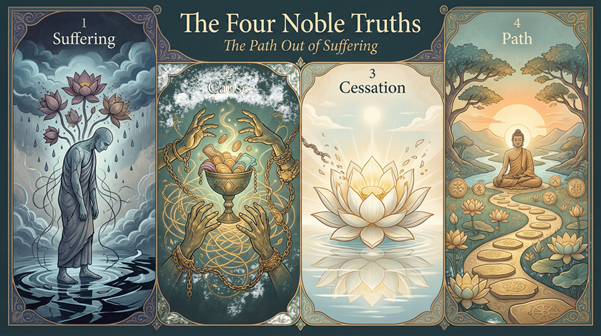
The Buddha’s major discovery is referred to as the Four Noble Truths. The Four Noble Truths are a diagnosis of the state of humanity, and a route out of our emotional shackles.
The First Noble Truth is that there is suffering.
Suffering is not just the pain, grief, illness, disappointment and loss that clearly exist in our world, but also something far more subtle: our own dissatisfaction with life. While we may appear outwardly to be successful, we feel restless, fearful, incomplete, or anxious about the future, and how long our present happiness will last. The Buddha saw that ordinary human life is shaped by this hidden instability of dissatisfaction.
The Second Noble Truth is that suffering has a root cause.
This is commonly referred to as craving. We crave for pleasure, for certainty, for security, for connection with others, and for control over our environment. We want things to stay the same when they bring us pleasure, and, conversely, we want them to disappear when they bring us pain. This deeper issue surrounding craving is not just the craving itself, but the fact that we cling to the things we crave, attempting to create a permanent self out of temporary emotions.
The Third Noble Truth is that like the cause of suffering, it can be removed.
The most important aspect of the teachings of Buddha is this. Buddhism does not teach us about despair. It teaches us about liberation. If suffering has a root cause, then it can be transformed through our understanding it. If something is ever-changing, it can be released.
The Fourth Noble Truth is that the path to release from suffering does exist.
The Buddha not only taught us about the state of humanity, but also provided a method for us to change our relationship to that state. The method is through ethical living, mental discipline and wisdom, or as stated above, freedom from suffering cannot be imagined into existence, but can occur when we train our minds to see things as they are, and respond differently than we currently do.
Why the Buddha’s Teaching Still Feels So Modern
Today’s changing civilization affected all parts of human experience besides the way human beings suffer.
The increase in technology, entertainment, convenience and stimulation has resulted in being more inundated by feelings of anxiety, dissatisfaction, jealousy, loneliness, burnout, and emotional turmoil than any culture in recorded history. Society continues to assure its members that success will only be achieved through the next purchase, accomplishment, relationship, or simply the next version of oneself.
However, it has proven to be true that an individual’s mind always desires to grasp something and is therefore never allowed to be at peace.
This phenomenon is why, even today, individuals relate so closely to the teachings of the Buddha, whose teachings provided the insight that while suffering comes from hardships and struggles that occur in life, it can also be caused in large part by how individuals habitually respond to it internally (e.g., craving, resistance, self-ego, fear, jealousy, and attachment).
This can be evidenced in daily life.
For example, when an individual receives a promotion that he/she has long sought, he/she quickly becomes concerned about losing that position and status.
When an individual is finally able to enter a long-desired romantic relationship, he/she often becomes fearful of change, abandonment, and rejection.
An individual purchases something that he/she believes will make him/her happy, only to find that the pleasure associated with it is fleeting and that a new desire replaces the previous pleasure.
Buddha identified this pattern. Human beings do not merely go through the experiences of life; they cling to, push away, and demand that the events in their lives satisfy those needs that they were never created to satisfy.
Thus, the Buddha’s teachings are not solely religious. They are also psychological, practical, and incredibly current.
The Middle Way: The Path Beyond Extremes
Prior to attaining his enlightenment, Siddhartha Gautama explored both ends of the spectrum regarding how he lived his life. On one end, he experienced the pleasures of living in luxury in a palace where he was provided every comfort and indulgence he desired. On the opposite side of the spectrum, he became an ascetic, fasting and denying himself all the comforts and physical pleasure he could experience because he believed suffering through physical means and starving himself would lead him to gain spiritual enlightenment.
Siddhartha discovered neither of these two extremes would give him the enlightenment he was seeking; therefore, that discovery became the foundation for the teachings of Buddhism and led to the development of the Middle Way which is the philosophy of balancing between indulgence and non-Indulgence/Asceticism.
The Middle Way is often misunderstood; it does not mean to be indifferent or take a passive approach to life. It means not being ruled by the extremes of either Indulgence or Non-Indulgence but rather to understand that pleasure will not bring happiness and the suffering of others is not to be embraced as holy.
In modern society, this teaching could not be more relevant. There exists a continuum of the life cycle that swings from overindulgence to burnout, over-stimulation to exhaustion, obsession to collapse. The Buddha taught that to attain peace one cannot feed every desire or strike down every desire forcefully, rather he taught us that the attainment of peace requires one’s understanding of desire and once one comprehends their desires they are no longer ruled by them.
Three Buddhist Practices for Ending Suffering
Buddhism is powerful not because of the things that a practitioner believes but because of the things that they practice. If the Buddha lived in today’s world, he would encourage all of us to not only admire the Four Noble Truths, but to put them into practice. Here are three suggestions for how to begin putting the four noble truths into practice:
1. The Craving Pause
Throughout your day, notice what you reach for automatically. This could be your smartphone; it could be the approval of others; it could be some way of distracting yourself from your negative feelings; it could be food or other forms of stimulus; or it could be trying to control your own experience in some way.
When you feel like reaching for something automatically, take a moment to pause before acting, and ask yourself a simple question: “What am I trying to take away from or keep away from myself?” By doing this, you will begin to see more clearly the workings of your own suffering and the ways in which the actions you take are often not really “freely chosen” actions, but rather reflexive (”reactive”) actions based on an underlying experience of some sort (e.g., discomfort, restlessness, or fear).
The intention for this practice is not to create another means of judgment upon yourself; rather, it is intended to create awareness. When the craving is visible, it loses a degree of its power over you.
2. The Impermanence Reflection
Every day, take a moment to contemplate a particular change that has taken place in your day. The change may be in your mood, energy level, something that you have said or done, something that you have planned for success, or something that you have planned for disappointment.
Regardless of the particular change in your day, contemplate the following question: “Did I suffer as a result of the change itself, or did I suffer because I wanted the change to remain different from what it was?”
This question is at the heart of one of the deepest insights of the Buddha: we experience suffering whenever there are changes, when we experience change and we resist it. If you regularly contemplate the impermanence of your life, it will begin to loosen the illusion of a stable point of reference, thus enabling you to respond with greater calmness, less reactivity, and greater awareness of reality as it actually is, rather than how it is idealized or imagined to be in your mind.
3. The Compassionate Response
The Buddha’s path is not only about insight but also about how you treat others.
When you are frustrated, hurt, or disappointed this week, choose one moment in which you would normally react with irritation, defensiveness, or coldness. Instead, pause and respond with patience. If possible, speak more gently than you feel and listen longer than you want to. Let go of the need to win the moment.
This response is a Buddhist view because we are all human beings who experience suffering, and that suffering does not stay contained within us. It spills into our words, into our relationships, and into how we interact with one another in action. Thus, every time you break the chain of that suffering and begin to respond with patience and compassion, you weaken the hold of suffering over you, and that is how Buddhism works. Compassion is not just a “feeling”; compassion is the disciplined, conscious decision to stop multiplying suffering for others.
The Freedom the Buddha Actually Offers
While the Buddha does indeed have many promises to offer, like “A life free of grief, disappointment, and pain”, he does not make this promise to be wise (as this would be false). The reality is that he offers something greater than fantasy, which is to no longer be a slave to their own reactions. You will still have feelings of loss, however, as a result of attachment to something, you will no longer be destroyed by that attachment. You will still have feelings of pain; yet, as such, you do not have to create an identity out of that pain. You will still have desires; therefore, you do not have to give in to each individual desire.
You will still live in an ever-changing world; thus, you do not have to wait for your changed world to be permanent before you experience peace of mind.
It has been over 2000 years since the Buddha first taught and his teachings continue to be true today. Human beings continue to suffer in different forms, but the basic pattern of the mind continues to look dramatically similar to what it was at the time of the original teachings.
The Prince who gave up the Kingdom did not do so because he found nothing of value in the world; he found that the Kingdom of the world could not conquer the inner suffering of a person.
Therein lies the true challenge of Buddhism, and there lies its promise.
The Four Noble Truths begin with suffering, but they do not end there. The Four Noble Truths end with the understanding that there is a possibility for a person to live life with clarity, restraint, compassion, and peace. In a world filled with people looking to acquire “more”, the Buddha has offered something much more valuable and much more rare than “more”:
The freedom from the need for something “more” in order to be whole.
Therefore, if you are able to find this freedom from the need for something more, then you have found a kingdom of your own.
By Dr Ioannis Syrigos
Recommended Reading
What the Buddha Taught by Walpola Rahula and Paul Demieville
The Foundations of Buddhism by Rupert Gethin
Read “Imagine Heaven for the ready Noble truth about Suffering. It has purpose and true eternal life
So true ,but not understood the in mixture of religions that we have been indoctrinated into all our lives. Only when we break the chains that hold us by threat of punishment can we really look around for a way out. Enlightenment is the sought after threshold that will set your self conscious to a new level. Then your mind will be enabled to experience the ALL THAT IS . You will then live in a state of peace. His teachings are not a set of rules or else but rather a way to achieve the next higher level of consciousness.