


The most famous figures in religious history are often prophets who spoke to multitudes, kings who built great temples, or reformers who challenged empires. However, there was a great mind in spirituality in the sixteenth century that died at thirty-eight years old, did not write much, and spent the majority of his life teaching a small number of scholars in the remote Galilee Mountains of Modern Day Israel. He was Rabbi Isaac Luria also known to history as the Ari, (the Lion). Luria was a mystic, visionary, and spiritual revolutionary living in Safed (Modern Israel) in the 1570’s. During his lifetime, the Jewish people were reeling from the trauma of being expelled from Spain and were attempting to comprehend how a just God could allow for such an immense amount of suffering and dislocation. The standard explanations offered by the religious authorities were inadequate, and Luria developed a completely different view of the cosmos and the Creator.
Luria sought a way to explain the suffering of his people, but he also sought a way to help his people heal from their trauma. The results of Luria’s inquiry have become among the most important teachings in the history of mysticism, and he is considered the father of the Lurianic Kabbalah.
This week we will take a journey back to the mountains of the sixteenth century in Galilee to meet the mystic who reformulated the creation of the Universe in his search for answers to the most fundamental questions regarding human suffering. Luria ultimately discovered these truths through careful observation and contemplation of the divine structure and has provided us with a pathway to the attainment of spiritual restoration..
The Problem Luria Refused to Ignore
While many spiritual leaders focus on God, transcendent reality, or the ideal realm, Luria was the first to deal with a subject so fundamental most humans avoid addressing it: the basic brokenness of our world.
The pain of losing a loved one, the pain of the body changing from life to death, the pain of wanting something we cannot obtain, and ultimately, the pain we feel from a broken world that is evident in our everyday lives. Everything we enjoy is temporary; nothing we have will give us lasting joy; everything we enjoy will eventually disappear, change, or we will become bored with that.
Therefore, it should come as no surprise that Luria’s first statement in his Kabbalistic writings is that the universe is “in a condition of exile and fragmentation.”
The beginning of the writings sounds hopeless and despairing. However, it is important to remember that Luria was not being cynical, he was being honest.
He did not deny the presence of beauty or love or even happiness in our lives; rather he was pointing out that everything in our lives is merely a collection of broken pieces from a larger whole. Our youth will fade; our health will one day turn to sickness; our relationships will end; our possessions will one day become worthless or useless. The same people who praise you today will disparage you tomorrow; fame will eventually pass away; success will fade.
Life is subjective. We are living in a world that continually changes; therefore, we expect that our lives should not change and this is what causes our suffering.
Luria did not create suffering; he simply acknowledged that suffering exists and dealt with it.
The Three Mysteries: Kabbalah’s Radical Diagnosis
Luria’s major discovery is referred to as the three central concepts of his Kabbalah. These concepts are a diagnosis of the state of humanity, and a route out of our spiritual shackles.
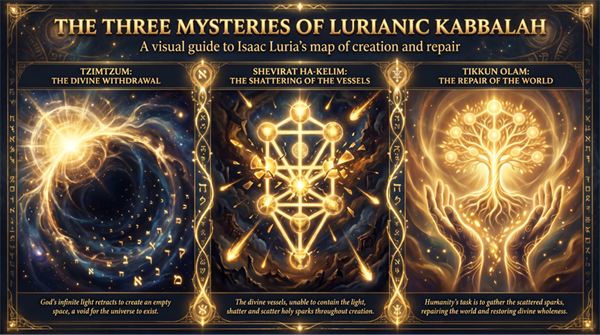
The first concept is Tzimtzum (Contraction).
There was only God’s infinite light (called Ein Sof). In order to allow for the existence of something besides himself, God would need to withdraw himself, thus creating an absence (a void) within His infinite being. During the act of creation, God contracted His being into a space where the universe could come into being.
Creation began not with an expansion, but with a withdrawal. God made space for us to exist.
The second concept is Shevirat Ha-Kelim (The Shattering of the Vessels).
The second major principle conveyed in Luria’s teachings is called Shevirat Ha-Kelim (”The Shattering of the Vessels”). When God created the void mentioned above, He sent a ray of His divine light into the void to create the physical universe. The ray of divine light was designed to be encapsulated in 10 spiritual vessels, called the Sephirot, but the heat or energy contained in the divine light was too great for the vessels to contain, and thus they fractured or shattered, and as a direct result of their breaking, their pieces (called “shards”) fell down to the lower worlds and created all of the “brokenness” we witness today in the world.
The third concept is Tikkun Olam (The Repair of the World).
Luria’s teachings on Kabbalah makes it clear that Kabbalah does not teach about despair, but rather liberation. Since the world is broken, due to the Shevirat Ha-Kelim, it is possible for it to be repaired through actions taken by humans. Since the sparks of divinity were trapped in the material world, it is our responsibility to free them through living ethically, praying and actively participating in the world. Through these three practices, we will gather the scattered shards of divinity and restore creation to its original harmonious state. To illustrate the three major concepts in Luria’s Kabbalah regarding how God created the world, the following visual representation of Luria’s creation map shows God’s act of creation and Tikkun Olam.
Why Luria’s Teaching Still Feels So Modern
The modern way of life has caused an enormous amount of change and transformation on nearly every aspect of the human experience except for one, which is how human beings experience suffering. As technology continues to advance, entertainment becomes more available, conveniences, and stimulation continue to increase, we have become so inundated with feelings of anxiety, discontent, jealousy, loneliness, burnout, and emotional turmoil than any previous culture documented.
Through continuous confirmation by society that an individual will achieve success by making the next purchase, attaining the next accomplishment, building the next relationship, or simply creating the next version of themselves.
However, it has been proven true that the individual’s mind will always desire to cling to something and will therefore be denied peace.
Because of the above phenomenon, even today, the teachings of Luria resonate with us, as his teachings are insightful and illustrate that although suffering is derived from the adversities and struggles experienced through life, a large portion of it is also caused by the fundamental brokenness of the world in which we inhabit.
This can be illustrated through everyday life. For example, if an individual has achieved a promotion that he/she has desired for a long time, it is not uncommon for that individual to begin to be consumed with fear of losing that position and status.
If an individual finally enters a romantic relationship that he/she has longed for, the individual may quickly become fearful of change, rejection, and abandonment.
If an individual is able to purchase an item that the person believes will bring the individual happiness, once that item is purchased, the individual will quickly realise that the happiness that was expected from the purchase is temporary and that the individual will now have a new desire that will replace the temporary happiness.
Luria identified this pattern. Human beings do not merely go through the experiences of life; they cling to, push away, and demand that the events in their lives satisfy those needs that they were never created to satisfy.
Therefore, Luria’s teachings provide more than just religion or spirituality; they also provide a foundation for everyday psychological needs, they are practical, and they are very much in line with contemporary views.
Three Kabbalistic Practices for Repairing the World
While a Kabbalist’s beliefs are important, Kabbalah represents a way of Acting. In today’s world, If Luria were alive, he would want us not only to see his cosmic map as an impressive diagram that he made, but to actually follow and apply it.
So, here are three ways to Apply these Insights:
1. The Practice of Tzimtzum (Making Space)
Consider how much space you take up during the course of a day. Observe the ways you use your space, how much you dominate in conversations, how many demands you place on other people, and how much you try to control a given situation.
When you are tempted to take charge of a situation, stop for a second and ask yourself this question: “Am I allowing others the opportunity to exist and thrive here, or am I taking everything for myself?”
You are acting like God during creation when you allow people to have their own space and to express themselves freely. You will help create an environment where people can grow, speak and be themselves, without constant intervention from you.
The goal of the Tzimtzum Practice is to increase your awareness, not to minimize your influence. By actively making space for others, you help empower them to be who they are, without your constant intervention and domination.
2. Finding the Sparks in the Shattered Vessels
At the end of the day, take a few minutes to think about a particular challenge or difficult person you encountered that day, a frustrating task, a conflict, or a moment of disappointment, all share the same purpose.
Think about this challenge or difficult person and ask yourself this simple question: “Where is the hidden Spark or Truth in this challenge?”
This question is based upon one of Luria’s greatest insights: we do not see the whole of ourselves (the broken shards) when we are suffering. The more often you seek out the hidden values, lessons, and opportunities that lie within our difficulties, the less you will view them as obstacles, and the more calmly, less reactively, and with greater awareness of reality, you will respond to the situation.
3. The Act of Tikkun (Intentional Repair)
The Path of Luria is not only an insight into how to treat yourself and others; it also shows you how to treat yourself in relation to the world around you.
During the course of your daily routines over the next week, select one moment when you would typically respond with mindlessness or arrogance. In this moment, try to stop and offer that action in the healing or order of the brokenness. If possible, try to speak softer than you feel, and listen longer than you want; release the urge to win.
The Kabbalistic response is to take the brokenness that all of us have and show compassion and patience towards one another. Therefore, each time you respond to others with understanding and compassion; you collect a Divine Spark of Creation, and Tikkun Olam will continue to grow and unite people in repairing the world once again through the Intentional act of Repair. Repair is more than just an “emotion,” it is the product of Discerned Consciousness, through a disciplined approach to our Inner Work; we now have the ability to create a harmonious quality of life, in our own homes, Families and Communities.
The Freedom Luria Achieved
Luria has many promises to share, including those related to the restoration of the universe; however, he does not promise wisdom (as this would not be true), but rather a reality beyond fantasy: that your actions have meaning throughout the universe.
Even though you will have feelings of grief for the loss of something you’ve lost, these feelings of loss won’t destroy you because you understand that the world and its ultimate “brokenness” exist due to the actions of individuals.
You still have feelings of suffering and/or pain; however, you don’t have to create your identity based on your suffering; in addition, you still have the same basic desires; thus, you have the opportunity to resist every individual desire.
You still live in an ever-changing universe; therefore, you don’t have to wait until your universe has changed before you experience a state of peace of mind.
It is over 400 years since Luria taught; however, Luria’s teachings remain true for people today. Human beings face struggles in their lives; and there are still fundamental similarities between Luria’s teachings and the experience of living today.
The Mystic who pioneered the concept of mapping the soul did not discover the world lacked value; he discovered that the brokenness of the world can only be restored by the conscious actions of an individual. Thus, for Kabbalah and its practitioners, the greatest challenge lies in the same promise offered by the original teachings of Isaac Luria.
The teachings of Isaac Luria begin with a broken world, but they do not stop there; the lasting lesson of Luria’s teachings acknowledges the ever-present possibility of living a life with clarity, restraint, compassion, and peace.
In a world filled with individuals seeking to acquire “more” of whatever material goods, wisdom, and/or power, Luria provided something of greater worth and greater scarcity than “more”; the ability to be whole without needing anything to be “whole” because you are actively healing that which is broken. Thus, in finding this ability to heal the brokenness of our world, you have found your own personal kingdom.
By Dr Ioannis Syrigos
Recommended Reading
Physician of the Soul, Healer of the Cosmos: Isaac Luria and his Kabbalistic Fellowship by Lawrence Fine
Major Trends in Jewish Mysticism by Gershom Scholem