


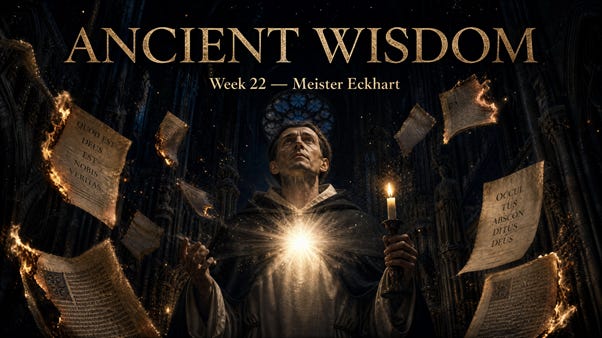
A Dominican monk appeared at the Inquisition in Cologne in winter 1327. He was not viewed as a rebel or an outsider, but rather as one of the most highly regarded theologians throughout all of Europe, who had been a professor at the University of Paris and was in charge of many monasteries. The things he had been teaching ordinary people in their native Germanic tongue were such an enormous threat to the Church but were also seen as so liberating, that the Church felt they had no other choice than to stop him from doing so.
His name was Meister Eckhart.
Eckhart’s “crime” was that he told people that they did not need to rely on the Church, the priests or even religion to connect with God. Rather, he taught that the same spark of God that created the universe also resides within the very spirit of every human. He famously stated,
“The eye through which I see God, is the same eye through which God sees me.”
Because of this, he has been tried as a heretic. The truths that he uncovered still remain among the most profound and practical spiritual teachings in the history of humankind.
This week, we will investigate the radical mystical teachings of Meister Eckhart. We will study how his teachings brought together the Western Religious Tradition and Eastern Philosophy, and how his belief in “letting go” has the potential to free you from a lifetime of searching for meaning and purpose.
Who Was Meister Eckhart?
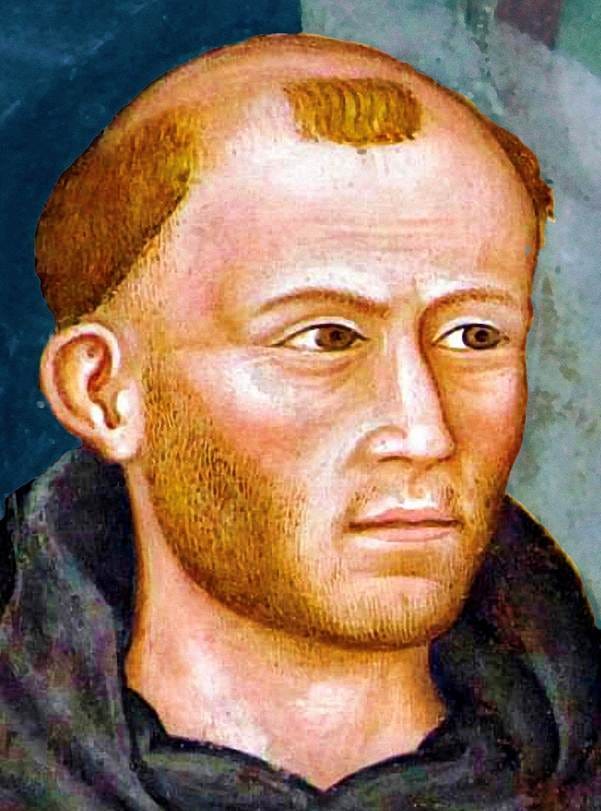
Eckhart von Hochheim, a German Catholic priest, philosopher, and mystic (circa 1260 – 1328), was born in the vicinity of Gotha, which at the time was part of the Holy Roman Empire. He became a Dominican monk at an early age, rising to the rank of Meister (Master) of Theology while studying and teaching in Paris, the center of medieval scholarship throughout Europe. Nonetheless, Eckhart believed that edifying knowledge should not be confined solely to the classroom, so he began to teach everyday people about God through his sermons delivered in their native German language. To accomplish this, he made complex religious ideas understandable to them by using the language of their lives; thereby, all human beings can experience and participate in the fullness of God today.
Eckhart’s insistence on teaching mysticism to commoners was viewed with alarm by the ecclesiastical authorities. In response, Archbishop of Cologne ordered an inquisitorial trial against Eckhart in 1326; however, he diligently defended himself, directly appealing to the Pope in Avignon. Although Eckhart passed away prior to a decision being rendered in his case, Pope John XXII, in a bull issued in 1329, condemned as heretical many of Eckhart’s statements.
Despite this condemnation, Eckhart’s teachings have continued to be disseminated underground through groups such as the “Friends of God” into the teachings of future philosophers, mystics, and more recently, the work of psychoanalyst, Carl Jung.
Eckhart’s Three Liberating Ideas
Eckhart’s philosophy is startlingly modern. It strips away the dogma and rituals of religion to focus entirely on the direct, unmediated experience of reality.
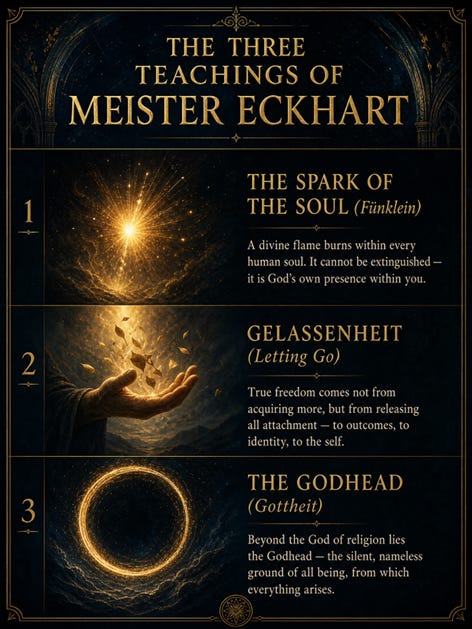
1. The Spark of the Soul (Fünklein)
Eckhart proposes that there is an aspect of our soul that is eternal and uncreated. He calls this aspect Fünklein or “the Spark” because it represents the point at which humanity and divinity are completely synonymous. Fünklein cannot be earned, prayed for, or become worthy of; rather, it is within you and exists in the very center of your being and is waiting to be recognized.
2. Letting Go (Gelassenheit)
Why does Eckhart say that we do not recognize our divine spark if it is already there? The answer he provides is that we are filled with ourselves. We are filled with our fears, desires, identities, and even our conceptions of God. Awakening does not involve acquiring more knowledge or virtue; it involves Gelassenheit, which is a German word coined by Eckhart meaning “letting go” or “releasing.” In order for the divine to fill our empty space, we must first empty ourselves, that means “letting go” or “releasement.” It is the practice of emptying yourself completely, so that the divine can fill the space.
3. The Godhead (Gottheit)
Eckhart makes a radical difference between “God,” the creator deity we worship, and the “Godhead,” which is the nameless, infinite, and silent ground of all existence. The God of religion is a construct of the human mind. The Godhead is the ultimate, absolute reality that transcends any conceptual thoughts we may have about it. To truly experience divine reality, Eckhart believes we must relinquish all preconceived notions of God: “I pray to God that he take away my concept of God.”
The Modernity of Eckhart’s Teachings
Eckhart’s teachings resemble the philosophical system of Zen Buddhism or Advaita Vedanta rather than those of Later Medieval Catholic Church. He understood that the ego is the source of human suffering; an individual constructs their identity based upon their ego and then spends their life trying to create more and more wealth, status, knowledge, etc., and accumulating all that will give him/her a sense of being somebody special or important.
Eckhart teaches us that this search for “meaning” or happiness through external accumulation and enhancement of ourselves is fundamentally misguided. We are searching for something that has always existed within us already; therefore, in order to have true peace, we must remove parts of the self that do not belong there. When we cease our efforts to create an ego-based existence and begin to experience our authentic selves (our empty “nothingness”), we can experience true connection to The Infinite.
How to Practice Gelassenheit Today
You do not need to be a medieval monk to apply Eckhart’s wisdom. Here are three ways to practice his philosophy in the modern world:
1. The Practice of Emptying
Observe how much time we spend creating distractions for ourselves during empty moments (e.g., scrolling through Facebook, listening to a podcast, and worrying about what will happen tomorrow). Take just one moment each day to practice “true emptiness.” Sit down for 5 minutes and empty the mind of all thoughts; do nothing. Do not try to meditate; simply allow yourself to exist without being anyone or going anywhere.
2. Release Your Attachments to Outcomes
Gelassenheit means acting without attachment to the results of your actions. When you create, work or serve others, do so completely but do not expect accolades or recognition from the actions you take. Eckhart refers to living “without a why.” If you act solely for the sheer joy of acting, you are acting out of the Divine.
3. Let Go of Your Labels
Our identities come from our work, our relationships, our political ideologies, and our past mistakes. These labels form a rigid prison for our souls. Work on releasing yourself from these forms of identification. Think to yourself, “If I am not my job, my thoughts, or my history, what is left?” What is left is pure awareness, the divine spark of the soul.
The Ultimate Releasement
The Church silenced Meister Eckhart because his teachings empowered the common person; to Eckhart, every person held the Truth inside them; they simply had to let go to find it.
In a society that keeps telling us we must search for meaning, acquire more, achieve more, and become more, Eckhart’s message transcends time and brings us relief by letting us realise that we do not have to seek out meaning or truth; we simply have to take time to still our minds, remove all distractions, and acknowledge the Divine Light of God that is within us all along.
By Dr Ioannis Syrigos
Recommended Reading
Meister Eckhart: From Whom God Hid Nothing by David O’Neal
The Way of Paradox: Spiritual Life as Taught by Meister Eckhart by Cyprian Smith