



We live in an age that demands proof: Did Merlin actually exist? Was King Arthur real? If not, the story goes, these legends are worthless. But what if this obsession with historical accuracy is causing us to miss something far more important? Here it is argued that the legend of Merlin represents humanity's last defense against a hollow materialism - a call to reclaim the imagination, wonder, and inner magic that our fact-obsessed culture has systematically suppressed. Discover why the wizard's greatest power has nothing to do with whether he walked the Earth, and everything to do with awakening what still sleeps within us all…
Approaching a subject such as lore about Merlin the Magician is to engage an old, old story that has been cast in poetry, history, music, art, and literature. Through it all is woven a story that has stood the test of time. A poet, an artist, and a musician engaged in an esoteric, enlightening discussion that offers them all a transcendent vision of the human condition may see the world and humanity’s place in it in a new way that seems somehow transforming. Not having the prosaic language to quite put their insight into words, they all resort to their own particular medium. The poet writes a poem. The artist paints a picture. The musician composes a song. The poem, the picture, and the song are totally different from one another, but they all produce similar feelings in their respective audiences because they are all based on the same, shared, transformative theme. They hope to convey an important insight.
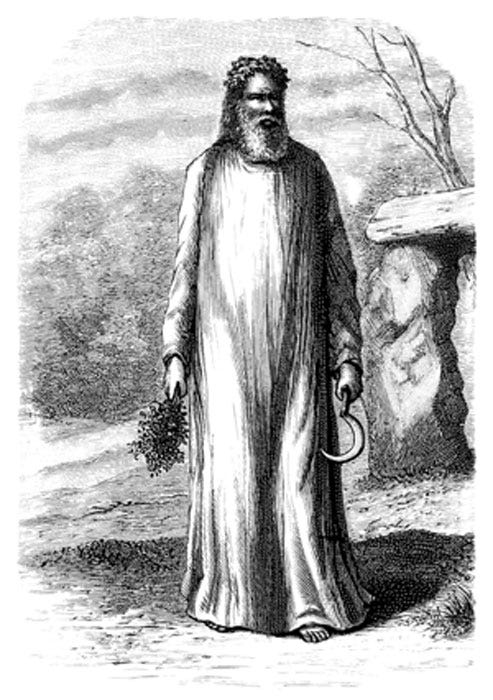
Merlin is More
Is the myth about Merlin based on a historical figure? Maybe. But probably not. Is Merlin a composite formulated from several people who lived in different geographical locations and different historical times? Maybe. But probably not. Are his actions based on actual events? Maybe. But probably not. Could he really produce magic simply by being Merlin? Maybe. But probably not.
Over the course of time Merlin’s importance has grown far beyond the motivations, methods, and deeds of any one man. It’s his story that is of eternal importance, not the historical relevance of his deeds. Sometimes religion is not enough. People need more. Sometimes scientific explanations are insufficient. People need more. Sometime mythological relevance doesn’t quite satisfy. People need more. Sometimes psychological motivation doesn’t do it anymore. People need more. Sometimes philosophical discussion falls short. People need more. Merlin has become the ‘more’.
Merlin vs Materialism
Today people live in a maddeningly literal age. Many have accepted the idea that if a character isn’t historical, he or she isn’t ‘real’. People have come to believe that if a historical Buddha didn’t live in India 2,500 years ago, Buddhism is simply an intellectual structure. If it could be proved that a historical Jesus did not walk the paths of ancient Galilee, Christianity would cease to be deemed viable. If Lao Tzu wasn’t a real person, Daoism is worthless. If Arthur and Merlin are not based on actual people, Arthurian studies are a waste of time.
Nothing could be further from the truth. But that’s what one gets when one chooses to follow only fact-driven, scientifically-minded, intellectually-reasoned, thought structures. Many people think that no other world view is possible. They are wrong. Merlin stands in direct opposition to that philosophy. He is an antidote to the sickness of materialism. His story is a plea for a return to the sanity of magic.
The current predominate world view is composed of a relatively modern way to understand reality. One is taught that if one cannot see it, taste it, smell it, feel it, hear it, or otherwise measure it, it doesn’t exist. That belief is called materialism. But things were not always subject to such a boring, so-called adult-focused, scientifically determined, fact-based approach to life. If one can open one’s mind to that ancient truth one will discover greater magic than can possibly be contained in any historical personage. When Merlin is freed from the shackles of a single historical character and no longer limited to scientific fact, he can fulfill the idea of ‘more’. Explanations are then insufficient. Only the work of poets, artists, and musicians will do.
The Power of Myth
When this truth breaks through and becomes apparent, no-one says: “I understand.” They say: “Ah ha! I get it.” One may not be able to put it into words, but one glimpses a transcendent reality beyond the ability of language to adequately express. This is the power of myth. It transports one to the land of ‘more’. It explains the power of Merlin the Magician. It also reveals the paucity of mental thought processes common to many people who were born and raised in the current intellectual age. One cannot condense transcendent reality to a few characters that will fit on a smart phone screen. One cannot dissect such things as love and compassion and look at them under a microscope. Yet people are willing to die for them. Who would be willing to die for something that doesn’t exist?
Existential truth is not always conducive to bumper-sticker-sized spaces. It takes patience, nuance, and understanding to move beyond surface reality into the mists of magic. Sadly however, magical attributes seem to have atrophied in today’s busy, techno-centered, science-based world. They can, however, be coaxed out of the crystal cave in which they have been imprisoned. Merlin didn’t live ‘back then’. He didn’t live ‘over there’. He lives in us, and our inner Merlin can yet be freed from its entombment. All it takes is a little imagination and intention. Then the magic can be released.

The stories that have grown up around the legend are more important than his physical life, if, indeed, he ever lived one. Merlin lore grew because the name Merlin became the focus for a greater reality. He is, and always has been since his inception, a means to express an inner truth that extends above and beyond language. The very word, ‘magic’, is so incrusted with linguistic baggage that it is almost useless these days. A few hundred years ago a horseless carriage was considered magical. The claim of turning on an electric light might have got one burned at the stake. If one insisted people could walk on the moon one would have been laughed of the village.
Nevertheless, stories about all those things were once told and enjoyed. Magic carpets, saying the ‘magic word’, and casting magic spells that provided entrance to magic kingdoms were common. All such notions would have been called silly if one stuck to the facts of science and a superficial, materialistic world view. Yet people did talk about them as long as they were presented in fantastic stories and fictional fireside tales. So who is to say that Merlin lore won’t someday prove to present a greater reality than is experienced today—a reality that one day might be taken for granted? And even if the outward magical mechanics don’t come to pass, the truths to which the stories point can help in many ways to illuminate the darkness of man’s humdrum lives by releasing the magic that still dwells within everyone, buried deep beneath the detritus of 21st century materialism.
Merlin lore is mythological lore, and mythology shows one how to navigate the perils of everyday activity. It tells us who we are and how we got here. It points to the paths wise men and women have already taken, and guides us into the experience of full human potentiality.
-vs-giants.jpg)
The Historical Lore of Merlin
Somewhere in the ninth century, in a time period purported to be: “the fourth year of the reign of King Mermenus, also called Merfyn Frych ap Gwiad, king of Gwynedd,” a Welsh scholar who called himself Nennius wrote a treatise called Historia Brittonum, or The History of the Britons. He claimed that his book revealed the history of the British people. In other words, he said he was writing about his culture’s identity and where they came from. Many scholars have since decided the work was a forgery, but in the long run, it doesn’t matter. The point is that someone, at some time, was asking the question, “Who are we and how did we get here?”
The date for Historia Brittonum is determined from the fact that in Chapter 4, Nennius says that: “from the Passion of Christ 796 years have passed, but from his Incarnation are 831 years.” So most historians who take Nennius seriously assume he wrote his book somewhere around AD 828.
He relates quite a tale and presents a history that would make the most conservative British citizen proud. Britain, according to Nennius, was first settled by people who escaped the battle of Troy, famous for such god-like characters as Helen, whose ‘face launched a thousand ships’, Achilles, whose only weakness was located in his heal, Odysseus, of the famed voyage following the battle, Ajax, and Hector, to say nothing of the Trojan Horse that figured so prominently in the defeat of the impregnable city.
One of the founders of Britain was Brutus, descended from Aeneas, whose father was a first cousin of none other than King Priam of Troy. It is from the name Brutus that the word ‘Briton’ is derived. This is the book that first mentions the young King Arthur. He is called a deux bellorum, a war leader, who famously fought 12 battles which united Britain during perilous times.
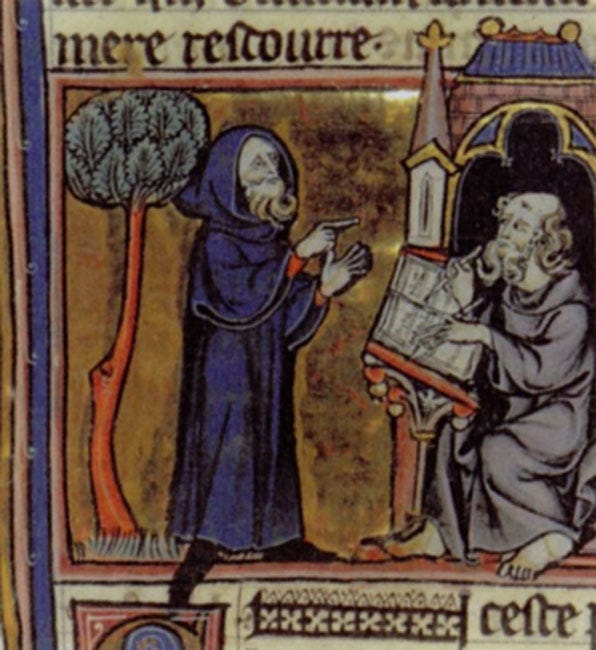
The reason Nennius’ Historia Brittonum is so important is because Geoffrey of Monmouth used it as his primary source when he wrote his classic Historia regum Britanniae, the History of the Kings of Britain, sometime between 1135 and 1138. This is the book that introduced the first version of the now familiar stories about Merlin Ambrosius, Uther Pendragon, and King Arthur. Geoffrey further developed the Merlin figure in his Vita Merlini, the Life of Merlin. This is the work that began the tradition of Merlin as a magician, a natural wild man of the forests, who possessed the gift of divination and the ability to work all manner of fantastic things, just by being Merlin. By the time of the 13th century this image had caught on. Robert de Borron wrote a romance called Merlin which turned an old Druid into a bit of a Christian prophet of the Holy Grail, the cup of the last supper.
Perhaps this was too big a swing to accept, because an extensive work called the Vulgate Cycle returned to an exploration of Merlin’s dark side. But by the end of the cycle, the wise court magician one has come to know and love is cast in the now familiar role of Arthur’s councilor and consultant to the Knights of the Round Table. Here we find the familiar stories of the sword in the stone and Merlin’s final demise at the hands of the Lady of the Lake, or Morgan le Fey, or Morgause, or Vivian, or any number of other dark witches, depending on whose account one reads.
His story is still being written, but what has finally emerged is a picture of a hinge figure—the last of one tradition and the harbinger of another:
• He closes out the age of the Druids as Arthur and his knights embody the triumph of mystical British Christianity.
• He is a sylvan man of wild forests that drip with mystery and magic, but he engineers the construction of Camelot, the archetypal city built on a hill.
• He represents an age of dark magic that gives way to a culture of shining light and virtuous chivalry.
• He rebuilds Stonehenge, the “Giant’s Dance,” but dedicates it as a symbol of light in the darkness.
• He sleeps in a crystal cave, but like Arthur, the “once and future king,” will re-awaken when he is again needed.
All this is to say that if one spends a lot of time trying to identify a historical figure named Merlin, one is apt to miss the big picture. What is important is the total story, not an individual man who might once have existed in Wales, or maybe Cornwall, or perhaps Scotland, or wherever else scholars have tried to find him.
.jpg)
Merlin in the 21st Century
Was Nennius an imposter? Is Geoffrey of Monmouth a credible historian? Did the Vulgate Cycle’s confusing, overlapping, and changing stories get it right? Is there any historical relevance to the mystical Merlin who still dominates the so-called ‘New Age’? Who cares? Those are interesting literary studies, to be sure, and assure the job security of many an Arthurian scholar. But of far more importance is what the stories mean. How do they apply to life in the 21st century? How do they relate to current times? How do they help us understand ourselves better? How do they help us live more fulfilling lives? To study Merlin the Magician is to study a mystery for the ages and unlock the magic that permeates every one of us. We know it’s there. It peeks out of its 21st century shroud from time to time and reveals its presence in déjà vu, dreams, out of body and near-death experiences, and daytime visions. It also is revealed from time to time in telescopes, microscopes, and the mathematics of theoretical physicists. In short, Merlin is alive and well. He is as relevant as today’s newspaper headlines. His story is our story, the story of the 21st century.
Top Image: The Magic of Merlin Source: denissimonov/ adobe stock
By Jim Willis
Sadly no longer with us, Jim Willis was author of nine books on religion and spirituality, having been an ordained minister for over forty years while working part-time as a carpenter, the host of his own drive-time radio show, an arts council director and adjunct college professor in the fields of World Religions and Instrumental Music. He is author of Supernatural Gods: Spiritual Mysteries, Psychic Experiences, and Scientific Truths and Ancient Gods: Lost Histories, Hidden Truths, and the Conspiracy of Silence
References
Bolen, J.S. 1989. Gods in Every Man. San Francisco, CA: Harper and Row.
Campbell, J. and Moyers, B. 1988. The Power of Myth. New York: Bantam, Doubleday Dell Publishing Group.
Stewart, M. 2004. The Merlin Trilogy: The Crystal Cave, The Hollow Hills, The Last Enchantment. New York: Harper Collins Publishers Inc.
Willis, J. 2004. The Religion Book: Places, Prophets, Saints and Seers. Detroit, MI: Visible Ink Press.
As John Michael Greer, Archdruid emeritus of AODA often says, a myth is something that never was, but always IS.
It is time for the return of Merlin—- to illuminate the threads that connect us- to form a new constitution and a new government