

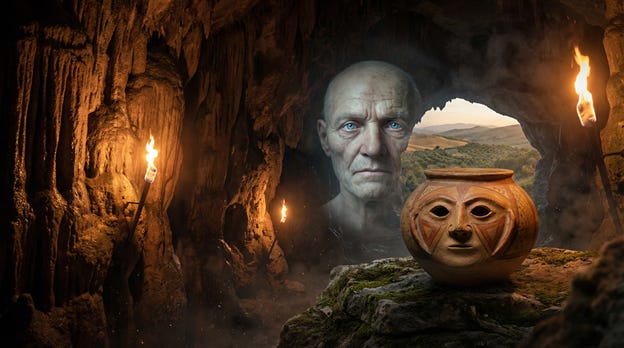
“From this we can conclude that all blue-eyed individuals are linked to the same ancestor. They have all inherited the same switch at exactly the same spot in their DNA.”
— Professor Hans Eiberg, University of Copenhagen
A DNA Revolution in a Hidden Cave
Deep within the limestone hills of Israel’s Upper Galilee, a forgotten world lay undisturbed for over six millennia. In 1995, a construction crew’s excavator accidentally punched through the roof of Peki’in Cave, revealing a breathtaking and eerie scene. Inside the cavern, stalactites hung over the skeletal remains of more than six hundred individuals. Their bones were carefully cradled in elaborately decorated ceramic ossuaries - burial boxes adorned with haunting, human-like faces and intricate geometric patterns. For 6,500 years, these people had rested in darkness, their true origins locked away in bone and stone.
The sheer scale of the discovery was unprecedented. With its chalices, bowls, and hundreds of ossuaries, Peki’in Cave represented the largest Chalcolithic burial site ever found in the Levant. Yet, the most earth-shattering revelation would not come from the pottery, but from the bones themselves. Two decades later, geneticists managed to extract ancient DNA from twenty-two of the skeletons, and the results sent shockwaves through the archaeological community. The findings fundamentally challenged long-held assumptions about ancient migrations, cultural evolution, and the very faces of the people who shaped early civilization.
These were not the dark-eyed, olive-skinned farmers who had cultivated the Levantine landscape for thousands of years. Astonishingly, nearly half of the individuals carried genetic markers for brilliant blue eyes - a trait virtually unheard of in earlier regional populations. In a land where darker complexions had dominated since the dawn of agriculture, these people possessed blond hair and fair skin. According to a groundbreaking 2018 study published in Nature Communications, this population was forged from a remarkable merger: local Levantine farmers had integrated with migrants from distant Anatolia and the Zagros Mountains of Iran. These travelers brought not just new genes, but an entirely new cultural framework that would revolutionize the Chalcolithic world.
