

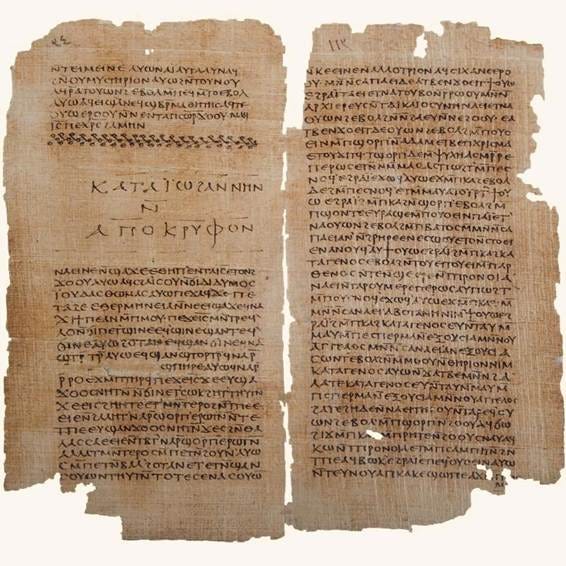
In 1945, an earthen jar was opened near Nag Hammadi in Upper Egypt. Inside were papyrus books that had survived for roughly sixteen centuries. They preserved more than fifty religious and philosophical works, many written by Christians whose ideas did not become the official faith of later churches. But you know that already, we have published many articles on the topic. However, what you don’t know, is that among them were three copies of a revelation that had almost vanished from history. A fourth copy had surfaced decades earlier in Cairo, but wars, accidents, and scholarly delays kept it from public view. The work is now called the Secret Book of John, the Secret Revelation of John, or the Apocryphon of John.
Its claim is more unsettling than the discovery itself. The text does not say that God failed to make a perfect world. It says that the being who made this world was never the highest God at all. He was an ignorant ruler who mistook borrowed power for absolute authority.
And do not confuse this with an argument of an outsider mocking Christianity. The book presents itself as a private teaching given by the risen Christ to John. It retells Genesis from inside an early Christian struggle over creation, suffering, authority, and the identity of the human soul.


