


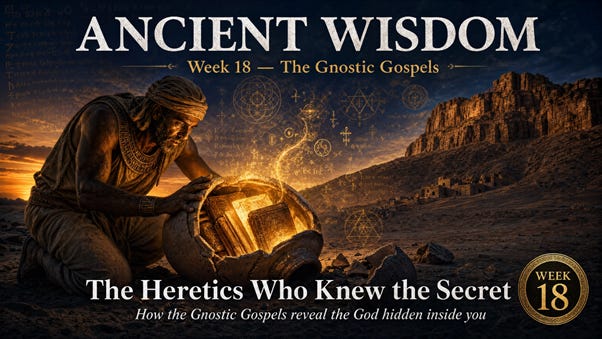
There is a vast spiritual movement that arose during the earliest years of Christianity that was conducted in secret, which created impressive, yet illegal texts that produced a very different form of salvation than the Jewish, Roman, and all other orthodox teachings had ever produced. This movement is called Gnosticism and consisted of many different groups of early Christian mystics and philosophers who sought concealed or hidden knowledge from within themselves.
They were spiritual revolutionaries living during the most crucial period of the formation of the Christian Church. When the Gnostics lived, the orthodox authorities were developing strict dogmas and hierarchical structures with the intent of providing a literal interpretation of the Holy scriptures. The traditional responses to the problems of suffering in the world were no longer adequate for these seekers, so the Gnostics devised a radically different concept of God. The Gnostics not only strove to seek explanations for why we suffer in this material world but, moreover, sought to direct us toward an understanding of our own true, pristine origins as divine beings.
As a result of their journey, the Gnostics ultimately created one of history’s most intriguing lost chapters, which has provided a connection between the early Christian teachings and overwhelming mystical insight. This week, we will travel back to Egypt, where a discovery in 1945 revealed a vast library of underground writings that contain the answers to the essential questions regarding humanity’s divinity, the Gnostics derived this understanding through self-knowledge and spiritual contemplation of the soul, and through these explanations thereby created a path to attain tremendous spiritual awakening.
The Problem the Gnostics Did not Ignore
In their time, most traditional theologians were focused on obeying the Church’s dictates, having faith in a distant, judgmental Deity and on human beings as a whole being sinful. The Gnostics began with an expansive subject matter that many of their peers avoided throughout their lives due to its frightening yet majestic characteristics: the material realm was irrevocably flawed, but the human essence, or soul, is divine.
There is comfort in believing that the world was created perfectly by a benevolent God, that suffering is simply a test or punishment for sin, and that salvation comes from external authorities. There is a deep-seated need for closure, safety, and guarantee; we yearn for the convenience of a system of simple rules/routines by which to live a spiritual existence. Even the most learned individuals within the Early Christian Church believed that God remains wholly separate from humanity and exists solely above them with authority over their lives.
It is easy to see now why the first tenets stated within the Gnostic theology that this damaged material realm is not the work of the one true God who created everything, but rather a benign, uninformed being whom called forth this world.
While these Gnostic philosophies appear vague and confusing at times, they were not intended to foster feelings of despair, instead honestly depict the state of humanity’s plight.
While they argue that life has no meaning, they simply assert that individuals must not cloister their individual experiences of suffering or wickedness within the context of a cosmic divine template. Many of the interpretation lenses that we utilize today, whether found within the books of the Bible, read through religious orthodox authorities or in the self-blaming nature of ourselves, have been misinterpreted; thus we create chaos within ourselves when searching for a strict and closed definition of our Universe. The universe is vast beyond our comprehension and, therefore, is a deceptive manner in which we maintain separation between ourselves and the true God; likewise, the belief or hope of being saved or healed from being deceived cannot be exacted until we wake up to this reality as humans.
Life is subjective and we live in an ever-changing, boundless spiritual reality, yet our minds continue to demand permanence and external salvation from the environment. This demand causes suffering and ignorance.
The Gnostics did not invent the concept of inner divinity; they chose to acknowledge the fact that there is such a thing as a divine spark within us and therefore dealt with it.
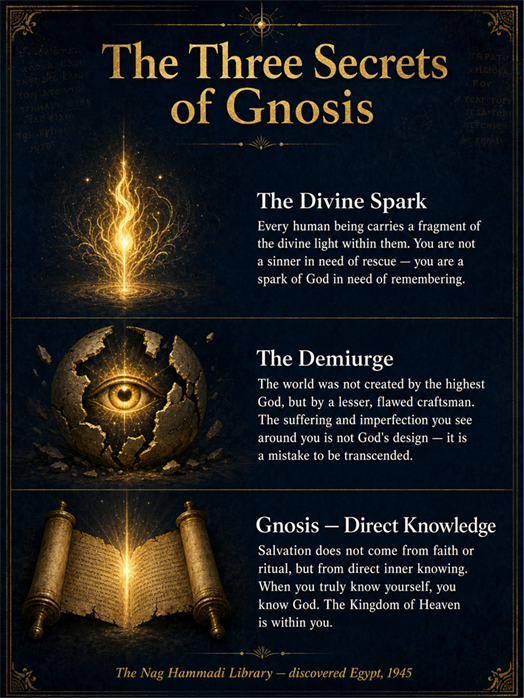
The Three Secrets of Gnosis: A Radical Diagnosis
The esoteric theology of the Gnostics is said to be their greatest achievement. By diagnosis, they described the human condition as ignorant, and they provided an escape route from the shackles of ignorance to attain the divine existence within themselves.
The first concept is The Divine Spark.
In the traditional Jewish/Christian view, humans were created out of sin and separated from God due to the Fall. The Gnostics believed that every person possesses within them a piece or fragment of the highest true God - that is to say, they believed that every person contains a divine spark, or a “pneuma.” Because the true God is pure light, and because the soul has been created from that pure light, every individual soul is, itself, also divine. There is thus no one person or thing that may not be reconciled to the divine. You are not separated from God, nor are you required to be saved by an external entity; instead, you are a piece of the divine light that has lost its way.
The second concept is The Demiurge.
The Gnostics, looking into the world surrounding them, saw the cruelty and imperfection of the world, and therefore determined that the world was not created by the supreme and loving God, but by a lesser being who they called the Demiurge - and their demiurge is not only ignorant, but is also sometimes malicious in his actions. The Demiurge believes himself to be the one and only God and demands absolute obedience; but in actuality, we owe our allegiance not to the demiurge, but to the transcendent God of light who resides beyond the world of matter.
The third concept is Gnosis - Direct Knowledge.
This is the primary focus of the Gnostic teachings. The Gnostic philosophy does not profess that salvation comes through institutionally enforced faith or ritual, rather, salvation comes through gnosis - a direct experiential knowledge of the divine. If, as the Gnostics state, the divine spark exists within you, then salvation cannot come from outside of you. “For he who finds the interpretation of these words will not taste death,” proclaims the beginning of the Gnostic Gospel of Thomas.
The ultimate master mystic has not a separate existence from God, but rather, the master mystic is interwoven into the fabric of the divine - and they achieve liberation by awakening to their true nature, which is, the divine.
Why Gnostic Teaching Still Feels So Modern
The evolution of civilization has influenced every facet of human experience, including how we now perceive the early history of Christianity.
With increasing institutional distrust, interconnectivity, and the rise of personal spirituality, there is a greater level of feelings of alienation, existential questioning, and a craving for authentic experiences than ever before in recorded history.
This has led to society’s continual reassurance that certainty will be achieved by adhering to rigid external authorities, tribal identities, or seeking material success.
Yet, it is evident that human minds desire to have something absolute to hold on to, and the human condition is always searching for that in a world where everything continues to demand attention.
This reasoning explains why individuals today are so strongly connected to the Gnostic teachings of their time. The Gnostics’ belief that suffering is largely due to our unwillingness to look within ourselves for the divine, as well as our reaction to the difficulties and struggles we encounter in life, provides a useful insight.
This is also demonstrated in our daily lives.
In general, when a person experiences a spiritual crisis, they will often respond with defensiveness and attempt to validate their perspective by relying more heavily on external rules or abandoning the spiritual component altogether.
When faced with an overwhelming amount of institutional failures in today’s world, people will usually feel a sense of fear resulting from meaninglessness, and many choose to retreat into narrow-minded and dogmatic ideologies.
Along the way, they will build a rigid system of identity by claiming to be “saved” or “enlightened” through something external to them, only to have the obvious truth of the diversity and complexity of their own inner world continually question that belief.
The Gnostics addressed this issue. Humans were not only witnesses to the experience of life; they were active participants who created barriers, thoughts, and limitations based on their perception of the universe as being a reflection of their rigid, externally-focused beliefs regarding the nature of salvation.
As such, Gnostic Philosophy is more than simply an interesting artifact of historical significance; it continues to hold valuable psychological and practical implications and applications with great relevance to modern life.
Three Practices for a Gnostic Mind
The core essence of Gnostic philosophy is not what somebody believes with all their heart but how they apply it to their lives. If the Gnostics were alive today, they would tell you that it is not enough to just admire the secret writings; instead, they would want you to use these texts in practice, just as they did. Here are three ways to start applying your Gnostic knowledge and beliefs:
1. The “Divine Spark” Reflection
When you go through your daily routine, take notice whenever you have a moment of self-doubt, shame, or feel the need to assign blame or judgement to yourself. This could happen when you think of a mistake you made, think back on a personal failure, or feel as if you were going to be “punished” for something you did.
When you experience an urge to label yourself as broken, pause before taking action and ask yourself,
“How can I see that within me lies a pure unblemished Divine Spark?”
At this point, you have now started to develop the Gnostic shift in your consciousness. You have moved your ego’s self-condemnation to the side and substituted the space for compassion for self.
To clarify, this practice is not intended to discredit your need to grow; it is simply to help you see that the illusion of feeling fundamentally unworthy has less power over you than before.
2. The “Illusion of the Demiurge” Practice
At some point each day, think about what the material world requires of you and ask yourself this:
“Is my ultimate devotion to a flawed system or is my ultimate devotion to something greater and more eternal than myself?”
The Demiurge, as you may have heard it described, is not limited to being a false god; rather, it describes the influences in an individual’s life when he or she fails to acknowledge that the material world is not the primary reality. The more an individual takes time to think about how society places unrealistic demands on them, the more they can dissolve the illusion of society’s success. An individual who realizes this will be better equipped to deal with stress and anxiety in their lives.
3. Seeking Direct Knowing (Gnosis)
The Gnostic path is not only about intellectual insight but also about how you relate to your own inner experience.
When you are going about your daily tasks this week, choose one moment in which you would normally look to an external authority - like a book, a guru, or societal consensus - for an answer to a deep personal question. Instead, pause and look inward with the understanding that the truth is already accessible within you. Let go of the need to look for validation only from outside sources.
This response is a Gnostic view because we are all part of an infinite, living spiritual reality, and that truth does not stay contained in rigid institutions. It spills into our immediate inner experience, into intuition, and into the present moment’s quiet knowing. Thus, every time you break the chain of external dependency and begin to respond with trust in your own inner light, you connect with the power of gnosis, and that is how Gnostic awakening works.
Gnosis is not just a “feeling”; gnosis is the disciplined, conscious decision to seek the divine within yourself.
The Freedom the Gnostics Achieved
Although the Gnostics offer many promises of an inner awakening, they do not present it as easy to attain or as accepted by the mainstream. They promise something greater than the acceptance of orthodoxy: the total liberation of your soul. You will encounter many obstacles along your journey; yet, your awareness will expand to a degree where external judgment will no longer hold you captive in fear. You will continue to experience times of constriction while still physically manifesting within a material reality. However, in those moments, you do not need to create an identity based upon your circumstances. You will exist within a culture of conformists, and therefore, do not be entrapped by your understanding of confinement.
Additionally, you will reside in a dynamic reality; thus, you will not have to wait until someone creates an external solution before you are able to access the freedom of divine connection directly.
It has been over 1,600 years since the Nag Hammadi library was placed in a lost state in the deserts of Egypt; the teachings contained within still reflect truth today. Human beings still wrestle with feelings of worthlessness and dependence upon external validation, but the fundamental law of the universe remains: within every human being exists a spark of the Divine.
The heretics who understood that this secret was obtained not out of arrogance but rather through their recognition that there was no possible way for an individual to be inspired through a dogmatic belief. The challenge and the promise of Gnostic philosophy resides in the recognition that the physical realm is flawed.
While the Gnostic philosophy begins with the frightening realization of a flawed material world, Gnostic philosophy does not conclude at that point. Rather, it concludes with the understanding of the potential of an individual to live a life filled with spiritual courage, unlimited spiritual growth, and the ability to create a profound relationship with the unseen God. The Gnostics provided a great deal more than just the opportunity for a person to find their external saviour to discover their own Divinity.
The freedom from the need for an external savior in order to find your own divinity.
Therefore, if you are able to find this freedom from the need for external salvation, then you have found an eternal kingdom of your own.
By Dr Ioannis Syrigos
Recommended Reading
The Gnostic Gospels by Elaine Pagels
The Nag Hammadi Library in English edited by James M. Robinson