


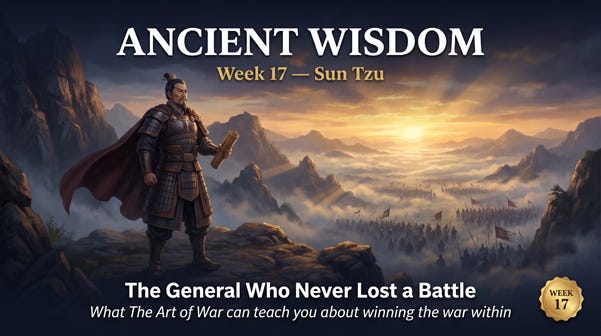
Sun Tzu is one of the most well-known military figures in history, yet instead of being remembered as simply a prophet, king, or empire challenger, he is recognized as a strategic mastermind. Sun Tzu was born in 500 B.C., and lived during the Warring States period, a time when China was divided into many different states that constantly fought with one another; the combat normally involved large armies. Although Sun Tzu lived at a time when the traditional methods of warfare were no longer feasible, instead of following the old ways, he developed a completely new concept of strategy and tactics that would eventually be the foundation of an entirely new system of warfare.
Sun Tzu’s ultimate goal in life was not just to find ways to win his battles, but to develop a way for mankind to better understand the idea of victory itself. The work that Sun Tzu created in this pursuit would go on to dramatically change the way all future generations approached warfare, as they would eventually incorporate the philosophies of Confucianism and Taoism into their understanding of strategy and tactics. By taking the military knowledge he gained through observation and thoughtful contemplation of military strategy and turning it into a philosophy, Sun Tzu has given us a new understanding and a pathway to the achievement of intellectual and emotional mastery.
What Sun Tzu Refused to Ignore
The approach of most commanders during his time was to gather armies as large as possible, build walls as thick as possible, and then to storm head first into the most bloody, and destructive battle with all that they had. The premise for Sun Tzu was to begin where his contemporaries would only ever avoid as it was so far beyond their comprehension, in the fear-inducing, awe-inspiring reality of being able to achieve victory without fighting at all.
This belief in victory by purely physical means is comforting; we want to believe that the hardest working and longest fighting people will always be victorious, and that all forms of conflict will be a direct competition of wills that will be entirely consumed in energy and effort. We crave the certainty, security, and straightforwardness of speedy resolution. We wish for our issues to have a simple enough solution that we can easily overcome. So, even the most educated individuals of Sun Tzu’s time still clung to this idea that warfare was simply a numerical game of courage and fortitude.
Therefore, when Sun Tzu makes the first accurate statement of his philosophy, that the study of military operation is a matter of life and death and must be treated with the utmost seriousness and not with the goal of increasing the number of lives lost to fight more, but the extremely limited objective of fighting less. And here is where this statement is going to seem contradictory to his contemporaries. It is going to generate confusion and disorientation for them.
While this does sound contradictory and confusing, Sun Tzu is not trying to promote a passive philosophy. Sun Tzu is simply trying to communicate the truth.
What he is saying is that there is merit to effort, but we cannot find meaning in life simply through the idea that we are supposed to smash our way through all obstacles. The direct assaults we make on the world in arguments or in competitions in the workplace or against our own bad habits are not true progressions. Victory over the world will not occur because we need it to fit neatly into a narrow window within a defined time period. The world is constantly shifting around us, the adversary is always changing, and therefore, the conflict could go on for an indefinite period unless managed with the greatest possible wisdom.
Sun Tzu’s Three Liberating Ideas: A Radical Diagnosis
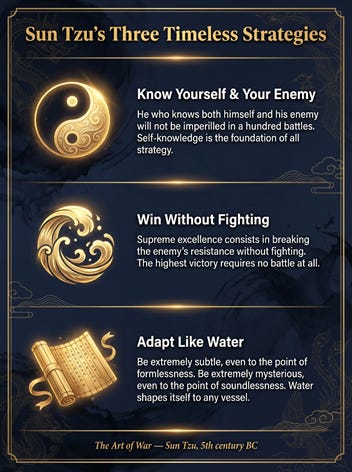
Sun Tzu’s major discovery is referred to as his strategic philosophy. These concepts are a diagnosis of the state of human ignorance, and a route out of our strategic shackles…
Know Yourself and Your Enemy.
This first idea was proposed by Sun Tzu; prior to him, people believed they had sufficient knowledge of themselves in order to act effectively against another. Sun Tzu noted that knowing yourself is usually insufficient. “If you know both yourself and your enemy, you need not worry about the outcome of a hundred battles.” Since conflict exists in relation to one another, any strategy created by the commander must likewise be created in relation to one another (relative, not absolute). Each person’s “relative strength” will depend on a thorough understanding of both the things that could trigger that person (e.g., flaws, strengths) and to identify fully who or what is in your way.
Win Without Fighting.
Sun Tzu looked at this chaotic stage from a point of view to understand war as a waste of all possible resources. He stated that “the greatest general accomplishes their mission by rendering the enemy’s plan (e.g., strategy) completely ineffective, through their actions. The second-best is to interdict the connection between the enemy’s units; and the third is to attack the enemy’s army on the battlefield. Thus the second quote states, “to attain supreme excellence means to overcome the enemy’s resistance without engaging in combat.” We are not required to exhaust ourselves in direct confrontation; true mastery is dismantling the problem before it even becomes a fight.
Adapt Like Water.
This is the primary point addressed by Sun Tzu’s teachings. The teachings do not discuss a rigid, set-in-stone way of doing things, but instead refer to an active, living “adaptability.” Because of the constantly changing nature of the surroundings or battlefield, a strategy cannot remain steadfast, but instead it’s required to “flow” with the changes in the environment to create the most successful approach. “Military methods look like water; they flow down and flow into empty spaces, just like water.” To be effective in an environment, the master strategist must recognize that they are not separate from their environment; they are part of and truly flow through the environment.
Today’s relevance of Sun Tzu’s Teaching
Our civilization is changing all aspects of human experiences. Modern technology, international trade, and increasing competition have led to an unprecedented increase in stress, conflict, and ideological opposition than any other culture in history. Members of our modern society are encouraged to believe that they will gain certainty only through following a rigid plan, working harder than others, or through the illusion of brute-force manipulation.
However, it is evident that every person wants to gain that which is known to be the absolute truth so he/she will never be at peace within a universe that is constantly changing.
This phenomenon illustrates why everyone today can relate so closely to Sun Tzu’s words. Sun Tzu teaches that the pain we endure from hardships and struggles we experience in our life are also created by the inability to accept the ever-shifting fluid nature of the world and the importance of developing strategies.
Daily experiences validate this idea.
When a person is faced with the difficulties of a coworker or struggles within themselves, often the immediate response will be to react defensively and forcefully by giving a perspective they have formed about it through intense argumentation.
A person may develop a fear of failing in the vastness of their professional environment by becoming rigid, repetitive, and narrow in their habits of working.
A person creates their identity around being “the strongest.” But in reality, they are continually challenged by the many sides of the world. Eventually, they will reach a point of total burnout.
Sun Tzu noted that we do not simply experience life. We behave as though we are attached to, repulsed by, or are demanding that the universe behaves according to our limited, rigid vision of how to fight a “battle.” Sun Tzu’s wisdom does not just apply to military tactics; it also applies to psychology, practicality, and our daily lives.
Three Practices for a Strategic Mind
Sun Tzu professed that a practitioner develops power through the practice of the philosophy rather than just by believing in it, which makes it more powerful than the philosophies of many others. If Sun Tzu were alive today, he would want us to put the concepts that he has illustrated into practice, not just admire his strategic abilities.
Here are a few ways that you can start implementing Sun Tzu’s concepts:
The “Information First” Reflection
Every day, consider whether you assume that you have enough information to act while in an emotional state (such as being angry or frustrated) during an argument, a decision about a challenging project, or judging how another individual “should” behave.
When you find yourself wanting to attack the issue immediately, take a moment to pause and consider this question:
“Am I acting with complete knowledge of myself and the other party involved, or am I acting on an assumption?”
When you do this, you are following Sun Tzu’s strategic model of “strategically pausing” to gather additional information before acting. The objective of this new practice is not to provide you with a way to dismiss your feelings but to create awareness of when you are being led by an illusion of complete knowledge that holds you hostage and traps you in making a mistake.
The “Path of Least Resistance” Practice
At the end of each day, think about how much friction you have encountered that day. The struggles that Sun Tzu describes are not limited to only the physical realms of war, but also include the internal battles and disagreements that we face every day.
Whatever challenge you may be facing today, ask yourself:
“Is it possible for me to see a non-direct and less taxing way to tackle the issue?”
This question is the crux of one of Sun Tzu’s greatest lessons about how we create our own stress and burnout by looking only for direct confrontational solutions.
If you consistently question how many options exist other than the direct confrontation, you will create a space in your mind where accepting that you could choose to do nothing is a much more viable option. The ability to think about several options regarding how to face obstacles will create more peace of mind, not only by allowing for greater calmness and lower reactivity but also through a reduction in time spent being frustrated over how to best have tackled the challenge.
Seeing the Fluidity in the Ordinary
The first point is that Sun Tzu’s teachings relate both theoretically and practically to how to relate with an external world that is constantly changing around us. As I go about my week, if there is an instance where I would typically get frustrated over an interruption of the day-to-day tasks I am completing, I am choosing to stop to apply the idea that this is an opportunity to always “flow” through my plans and adjust to my surroundings.
Adaption does not mean that you have to give up on your goals or dreams, because it could happen if the forecast were not perfect.
As long as we recognize that victory is not limited to rigid concepts, we can adapt to changing conditions. By continuing to work through rigid thought patterns, we can manage ourselves with the same flexibility and grace as water. This flexibility is a reflection of the strategic ability of Sun Tzu, meaning that adaptability is not an issue of just “feeling,” but a commitment to discipline your mind to become part of your reality.
The Freedom Sun Tzu Achieved
While Sun Tzu provides many promises like a life of mastery over strategy, his promise is not an easy one. His true offering is not only through effort, but rather through the complete liberation of the mind from superfluous strife. You will still encounter adversity; however, with your expanded perspective, direct confrontation will not cause you to be overwhelmed.
You will never be without the difficulties of your life; however, as such, you need not create a stereotype of yourself based upon that struggle. You will continue to exist in a society in which brute force is favoured; therefore, you need not become engulfed in a strategy to imprison yourself.
You will exist in an environment where the external conditions and structures are in constant flux; therefore, you need not wait for external conditions to stabilise in order to experience the freedom of fluid adaptability.
It has been over two thousand five hundred years since the time of the writing of the book The Art of War by Sun Tzu. The truths taught by Sun Tzu still apply to us today. They continue to encounter both rigid thought patterns and the continual dramas of needless strife; however, the fundamental behaviour of the universe will continue to reward individuals who strive to adjust and adapt.
The general who never suffered defeat was not the most powerful, but rather he proved that the security of brute force would never conquer the inherent natural desire of human beings for the greatest effortless level of excellence.
This is the true premise of the challenge involved with the philosophy of Sun Tzu and the true promise provided by his philosophy.
The teachings of Sun Tzu start with the terrifying reality of life-and-death conflict. But concluding with an awareness that every human being can find within themselves the potential to live their life with strategic courage, with boundless adaptability, with a profound connection to the flow of reality. In a world that is constantly trying to build stronger barriers and create more fierce battles, Sun Tzu’s philosophy provides something of enormous value and importance, superior to traditional brute strength:
The freedom from the need to fight in order to find your victory.
Thus, if you are able to achieve the freedom to obtain success without conflict, then you will create your own invincible territory.
By Dr Ioannis Syrigos
Recommended Reading
The Art of War by Sun Tzu (Translated by Samuel B. Griffith)
Mastering the Art of War by Zhuge Liang and Liu Ji (Translated by Thomas Cleary)