


As per your request for articles with practical applications of ancient knowledge in our modern lives, each Wednesday, we will be releasing our new “Ancient Wisdom“ series. In this series, we will explore the lessons learned from great civilizations of the past, from all over the globe. We will focus on how that wisdom applies today to help improve our lives.
So let’s this journey begin …
It is easy to see how the anxiety and uncertainty in our day to day lives can feel like a never-ending struggle between our many responsibilities and the overwhelming distractions surrounding us. Many times, we feel powerless to change our circumstances. But what if the key to creating an unbreakable shield against this chaos is not through some new form of technology or technique, but rather through the wisdom gained during one man’s lifetime centuries ago? A man who, during his time, was one of the most powerful and respected leaders in history.
This is the story of Marcus Aurelius, the last of the “Five Good Emperors” of Rome, and of the teachings of Stoicism, which influenced his journey.
The Philosopher-King on the Battlefield
Marcus Aurelius ruled from 121-180 CE. He wasn’t a philosopher studying in an isolated school; He was an emperor and spent most of his life fighting wars on the battlefield, fighting off disease, and dealing with the burdens of ruling over a huge empire.
Marcus used the quiet moments between fights to write down all his thoughts. These were not originally intended to be published; They were private notes written to himself. This collection of notes eventually became known as “Meditations”.
He wrote his notes in Koine Greek (the language spoken in Rome during the time of Christ). Originally, “Meditations” were not meant to be shared with anyone outside of Marcus’ immediate circle. Instead, they served to provide Marcus guidance, direction and a way to practice Stoicism (the ancient philosophy started by Zeno of Citium in Athens) on a daily basis. “Meditations” show us many of the same struggles the modern world faces today. For example, What brings you satisfaction? How do you handle disappointment and loss? And how do you achieve a meaningful life?
The Stoic Toolkit: A Guide to the Good Life
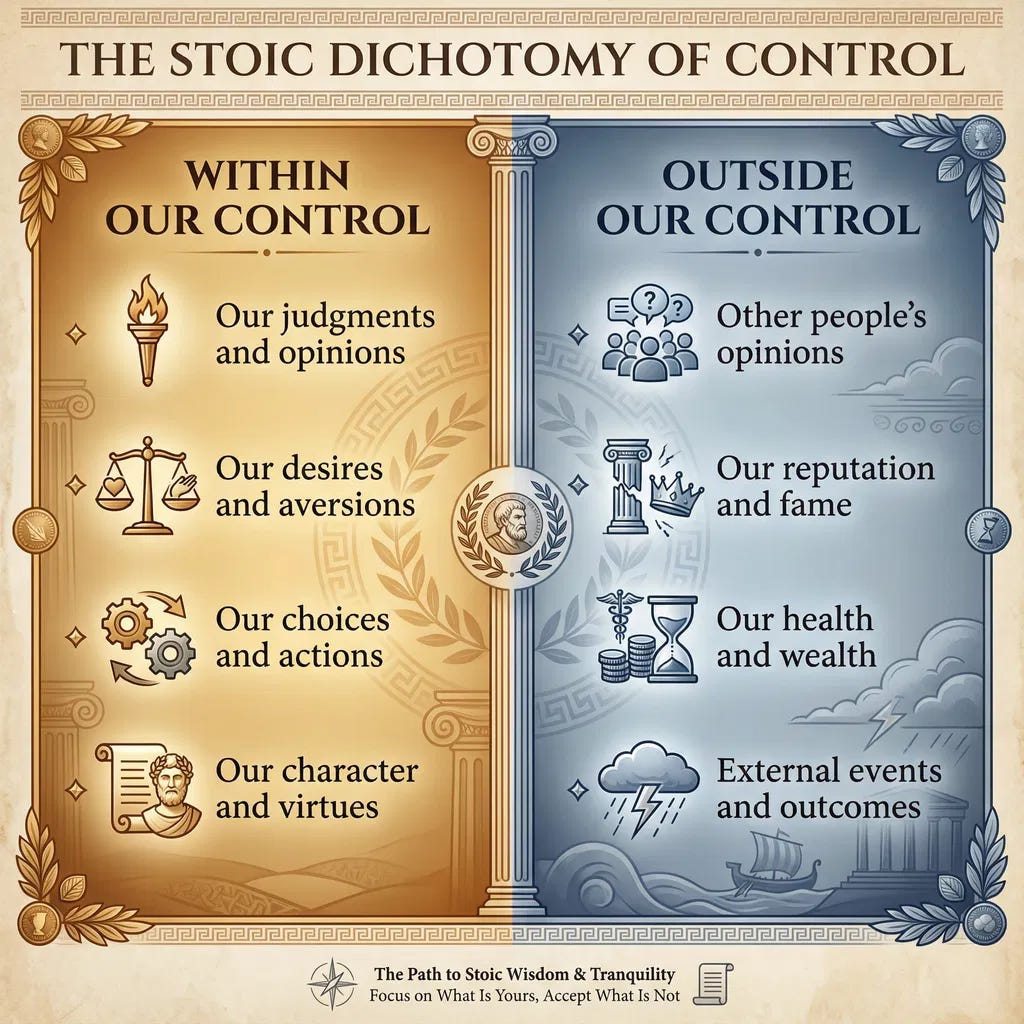
The essence of Stoic philosophy rests on the idea that we have zero control over what happens to us (through events), but 100% control over how we respond to events, that is, how we think, feel, react. This principle is called The Dichotomy of Control; and, it was made popular by Epictetus, one of the early Roman Stoics, who said:
“Some things are up to us, and some things are not. Up to us are opinion, impulse, desire, aversion, in short, our own choices and how we respond to life. Not up to us are our body, wealth, reputation, and most events in the world around us.”
By following this one principle of The Dichotomy of Control, we have the opportunity to alleviate our anxiety related to external factors/events that happen in our lives. According to the Stoics, it is not necessarily the circumstances that are responsible for our suffering; rather, the way we reflect on those circumstances and our interpretation of them creates the pain. A good example of this would be a person experiencing a traffic jam. The traffic jam itself does not make a person feel anxious. Instead, it is the individual’s interpretation of the situation as a ‘disaster’ that creates the elevated blood pressure and releases stress hormones. By concentrating entirely on what is under our control, we can experience a state of inner peace (apatheia) and calmness irrespective of situations “outside” ourselves.
Ancient Wisdom for Modern Problems
Stoicism and the teachings of Marcus Aurelius can provide us with the tools to cope with today’s difficulties and challenges.
Taming the Anxious Mind
Today’s world is full of anxiety. One way to calm an anxious mind is by using the Stoic question: “Is this within my control?” If the answer is no, then you should not waste any of your energy worrying about it. If the answer is yes, you should focus your energy on being proactive and taking action instead of worrying.
Building Resilience in a Chaotic World
Stoicism is not about irrational optimism or unreasoned positivity. The Stoics did not claim the future was going to be great; rather they said we will have to be prepared for whatever comes our way through premeditatio malorum (the premeditation of evils). This technique involves considering every possible negative outcome from the situation at hand and allowing yourself to consider each negative possibility before going forward in preparation to be able to withstand the most undesirable. By considering the worst possible outcome in advance, the negative aspect of that outcome has less of an emotional hold on us than if we had not taken the time to prepare for it. We develop psychological resiliency to face any challenge with courage and grace!
Finding Meaning in the Mundane
According to the Stoics, living in accordance with the natural order and cultivating virtue was the ultimate goal of life. The Stoics believed that each of us has our own specific contribution to make to the universe, through our own unique talents and abilities, and thus we all are obliged to make our contributions to the universe as best we can, regardless of how small they may seem at times. When we focus on being good people by developing the virtues of honesty, justice, courage and wisdom in every facet of our lives, regardless of how mundane or trivial they may seem to be, we can find deep and abiding meaning and value even in the most mundane and ordinary aspects of our lives.
Practical Stoic Exercises for Today
1. The View from Above
In moments when you feel like you are lost in your medical, financial, or emotional problems, attempt to engage in a visualization exercise where you float from your body to the air above your city, country, and the world. From this distance, the perception of how much of a burden your issues are will be evident. This exercise, often mentioned by Marcus Aurelius, helps to cultivate a cosmic perspective and put your troubles in their proper context.
2. The Stoic Journal
At the end of the day, dedicate time to ponder over your actions. What did I do right today? What did I do wrong today? How did I react to things that were not within my control? This reflective practice is a powerful tool of improvement. The feedback you will receive from this practice will help you strengthen these Stoic principles.
3. Negative Visualization
Take some time each morning to think about the impermanence of everything. Think about what would happen if you lost all of the people and things you love. This is not meant to be depressing, but rather to provide you with a greater appreciation and gratitude for your loved ones and possessions while you have the opportunity to enjoy them.
Marcus Aurelius’ Legacy
In 180 CE, Marcus Aurelius died. Yet, through his lifetime, he wrote down his thoughts and philosophies in a humble tent, in the middle of a foreign war. Since that time, his writings have provided comfort and strength to many, including emperors, presidents, soldiers, and many others dealing with the trials of life.
In times when it seems like the world is out of control, the ancient teachings of Stoicism remind us that the mind can be an unbreakable fortress, as long as we continually build it.
This concludes our first Ancient Wisdom reflection. Simple changes in our behavior and our perspective can lead to massive changes in our lives.
By Dr Ioannis Syrigos
Suggested Books to read:
Meditations by Marcus Aurelius
The Discourses & The Enchiridion of Epictetus by Epictetus
Fascinating! Thank you very much. Looking forward to more.
'...mind can be an unbreakable fortress, as long as we continually build it.'
Fascinating article! You definitely made me want to read more about Stoicism and Marcus Aurelius.