


“Your task is not to seek for love, but merely to seek and find all the barriers within yourself that you have built against it.” - Rumi
When faced with division, uncertainty and the volume of noise caused by technology there is one question that remains: Where do we turn to find Meaning? Humans desire a place where we can be connected with one another, have purpose and experience a type of love that transcends simple transactions. We build careers, family and an identity, but at times we experience a void within us that is unnameable, a void that longs for something more than what we have created for ourselves.
Rumi, a Persian poet and Sufi Mystic of the 13th Century, created the discovery of something revolutionary:
What if instead of seeking something ‘more’, we could subtract from our lives something that prevents us from being in love?
Rather than searching for ‘Love’ we need to search for the ways we block ourselves from experiencing Love. Rumi’s words have stood the test of time and today he is still considered the best-selling poet in America.
The teachings of Rumi are not gentle and easy going philosophies; they are about transformation through an ecstatic experience of annihilation by fire. Rumi’s teachings are an avenue into the Science of Divine Love.
The Scholar and the Sun: A Fateful Encounter
In the year 1207, a scholar from what is now Tajikistan named Rumi was born. He was a very accomplished Islamic teacher, and the way in which he lived was similar to how many would live: there was much work to be done, and Rumi was dedicated to this work. His life was one in which the daily events unfolded predictably, and he sought after a spiritual type of relationship with God. All of this changed for Rumi during the year 1244 when an unknown dervish named Shams-i-Tabrīzī visited him.
Unlike Rumi, Shams was not a learned theologian. Instead, he served as a mirror, the embodiment of God’s love that was reflected in Shams’ life. When Shams met Rumi, a bond was quickly formed that would have major implications for Rumi. After their initial encounter, Rumi spent months with Shams discussing spiritual subjects together. It was as if both men had come together at the confluence of two oceans; their connection was great.
While he was in the presence of Shams, Rumi ignored his other obligations, such as his family, as well as all of the duties of a typical Islamic professor or teacher. Through his relationship with Shams, he discovered a pathway to God.
After Shams vanished under mysterious circumstances (many believe he was killed by Rumi’s envious students), Rumi fell into an enormous abyss of sorrow and despair. This sorrow was too strong for him to carry forward to remain as the same person that he had been before the loss, and from the depths of his grief came forth one of the greatest poets that ever lived. The grief of losing his beloved friend turned into the passion that inspired the creation of poetry and the ecstatic dance known as the Whirling Dervish. As he expressed the pain of separation, he poured forth his yearning for his lost friend, which was, in reality, his yearning for God.
The concept of tragic loss becoming the womb for new birth is central to Rumi’s teachings. It is only through a spiritual crisis, a shattering of one’s sense of self, that one can return to the Oneness of God.
The Three Pillars of Sufi Love-Mysticism
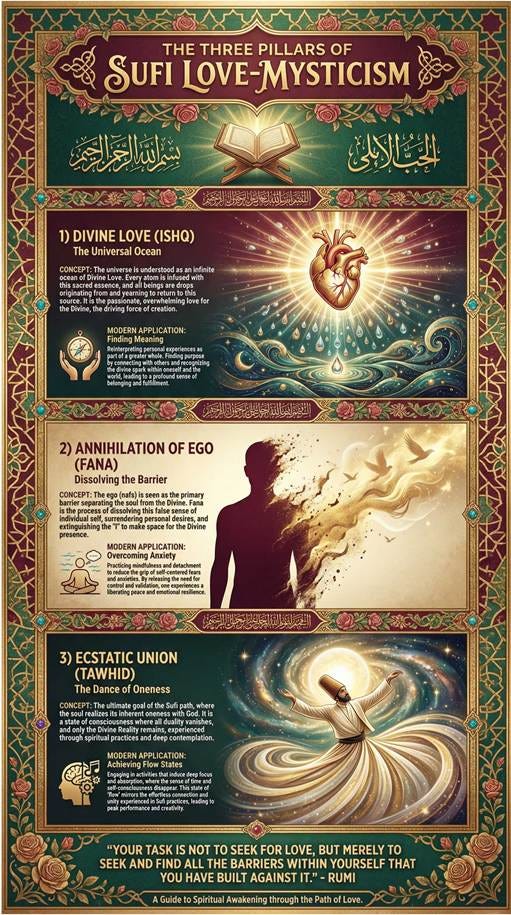
Sufism, is recognized as the mystical branch of Islam, and is often called the “science of the heart.” Rumi’s path, which later on became the Mevlevi Order (or Whirling Dervishes), is built on three pillars that guide the seeker from separation to union.
Divine Love (Ishq) The universe is an ocean of divine love, and our individual souls are nothing more than drops from that ocean, longing to return.
Modern Application: Finding meaning beyond materialism and trying to see connection in a divided world.
Annihilation of the Ego (Fana) The ego (or *nafs*) is the primary barrier to experiencing divine love. Through spiritual practice, it must be dissolved.
Modern Application: Overcoming self-limiting beliefs, anxiety, and the need for external validation.
Ecstatic Union (Tawhid) Through practices like whirling, poetry, and music, the seeker can experience a temporary state of union with the Divine.
Modern Application: Accessing flow states, peak experiences, and a sense of oneness with life.
Three Practices for the Modern Seeker
The spiritual path of Rumi was not limited to the attainment of knowledge through academic studies; rather, it consisted of the experiential learning of an individual.
The following are three practices that can be adapted from Sufism, which will help you begin your journey on the ecstasy-inducing path.
1. The Practice of Whirling (Sema)
Dancing in the whirling dervish tradition is not simply presenting yourself or entertaining others, it is a profound way in which one can move to a meditative state. The dancer points one arm up toward God as a sign that he/she would like to receive God’s blessing and with his/her other arm also reaching out toward the ground as a way of directing that blessing through themselves and into the world. Through this action, the dancer creates a connection between mankind and God.
How to Practice (Simplified):
Find a quiet space where you won’t be disturbed.
Stand with your arms crossed over your chest, hands on your shoulders, acknowledging your own heart.
Begin to turn slowly counter-clockwise (towards your heart).
As you turn, slowly raise your arms. Your right palm should face upward to the sky, and your left palm should face downward to the earth.
Keep your eyes soft, perhaps gazing at your left thumb.
Don’t try to force anything. Let the movement become a prayer. Feel yourself as a spinning top, stable at the center while the world revolves around you.
Start with just a few minutes. The goal is not to get dizzy, but to achieve a centered stillness in motion.
2. The Practice of Poetic Contemplation
Rumi’s Perspective: He saw poetry as spiritual technology rather than as a form of art. His poetic writings have been created to talk to the soul, not the rational mind. They are to be experienced, rather than analyzed.
How to Practice:
Choose a short poem or a few lines from Rumi.
Read the poem aloud three times. The first time, just to hear the words. The second time, to understand their meaning. The third time, to feel their emotional resonance.
Sit in silence for 5-10 minutes. Don’t analyze the poem. Let the words wash over you. Then ask yourself, what feelings or images arise? What memories or longings are stirred?
Journal about your experience. What barrier within you did the poem touch? What truth did it reveal?
3. The Practice of Finding the Beloved in the Everyday
Sufism believes that the Universe and the Divine are one and they teach us to look inward within ourselves where God resides rather than outward. Rather than viewing God as being separate from our existence; we view God as living through all that exists, in everything we see and everywhere we go, thus allowing us to find ourselves through God’s eyes.
In Sufism, we learn that our goal is to learn how to love the Beloved in every aspect of life - whether it be through the beauty of nature or compassion towards every other person or through our own pain and suffering. Thus we are taught to find the beauty in everything and everyone we encounter.
How to Practice:
At the end of your day, perform a “Beloved Review.”
Ask yourself: “Where did I see a glimpse of the Beloved today?”
It might be in the kindness of a stranger, the beauty of a sunset, a moment of genuine connection with a loved one, or even the lesson learned from a difficult situation.
Write down at least one instance. The goal is to train your mind to seek and find the presence of divine love in your ordinary life.
An Invitation
In Rumi’s poetry, he invites us to radically transform how we view the concept of love by inviting us to not ‘seek’ romantic love outside of ourselves, but rather, remove the barriers we build between ourselves and romantic love, through an inner journey of acceptance and release. This invitation is a powerful expression of the importance of trusting our hearts, being open to heartbreak, and using heartbreak to find ways to connect to the infinite possibilities of love.This journey is one of courage; having to confront our ego and its fears is a challenge every single one of us must meet on our own path of courage. However, this also leads to great joy because becoming connected to love’s source means becoming connected to the ocean from which we are all born.
“Out beyond ideas of wrongdoing and rightdoing, there is a field. I’ll meet you there.” - Rumi
By Dr Ioannis Syrigos
Suggested books
The Masnavi, Book One (Oxford World’s Classics), by Jalal al-Din Rumi and Jawid Mojaddedi
Divan of Shams of Tabriz, by Jalal al-Din Rumi and Hojat Naghshejahan
Rumi is not really offering spiritual comfort food here. He is handing the ego a candle and saying, “Good news, we’re burning down the storage unit.” The path is love, yes, but not the cute kind that fits on a mug. It is the kind that strips the false self, turns grief into prayer, and makes the seeker stop treating God like a missing object.
And yes, the Islam matters. Rumi without Sufism, Qur’an, Muhammad, prayer, discipline, and surrender is not Rumi. It is wellness fog wearing a Persian hat.
Hi! Please check out my latest article about Rumi and please do not hesitate to restack it, should you find it inspiring 💫
https://mahnazhatami.substack.com/p/bowing-to-the-sun?r=6a6pnp&utm_medium=io