

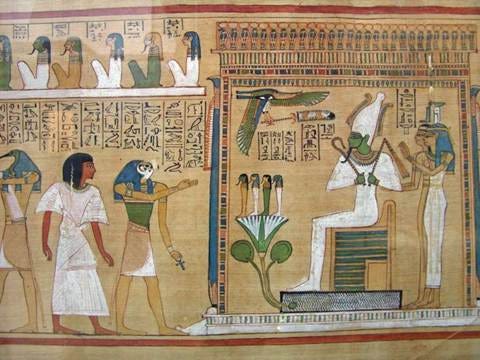
While it’s common to associate Ancient Egypt with an overwhelming focus on death, when you view Ancient Egyptian Civilization from a different lens, you can see how much of their efforts promote life and what they viewed as their only way to continue living eternally. Ancient Egyptians loved life and wanted to preserve that love for eternity.
To attain eternal life within the Field of Reeds (the ancient Egyptian version of paradise) you had to possess a soul, and in order to possess a soul you had to successfully navigate the perils associated with traveling through the underworld. The final obstacle that every soul faced was not an obstacle of physical nature or magic, but an obstacle of conscience. Every soul, from the lowest level farmer all the way up through the most powerful pharaoh, had to present itself to the Weighing of the Heart and receive judgment from Ma’at (the ancient Egyptian Maiden of Justice).
What occurred after every soul received its judgment? According to the ancient Egyptian texts there was a terrifying creature and a punishment greater than the most popular modern-day vision of hell.

