


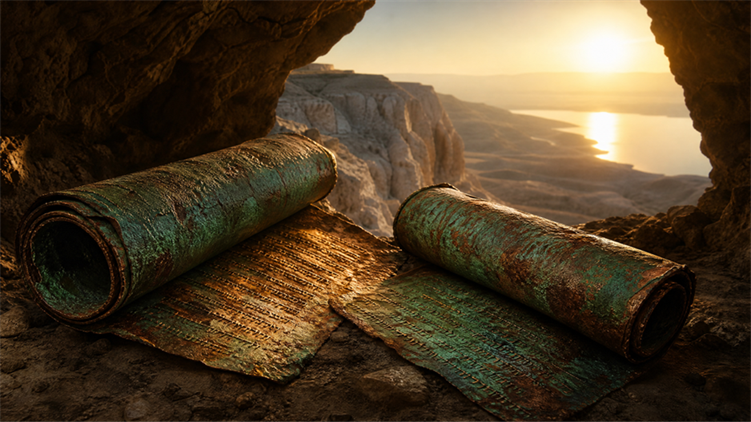
In 1952, archaeologists exploring the limestone cliffs above the Dead Sea made a discovery that did not fit with anything else they had found.
They were excavating Cave 3 at Khirbet Qumran, the site famous for the Dead Sea Scrolls. By this point, researchers were accustomed to finding fragments of parchment and papyrus containing ancient biblical texts and sectarian rules. But at the very back of the cave, separated from the other manuscripts, lay two rolls of heavily oxidised metal.
It was copper, mixed with about one percent tin, and it was covered in hammered Hebrew script.
The metal was so brittle that it could not be unrolled. For four years, it sat in a museum while scholars debated how to open it without destroying it. Finally, in 1955, the Jordanian government sent the rolls to Manchester University’s College of Technology in England. There, Professor H. Wright Baker carefully coated the outside of the rolls in aircraft glue, baked them in an oven, and used a tiny circular saw to cut them into 23 curved strips.
When the strips were laid out and translated, the scholars realised they were not looking at a religious text but a treasure map.
The document, now known as the Copper Scroll (officially designated 3Q15), lists 64 specific locations where vast quantities of gold, silver, and sacred vessels were hidden. The total weight of the treasure described is staggering, estimated by some scholars at 26 tons of gold and 65 tons of silver.
Today, the Copper Scroll sits in a glass case in the Jordan Museum in Amman. And as far as anyone knows, not a single ounce of the treasure it describes has ever been found.
