


As we live in this hyper-connected, overstimulated world, where the concept of “true silence” can be both exciting and frightening, we find ourselves constantly pressured to produce more and perform more as a result of an unlimited amount of social media notifications and news feeds, along with feelings of societal obligation. At the same time, our brains are in a state of constant overdrive, with anxiety, disorganization, and concern regarding what we need to do next. All these thoughts battling it out within our heads, some even having become physically painful to us.
What will help us cope with all the technological distractions of today’s world?
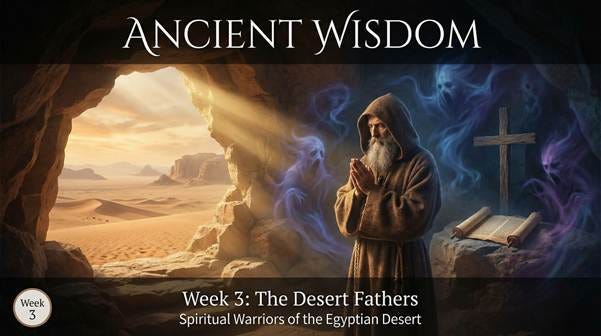
Three hundred years after Christ, in the middle of a grappling Roman Empire, a small group of men and women left their cities in search of the quiet desolation of the Egyptian desert to become the Desert Fathers and Mothers. While they may not have called themselves “philosophers,” these people represented the prototypes of spiritual warriors and athletes of the soul, confronting their struggles against the inner demons and uncertainties we face every day by entering into the deepest realms of solitude possible. Through this, they became known as the Desert Fathers and Mothers, who continue to provide us with the oldest and most reliable sources of wisdom, a powerful antidote to the noise of our modern lives.
The Flight to the Desert: A New Kind of Martyrdom
The Edict of Milan (313 CE) ended the Christian persecution era and closed the door on martyrdom as the pinnacle of faith. In its place arose a more subtle form of spiritual heroism, the flight into the desert. St. Anthony of Egypt (c. 251-356), often referred to as “The Father of Monasticism,” heard God’s call to leave behind all material possessions and live a life of extreme asceticism.
St. Athanasius, who chronicled St. Anthony’s life, depicts Anthony’s experiences in the desert not as peaceful meditation but rather a fierce battle for spiritual survival. During his twenty years in the wilderness, he was said to endure torment at the hands of demons in the forms of alluring women, horrific beasts, and physical abuse. To the Desert Fathers, the spiritual world was very real; thus, the wilderness was viewed as the battleground. Through this internal struggle and victory over their internal demons, those of the desert believed they were cleansing their souls in preparation to experiencing God directly.
“A brother came to Scetis to visit Abba Moses and asked him for a word. The old man said to him, ‘Go, sit in your cell, and your cell will teach you everything.’”
This maxim summarizes their way of living. The cell (a small, isolated structure) served as the place of both testing and spiritual growth for the soul. In the silence and solitude present in the hermit’s cell, the individuals were able to confront their inner selves with a degree of clarity not possible while living among the distractions of civilization. The passions, temptations, and “demons” that one can effectively ignore in their busy life, became completely present for them while secluded in their cells.
The Core Practices: Stillness, Struggle, and Silence
The Desert Fathers developed a sophisticated spiritual “technology” for navigating this inner battlefield. Their practices were not about relaxation, but about a vigilant, moment-to-moment struggle for spiritual purity.
These practices were not for the faint of heart. They involved extreme fasting, sleep deprivation, and constant prayer. Yet, from this harsh discipline, a profound wisdom emerged, a wisdom of self-knowledge, humility, and radical love.
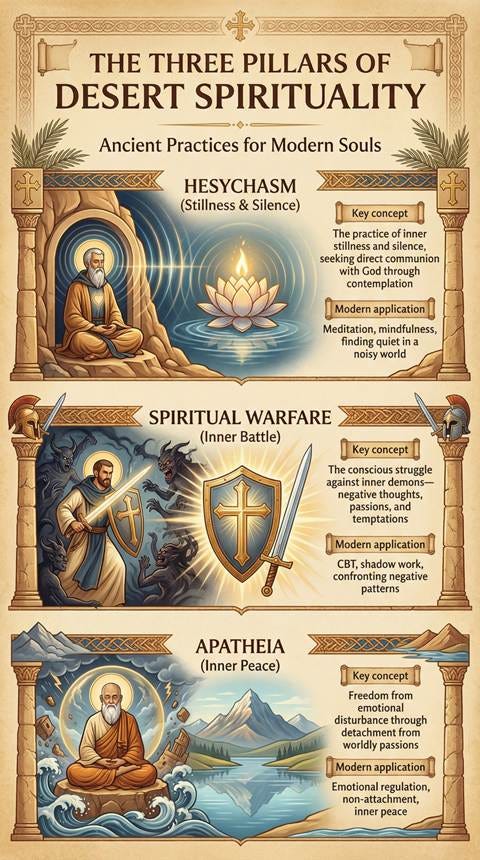
Hesychasm
The technique of promoting stillness and silence by repeating short prayers such as the Jesus Prayer to calm the mind.
Modern day uses would include: Meditation, practicing awareness (mindfulness), and seeking solace from the overwhelming noise of life.
Spiritual Warfare
The conscious battle against negative feelings that can arise from within, including negative thinking, passions, and temptation (e.g. anger, lust, despair).
Modern day uses would include: Utilizing Cognitive Behavioural Therapy (CBT), shadow work, and addressing negative thinking.
Apatheia
The state of balance and peace available after one becomes detached from the worldly desires and continues to pursue the way towards the path of righteousness (which is not apathy!).
Moden day uses include: Finding emotional control and peace amongst turmoil and chaos.
Three Ancient Practices for Modern Souls
Even if we are not living an ascetic lifestyle, it can be helpful to study the teachings of the early monastics. In recent years many people have been encouraged to live a more intentional life and to increase peace within through practicing their faith. These teachings can help us develop a healthier relationship with ourselves and with others.
Doing this will help you establish a more peaceful existence. Here are some of the teachings of the Desert Fathers that can be useful to you.
1. The Practice of the Daily “Desert Hour”
Set aside an hour each day to have your own personal “desert.” For one hour, put away your phone, computer, music, and books; simply sit quietly. At first it may be hard to sit quietly because your mind is racing with worries, tasks to do, and restless thoughts (the “demons”). Do not try to fight these thoughts or deny them; rather, simply observe these thoughts as they come and go, without judgment. Over time, your thinking will become quieter and you will be able to hear the voice of your own conscience.
2. The “Watchfulness” (Nepsis) Journal
Keep a small notebook with you throughout the day. When you feel a strong emotion (anger while driving, envy of someone on social media, fear about the future), write it down. Track the situation that triggered the emotional response and the pattern of thinking related to the emotion. The Desert Fathers called this “watchfulness.” When you become aware of your “inner demons,” you take power away from them and start to see them as external temptations that you have the ability to resist.
3. The Practice of “Cutting Off” Thoughts
The Desert Fathers taught that a sinful act begins with a single thought (logismos). If a person allows themselves to think about that sinful act, then the thought turns into a passion and eventually becomes an action. The way the Desert Fathers practiced to stop the cycle of sinful behavior was to “cut off” a thought as soon as it entered their mind. When you notice yourself thinking negative, anxious or uncharitable thoughts, replace them immediately with a short positive prayer or mantra, such as a verse from Scripture or “Lord, have mercy,” or even a positive affirmation. The goal of this practice is not to suppress your negative thoughts, but rather to train yourself to consciously decide which thoughts you will cultivate.
The Wisdom of the Wasteland
According to The Desert Fathers, they believed that you cannot obtain inner peace by simply having more things in life - it is actually about taking away the extra unnecessary things from your life instead. They show us that the real source of strength will always come from being alone with Yourself; there are no stronger demons than the ones we create for ourselves through our minds. By embracing moments of silence, by bravely confronting our inner darkness, and by practicing a vigilant watchfulness over our thoughts, we can begin to build our own inner monastery, a place of unshakeable peace in the midst of our chaotic world.
By Dr Ioannis Syrigos
Suggested Books to read:
The Wisdom of the Desert by Thomas Merton
The Desert Fathers by Benedicta Ward (editor)
That was the true path to the Christus AKA Christianity
The desert fathers' procedures to practice silence, chant and pray, are nothing new some one practicing yoga and Vedic meditation. If we include the Vedic literature in our dialogues, your efforts to remind the readers - mostly Christians - would be cut to 10%, if that. Wisdom is wisdom, no matter what the source, if it can benefit humanity, it should be made available to them, no matter what the source!