


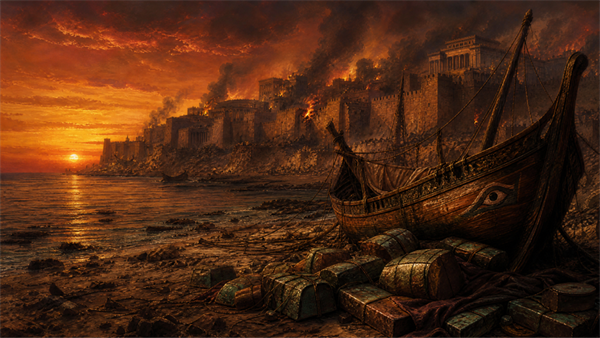
Around 1200 BC, the lights went out across the civilised world.
Within the span of a single human lifetime, almost every major palace civilisation in the Eastern Mediterranean and the Near East collapsed. The Mycenaean kingdoms of Greece burned. The mighty Hittite Empire of Anatolia shattered into fragments. The wealthy trading hub of Ugarit on the Syrian coast was wiped off the map. Even the New Kingdom of Egypt, the superpower of the age, survived only in a severely weakened state, never to fully recover its former glory.
For centuries, historians blamed this catastrophic event on a single, terrifying cause: the “Sea Peoples.” According to Egyptian records, a mysterious confederation of seaborne invaders swept across the Mediterranean, destroying everything in their path. It was a simple, dramatic story of civilisation overwhelmed by barbarism.
But modern archaeology has revealed a truth that is far more complex and far more unsettling for our own time. The Late Bronze Age was not a collection of isolated kingdoms. It was a highly globalised, hyper-connected world, bound together by an international supply chain. And when that supply chain broke, the entire system tore itself apart.
What the cargo of a single sunken ship reveals about the fragility of the ancient world, why the tin trade was the Bronze Age equivalent of modern rare earth minerals, and what the real evidence shows about the true cause of the collapse.
