


Plato’s Allegory of the Cave examined the radical possibility that our understanding of reality may be based on only a limited number of shadows. The philosopher Plato, who was an idealist of sorts, asked the question What is real? His student Aristotle was concerned with the practical question of how one should live; his question was more immediate than Plato’s. While Plato pointed toward the transcendent world of Forms, Aristotle focused on how we can live “well” or flourish as a human being in the physical world. His answer to the question of how to live is known as “Eudaimonia,” and has been extremely influential throughout the history of Western thought.
Eudaimonia vs. Hedonia: The Great Divide
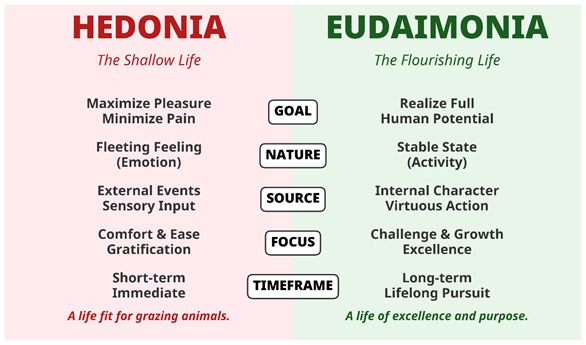
Eudaimonia is often translated as happiness, but this translation has the potential to confuse and mislead us. In contemporary society, happiness is often associated with pleasure, comfort, and positive feelings, which is a type of experience that can be described as hedonism. According to Aristotle, hedonism represents an ultimately empty and superficial lifestyle. A person who continually seeks after pleasure is leading a life that is unsuited to human being - it would be better suited to a life of a grazing animal.
In contrast, Eudaimonia, as Aristotle defined it, is a form of existence rather than an ephemeral state. The term Eudaimonia can be understood as “human flourishing” or the way humans can achieve a “good” life through living properly and being virtuous. Eudaimonia is an active pursuit of excellence in everything we do throughout our lives. The ultimate satisfaction of Eudaimonia is not found in feeling happy or in feeling satisfied; it is derived from fulfilling our potential as a human being. It defines who you are, not what you experience, and it describes your ability to excel and make meaningful contributions as a human being.
The Doctrine of the Mean: Virtue as the Middle Path
To reach Eudaimonia, what must be done? For Aristotle to attain Eudaimonia, it is to cultivate a virtuous character through Arete (Virtue). Virtue defines how we live our lives, not simply by adhering to rules but by developing a virtuous character that acts appropriately, at the appropriate time, for the right reasons. The key to a virtuous character is found in Aristotle’s Doctrine of the Mean.
In each aspect of life, Aristotle claimed that the wrong response can occur in two ways- extreme excess and extreme deficiency. The virtuous or good response is found in the “Golden Mean” between these two. However, the golden mean is not an objective calculation but instead will vary from situation to situation and requires virtuous practical wisdom to arrive at it.
Take courage as an example of how to embody the Doctrine of the Mean. The first person is a coward, running from any type of danger. The second person is a reckless person, who rushes into every danger without considering the consequences.
The courageous person is one who analyzes the situation, considers the risks involved, and demonstrates the necessary amount of courage at the appropriate time.
To further illuminate Aristotle’s Doctrine of the Mean, the accompanying chart provides additional examples of the key virtue of Aristotle with the associated vices of deficiency and excess.
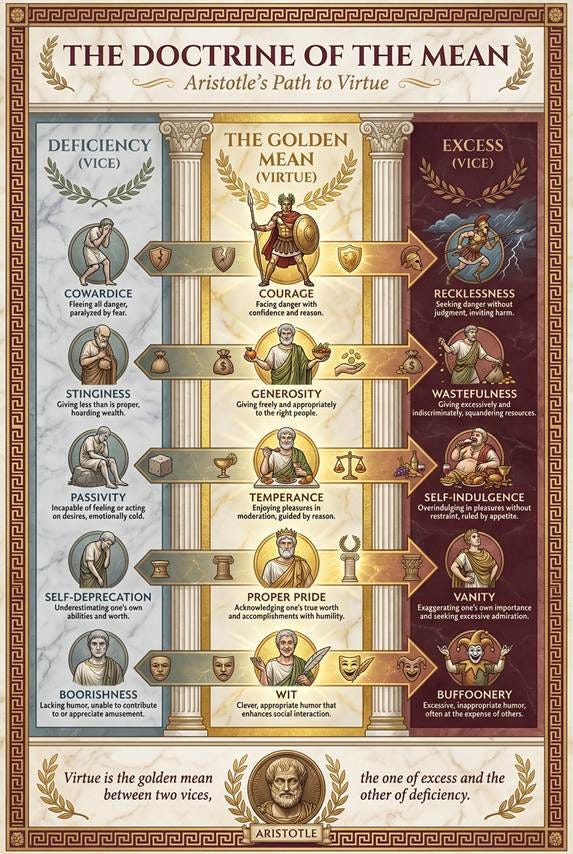
The Doctrine of the Mean — Aristotle’s Path to Virtue
To find a mean between extremes, you require phronesis (or practical wisdom). Phronesis is intellectual virtue that enables you to make good decisions about that which benefits you and others. Theoretical wisdom is concerned with immutable truth; phronesis is concerned with motion (actions) and the way to apply general principles to specific occurrences. Through experience and the regular practice of acting with virtue, phronesis also allows us to understand what morally matters in a given situation and act accordingly.
The Indispensable Role of Friendship (Philia)
Friendship (philia) has become largely excluded in contemporary conversations surrounding wellness, but for Aristotle, it was an essential dimension of an individual’s ability to flourish or fully actualize their potential as an individual. In his famous quote, “Without friends, no one would choose to live, even with every other good,” he asserts that friendship plays a vital role in one’s experience and quality of life. He described three types of friendship that offer distinct ways of supporting one’s Eudaimonia:
Friendships of Utility: These relationships are developed because both parties gain some benefit from the relationship. In a professional or business setting, utilitarian friendships are frequently formed but are temporary. The relationship will end once the utility has ended.
Friendships of Pleasure: These relationships are formed when people share common values or interests, and therefore, they can find enjoyment in each other’s presence. These types of friendships are transient and will last as long as the two parties can experience enjoyment together.
Friendships of Virtue (Perfect Friendship): These friendships represent the highest form of friendship. Individuals in virtuous friendships are admirers of and respect each other’s moral character, thus creating an atmosphere in which each person wishes for the other’s welfare for its own sake, rather than for any implied utility or enjoyment. Perfect friendships are rare, long-lasting and significantly contribute to one’s Eudaimonia because they rely on an individual’s shared commitment to the pursuit of goodness and excellence. The idea that a true friend is “like another self” is central to Aristotle’s concept of friendship, as it allows individuals to comprehend and develop their virtues as they reflect them through the eyes of their qualified friends.
The Three Practices of Flourishing
Aristotle defined virtue as not being inherent in humans at birth, but instead being learned through our actions (habituation/ethos). We become just individuals by consistently doing just actions, temperate individuals by doing temperate actions, and courageous individuals by consistently behaving courageously. The habitual practice of this (through phronesis/wisdom) forms a virtuous character. In the original article, three practices were discussed, which can be further enriched with our deeper understanding:
The Virtue Audit: At the end of each week, review everything you’ve done. Pick one of the twelve virtues defined by Aristotle (courage, temperance, generosity, etc.), and decide where you stand relative to this virtue for the week. Were you deficient in this virtue, excessive in this virtue, or were you in the mean? For example, did you respond to a difficult conversation by being cowardly (deficient), aggressive (excessive), or assertive and courageous (the mean)? This process will help individuals build their own self-awareness so they can develop their character.
The Golden Mean Practice: Identify an area in your life that you tend to go to extremes. You either overreact to things (excess) or underreact to things (deficiency). Over the next week, work on coming to the mean in this area of your life. If you underreact, make it your goal to speak up once during each day. If you overreact, practice giving yourself three seconds before responding to anything. You’re not trying to achieve perfection - you’re aiming to create habits of virtuous action through consistent practice.
The Contemplative Life: According to Aristotle, the best form of flourishing for humanity was the contemplative life (the life of the mind). Therefore, take time every day (even if only for 15 minutes) to think deeply without any distractions. Read something challenging, think about a philosophical question, or sit silently and think about your thoughts. This practice will help individuals develop the intellectual virtues that Aristotle referred to as the pinnacle of human excellence.
The Lasting Wisdom of Aristotle
In addition to addressing comfort, pleasure, and immediate gratification as an ever-growing trend in the current culture, Aristotle’s philosophy provides a uniquely radical remedy to this problem. A good life is not so much about living a life that is filled with comfort, but rather about living a challenged, enabled, and elevated experience. It provides deep, meaningful, beneficial existence that is not created by material items, but by living a high-quality, character-strengthened lifestyle. The Allegory of the Cave depicts to us that what appears to be real may in fact not be real at all. By contrast, Aristotle’s Principles of Ethical Conduct and his view of Ethics offer humanity tools for creating a fulfilling life regardless of the current social or cultural climate. In order to develop our full capacity to prosper as humans, we must focus on living in harmony with the world around us, enhancing the virtue of who we are becoming. Aristotle’s Ethical and Moral Principles, combined with developing virtuous friendships, creates opportunities for achieving a deeply fulfilling life.
By Dr Ioannis Syrigos
Suggested Books
The Nicomachean Ethics, by Aristotle.
The Eudemian Ethics, by Aristotle.
It's noticeable that you chose not to use Eudomania as membership bait.
There would be few takers?
Ariatotle's popularity rests on the appreciation of grazing animals?