

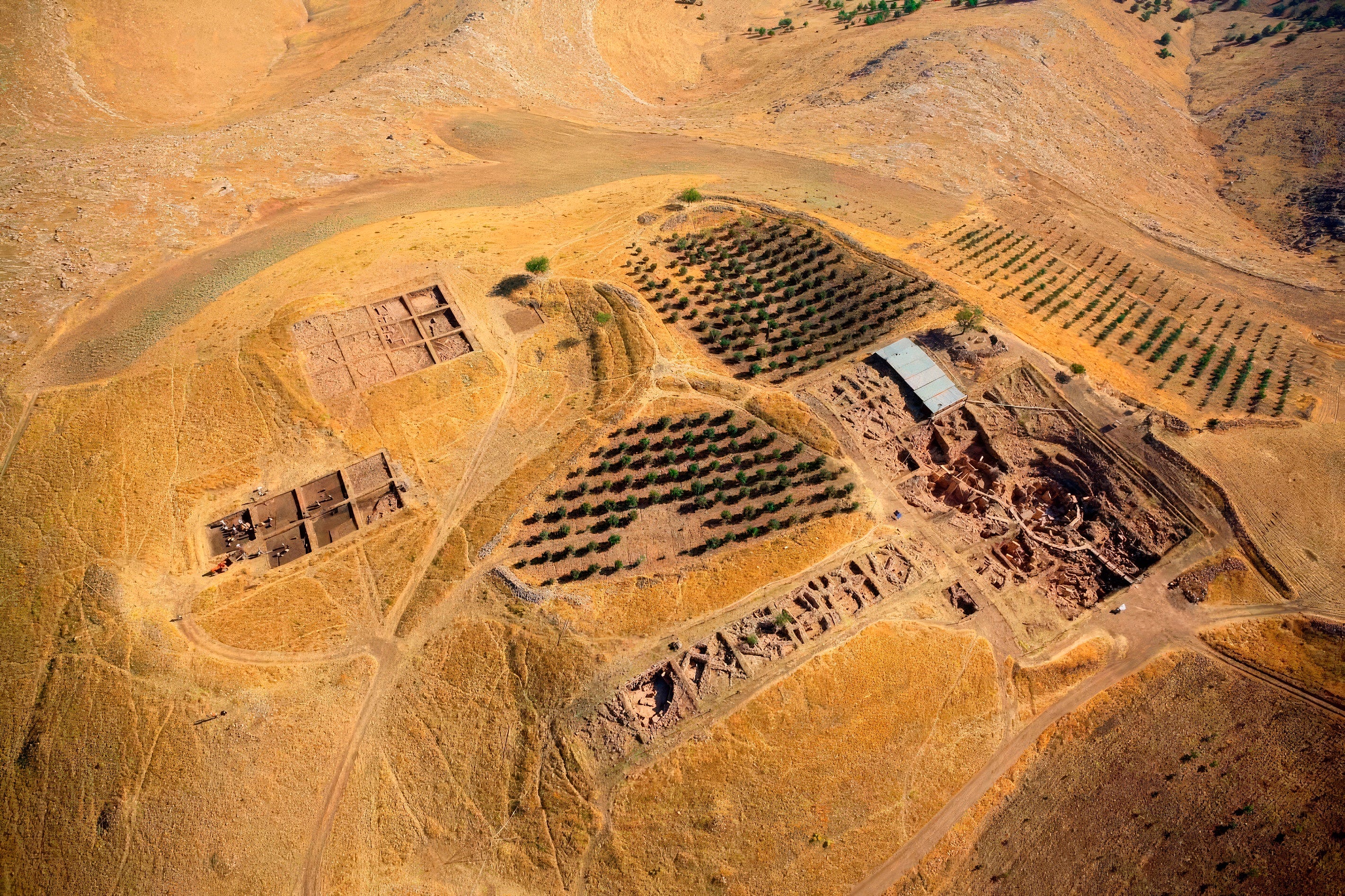
Twice as old as Stonehenge, Göbekli Tepe was built by hunter-gatherers who did not yet have the wheel to assist them in their development. However, 30 years after its discovery, the debate over the site has intensified, with archaeologists having a wide range of views about what kind of ritual activity took place at the site.
The early phases of human civilization were once believed to have followed a specific progression, beginning with nomadic hunter-gatherers, who then developed agriculture and established permanent settlements, followed by the establishment of large population centres, and finally the complex social hierarchies that allowed for the development of religious beliefs and monument construction.
The investigation of Göbekli Tepe was initiated in 1994 by German archaeologist Klaus Schmidt, who uncovered a large, sophisticated, ceremonial structure dating back approximately 12,000 years. Today, some of the theories and interpretations regarding this structure and what it represents for human history are being evaluated by a new generation of archaeologists who disagree with Schmidt’s ideas.
For an in-depth investigation of this ongoing debate and the unanswered questions regarding Göbekli Tepe, consider subscribing to Ancient Origins to learn about all of the competing theories.
The Cathedral on a Hill
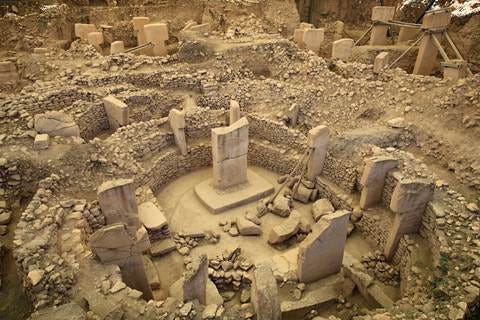
Göbekli Tepe is an incredibly large archaeological site composed of several circular structures, each made up of enormous stone pillars shaped like T’s (T-shaped). The tallest of these pillars are 5.4m (18 feet tall) and can weigh as much as 22,680kg (50 tons). All of these pillars were made using only flint tools and stone hammers and transported over long distances (hundreds of yards) up the hill, where they were erected with such precision that they all have perfectly aligned geometric shapes.
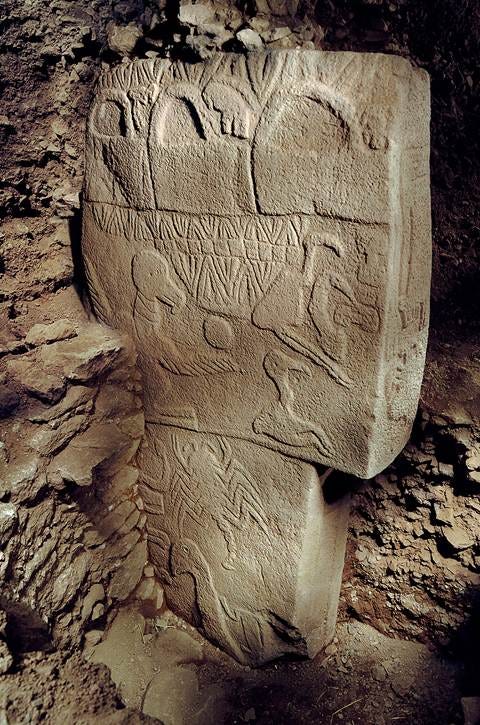
The bas-relief carvings on the pillars are quite stunning. Instead of the traditional Neolithic representations of fertility and game animals that we see in most other archaeological sites, Göbekli Tepe’s pillars are primarily covered with representations of scary, aggressive-type animals: scorpions, spiders, snakes, wild boars, and vultures (to name a few). Schmidt believed that the T-shape of the pillars represents an abstract form of human beings and were gathering areas for a regional cult of death worshippers (a “death cult”). “The first thing is the temple; the second (and last) thing is the city,” as Schmidt famously said. He further posits that the monumental construction effort involved in building Göbekli Tepe forced groups of hunter-gatherers to discover agriculture to provide food for the enormous number of workers involved in constructing the site. In Schmidt’s view, the onset of religion is what catalyzed the emergence of organized civilization.
The Astronomical Alignment Debate
Schmidt’s “religion first” theory quickly gained acceptance as the prevailing theory regarding the significance of Göbekli Tepe, but just as quickly many competing theories were put forth, including the proposal that Göbekli Tepe was used for astronomical observations.
There are several researchers that have proposed the theory that the central pillars of the enclosures were aligned so that the movement of certain stars, especially Sirius and the constellation Orion, could be tracked. The animal engravings found within the enclosures are interpreted as an early attempt at establishing a zodiacal system, and they theorize it was used to help track the seasons (through the movement of stars) or to record an event; possibly the impact of a large comet that occurred at the end of the last ice age.
Mainstream archaeologists have disagreed strongly with the astronomical theory. They have pointed out that the enclosures were originally constructed underground (with roofs), so it would have been impossible to observe the night sky directly. Additionally, the night sky would have had a drastically different arrangement 12,000 years ago, due to the precession of the equinoxes; therefore, there have been inconsistencies in attempts to align the central pillars of Göbekli Tepe with ancient star maps.
The Skull Cult and the Houses of the Living
After Klaus Schmidt’s passing in 2014, the new research team began testing Klaus Schmidt’s premise that Göbekli Tepe was only a “ritual site” completely distinct from the surrounding environment in which it was located. Recent excavations nearby have unearthed structures consistent with the existence of domestic dwellings, cisterns for collecting rainwater, and tools used in the food preparation process. All of which has led the research team to develop a new hypothesis around Göbekli Tepe being an active location of people living and working daily rather than just a “cathedral in the sky”. It is proposed that the monumental pillars located within the monumental enclosures may serve as central architectural pieces for multi-use communal houses versus serving solely as open-air temples.
In addition, while there remains evidence of activity associated with “dark” rituals, as seen in a 2017 publication by anthropologists, there also remains the potential for ritualistic skulls being displayed at the site. The study reported finding many human remains that were intentionally cut and had carved grooves in the skull, many had been drilled through the centre of the cranium to allow the individual to be suspended by cords. This is the earliest known archaeological record for the existence of a skull cult as part of a wider set of ritualistic behaviours within the region (and possibly beyond).
The 95 Percent Mystery
Göbekli Tepe’s continuing debate is indicative of the fact that extremely little is currently known about this site and what it holds; so far only a small portion of its extensive area (less than 5%) has been excavated. Ground-penetrating radar and geomagnetic survey results suggest that the four known monuments represent only a small part of the buried area - there are approximately 15 additional monumental enclosures with hundreds of large pillars lying below ground.
The long-awaited results of ongoing excavation work will not be available until many more decades (even centuries) from now. Up until then, the oldest religious site in the world represents a mirror to the opinions humans have regarding their own natures, whether it served as an observatory free of violence, as a site devoted to the worship of ancestors or whether it was simply the unintended outcome of an enormous attempt at architectural construction, thereby giving rise to agriculture.
Whether or not it was constructed based on intentional designs does not change the fact that the people who built Göbekli Tepe (hunter-gatherers) were able to accomplish what had, until recently, been believed to be impossible: they looked at their unrestrained, chaotic environment and created something that would endure throughout time.
Top Image: Aerial view of the Göbekli Tepe excavation site in southeastern Turkey, showing the massive circular enclosures built nearly 12,000 years ago. Source: UNESCO World Heritage Centre
By Aris Manus
References
Curry, Andrew (2008). Gobekli Tepe: The World’s First Temple? Smithsonian Magazine. https://www.smithsonianmag.com/history/gobekli-tepe-the-worlds-first-temple-83613665/
Nalewicki, Jennifer (2025). Göbekli Tepe: The Mysterious Site Older Than Stonehenge. History.com. https://www.history.com/articles/gobekli-tepe
Gresky, J., et al. (2017). Modified human crania from Göbekli Tepe provide evidence for a new form of Neolithic skull cult. Science Advances. https://www.science.org/doi/10.1126/sciadv.1700564
Haklay, Gil (2020). Geometry and Architectural Planning at Göbekli Tepe, Turkey. Cambridge Archaeological Journal.

This is not a primitive site. It’s very complex, futu🛸ristic!
Highly doubt that all of a sudden an ancient settlement suddenly wanted to erect massive monuments that would take a tremendous amount of energy and food and time. I believe I read elsewhere that there are other similar sites like it in the surrounding areas, though made from wood, which points to a long tradition before Gobekle Tepe. Also, the site existed for around 1000 years I believe until all at once it was buried. Either the belief systems crumbled or a different culture took over.
I’ve long been fascinated by this site. The fact that it existed around 12,000 years ago is astounding