

Thousands of years before hospitals, anesthesia, or antibiotics, skilled practitioners made openings in living skulls. The healed bone they left behind tells a startling story of survival.
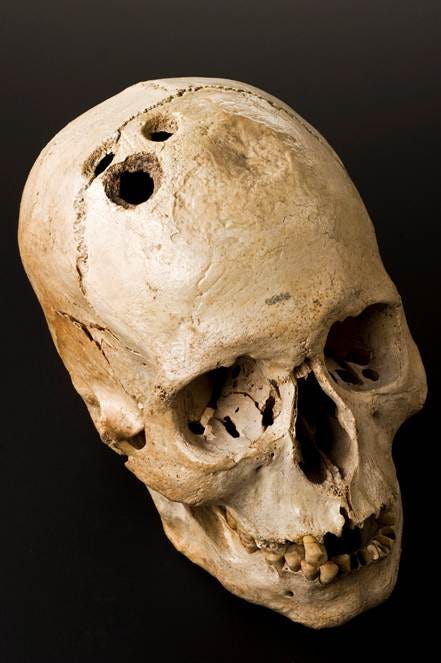
At first, the skull from Jericho looks impossible. Its crown bears four openings, each made when its owner was alive. But the bone around them does not have the raw, broken look of a fatal blow or a fresh incision. It has begun to remodel. The person survived long enough for the body to answer a wound to the head with new growth.
That one skull is not an isolated marvel. Across the ancient world, archaeologists have recovered crania with deliberate openings made by scraping, cutting, or careful grooving. The procedure is called trepanation, or trephination. It is among the oldest forms of surgery known from human remains, and it was sometimes astonishingly successful.
This is not a story about primitive people somehow possessing a lost version of modern neurosurgery. It is stranger than that. It is about observation, hard won technique, community care, and the physical evidence of people who lived through an operation that still makes modern readers flinch.
The Evidence Is Written in Bone
Bones can be a great witness, but very slowly. The result of an operation on a deceased individual may leave sharp edges and little evidence of healing at the location of the entrance wound. In contrast, persons who lived beyond this critical period may leave a very different record of their injury; their entrance wounds will have smooth and rounded edges, and new bone may in fact form at the edges. This is what allows archaeologists to conclude that some patients survived surgery.
Most researchers openly acknowledge this limitation. The smoothness of the edges of the opening does not indicate precisely how long the individual lived after surgery; therefore, it cannot be considered a reliable measure of time. The process of healing bones is a complex one, and it is debatable whether the changes in bone structure used as indicators of trephination in antiquity will provide the archaeologist with consistently reliable evidence for the survival of the individual. However, the strength of the evidence does not diminish the need for caution.
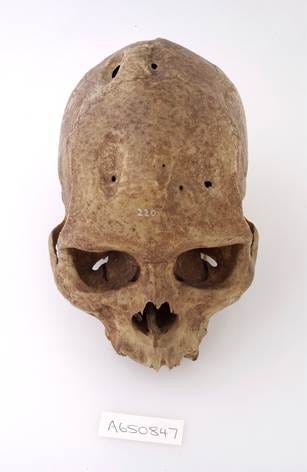
Regardless of this confusion, a number of skulls pose a significant challenge to interpretation. The skull from Jericho, for example, has four openings with evidence of healing, and the specimen from New Ireland in Papua New Guinea shows evidence of eight separate trepanations, with many of these openings having healed by the time of death. The examples demonstrate that trepanation was not limited to one desperate attempt but rather a procedure that was repeated in certain cultures.
A Surgery Older Than States
There is significant archaeological evidence for healed trepanation going back deep into prehistory. In a comprehensive survey of medical and archaeological literature, several healed trepanation specimens have been documented between approximately 10,000 to 5,000 BC, and many additional specimens have also been found in Europe, the Middle East, Asia, Africa, Oceania, and North America following that time period. Trepanation appears to have been practised in societies with vast geographical distances and divergent belief systems.
However, the fact that trepanation was practised across a wide aperture of cultural contexts does not necessarily imply that every society used the technique to treat the same medical conditions. The creation of a hole in a patient’s skull may have been an urgent method of addressing an acute injury, an attempt to alleviate pain or pressure, a form of ceremonial treatment, or may have been something that cannot be known based upon present evidence. Archaeology is capable of demonstrating evidence of surgical intervention; however, archaeology cannot tell us what conversations took place around the patient before, during or after the procedure, nor can archaeological evidence tell us what the healer told the family about the expected outcome.
The consistent reconstruction of this surgical procedure suggests that the individual performing the surgery likely returned to a conceptual vision of precisely removing a cranial area while attempting to prevent damage to underlying tissues. This was not simply an act of serendipity. To perform this procedure properly, an individual required a learned technique; an assortment of instruments; knowledge of how to use these tools; a reliable source of funding for instruments and surgical procedures; and a supportive social network to assist the patient post-surgery.
Why Did They Do It?
The most convincing medical motive is head trauma. With the frequent use of sling stones or clubs as weapons in the mountains of ancient Peru, many people would have suffered from skull injuries. Of eleven burial places located in the Cuzco area, it was shown that one of the primary reasons trepanation was performed was to treat cranial trauma. It appears that the surgeons did not perform this operation without due consideration, since they often avoided the most dangerous parts of the cranium for trepanation, as they did not operate on regions close to large blood vessels or membrane coverings of the brain.
Several other theories also exist regarding the reason for performing trepanations; however, many of these theories are unsubstantiated. Historical documents, along with more recent legends and customs, have suggested that some of the reasons for doing a trepanation were due to headaches, convulsions, altered states of behaviour or spiritual beliefs regarding spirits within the head. However, these theories may only be applicable in certain locations and at certain time periods. They should not be viewed as a global resolution. The methods of the actual surgical procedure could have had a variety of social, medical, and ritualistic significance.
The Peruvian Learning Curve
Ancient Peru provides the clearest evidence that trepanation could improve through experience. In one Cuzco region study, researchers identified 66 individuals with 109 skull openings. Circular cutting and scraping were the main methods. The study estimated an overall survival rate of 83 percent and reported little ensuing infection in the sampled remains.
The results also showed change over time. The authors concluded that success rose as techniques improved through repeated practice. Later analyses of larger Peruvian collections have estimated long term survival rates from around 40 percent in some earlier periods to as high as 91 percent in the period from AD 1000 to 1400. These are not universal ancient survival rates but estimates from specific Peruvian samples, inferred from patterns of bone healing. But they are remarkable all the same.
The comparison is sobering. The American College of Surgeons notes that these estimated outcomes in some Andean samples rival or exceed the mortality recorded for cranial operations during the American Civil War. The difference does not mean ancient practitioners had modern medicine. It suggests that repeated experience, careful technique, and an understanding of which areas to avoid could save lives even in a world without sterile operating theaters.
How the Surgeon Acted and Thought
Although there is no known ancient surgical textbook that provides a detailed explanation for every surgical decision made by the Cuzco surgeons, the evidence from the remains indicates that the surgeons employed practical reasoning to guide their surgical choices. For example, surgeons in Cuzco chose ways and places of performing burials that maximized the likelihood that they would not have to cut through very thin areas of bone in order to access the soft tissues below. The method of using circular grooves and/or scrapes to cut through the skull in a gradual manner rather than attempting to gouge through the bone using a blunt object (e.g., an awl) also would have improved survival rates for patients with cranial wounds.
Survival after the opening of the skull would have depended not only on the surgeon’s ability to create the opening but also on what was done following the creation of the opening. A patient with a cranial wound would have had to have access to food, water, shelter, and protection from additional injury as well as the availability of persons who were willing to assist with the patient’s survival despite the patient’s pain and weakness. In summary, repaired skulls are not just evidence of a surgical profession, but also evidence of the level of care provided.
Not a Lost Supermedicine
Trepanation, was a hazardous practice. It produced various results as evidenced by historical records due to varying levels of recovery from surgery. Some skulls have been discovered either with evidence of incomplete operations or without having healed. Researchers typically do not know when an individual was exposed to a trepanation opening, either on their deathbed, after having died, or in instances when the procedure did not have a successful outcome. The physical evidence found in archeological sites of survivors is much more visual than that of individuals who died without having healed even partially; therefore, all heuristics must be carefully assessed rather than viewed as miraculous occurrences.
The act of performing trepanation does not diminish its significance but actually increases the human characteristics associated with it. Through careful and constant observation of wounds and injuries, ancient medical practitioners were able to establish juxtapositions of trial and error through generational advancements. Success in achieving satisfactory treatment was not demonstrative of the mystical nature of the practice but rather a reflection that the development of skill through careful observation can exist long before the advent of a formalized scientific methodology.
The Jericho skull has waited more than four thousand years to make that point. Its four openings do not tell us the patient’s name, the reason for the operation, or whether the healer understood the brain. They tell us something simpler and more astonishing: someone opened this person’s skull, and this person lived long enough for the bone to begin its slow reply.
Top Image: A Bronze Age skull excavated at Jericho, dated to about 2200 to 2000 BC. Four openings show evidence that healing had begun. Source: Wellcome Collection and Science Museum, London. Creative Commons Attribution 4.0.
By Aris Manus
References
Andrushko, Valerie A., and John W. Verano. “Prehistoric Trepanation in the Cuzco Region of Peru: A View into an Ancient Andean Practice.” American Journal of Physical Anthropology 137, no. 1, 2008, pages 4 to 13. PubMed record: https://pubmed.ncbi.nlm.nih.gov/18386793/
Partiot, Caroline, et al. “Cranial Trepanation and Healing Process in Modern Patients: Bioarchaeological and Anthropological Implications.” Journal of Anatomy 237, no. 6, 2020, pages 1049 to 1061. https://pmc.ncbi.nlm.nih.gov/articles/PMC7704229/
Kushner, David S., John W. Verano, and A. R. Titelbaum. “Trepanation Procedures and Outcomes: Comparison of Prehistoric Peru with Other Ancient, Medieval, and American Civil War Cranial Surgery.” World Neurosurgery 114, 2018, pages 245 to 251. https://doi.org/10.1016/j.wneu.2018.03.133
Chavez Rivera, Angel D., and Tiffany R. Sanchez. “Trepanation Reveals the Success of the Incas.” American College of Surgeons, 2022. https://www.facs.org/for-medical-professionals/news-publications/news-and-articles/bulletin/2022/november-december-2022-volume-107-issue-11/from-the-archives/
Wellcome Collection. Bronze Age skull from Jericho, Palestine, 2200 to 2000 BC. https://wellcomecollection.org/works/va96ydta
Wellcome Collection. A human skull showing signs of trepanning, New Ireland, Papua New Guinea. https://wellcomecollection.org/works/najhwrtz
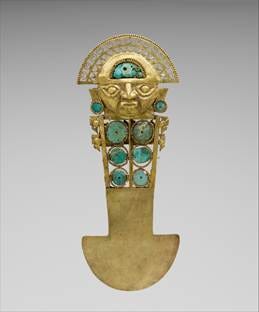
Metropolitan Museum of Art. Ceremonial Knife, tumi, Lambayeque or Sican, Peru. https://www.metmuseum.org/art/collection/search/316427
Tags
Ancient Medicine, Trepanation, Archaeology, Ancient Peru, Medical History, Human Survival, Ancient Mysteries


_MET_DP215693.jpg)