


In a secluded monastery high in the Himalayas, lit only by the weak flicker of butter lamps, a monk sits next to the body of a recently deceased man, and whispers in his ear. The monk does not give a eulogy; nor does he provide consolation to the man’s grieving family. Instead, he provides instructions to the dead man that are detailed and immediate in nature.
“Noble One,” the monk advises, “It is the moment for you to pursue the Path. You are on the verge of death. You previously have met the Clear Light through your Teacher; and now you will experience this Light in Reality.”
For more than one thousand years, Tibetan Buddhists have used this text, commonly referred to as The Tibetan Book of the Dead in Western cultures, to help guide a person’s consciousness through the trip of death, with its uncertainty and wonder. Yet calling this text the Book of Death is incredibly misleading.
This text is a profoundly comprehensive guide concerning the human mind in the broadest sense, and while the text provides urgent guidance to the deceased, it is not primarily intended for the dead. Instead, it provides guidance and direction to the living.
The Treasure of the Second Buddha
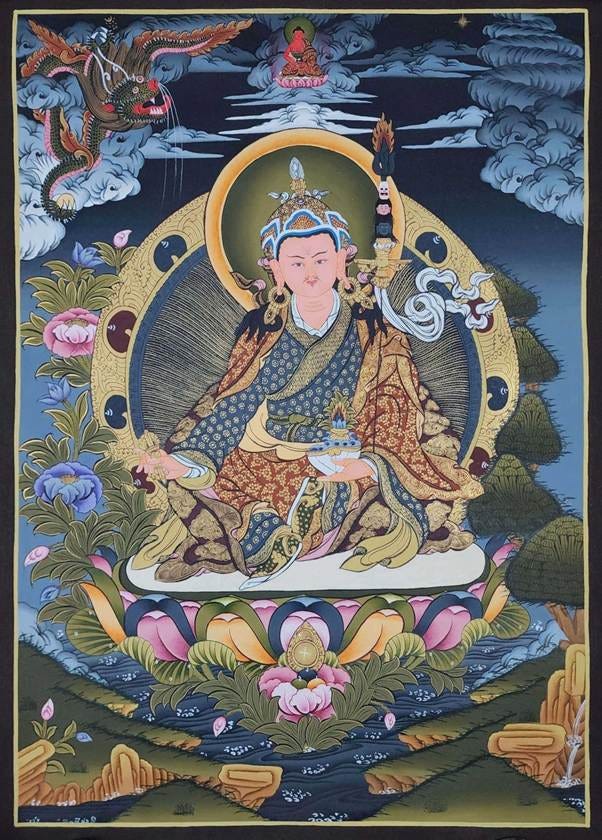
Buddhist Handmade Thangka of Padmasambhava, Guru, Hand Painted , The lotus-born master, wisdom beyond time (Source: Handmade Handicraft)
Bardo is translated into Liberation Through Hearing in the Intermediate State. In Tibetan history it is said to have been written in the eighth century C.E by Padmasambhava (Guru Rinpoche), a great tantric master who brought Buddhism to Tibet. Padmasambhava and his consort, Yeshe Tsogyal, recognized that people were not yet ready to understand this deep psychological understanding, so they buried it as a terma (treasure) buried either physically in the earth or mentally in the minds of people. Six hundred years later, Bardo was rediscovered by the mystic Karma Lingpa.
When Bardo was first brought to the West in 1927, it created a tremendous stir since it was translated by Walter Evans-Wentz. Carl Jung, whose work we looked at last week, was so affected by this that he wrote a psychological commentary for a later edition of Bardo. Jung understood that the terrifying demons and glowing gods in the text are not real entities waiting for you after death, but rather archetypes that represent projections from the depths of the human mind.
The Six Bardos: The Spaces In-Between
In Tibetan Buddhism, the word bardo means “intermediate state” or “gap.” We tend to think of life and death as two distinct, solid things. But the Bardo Thodol teaches that existence is a continuous series of transitions.
The text outlines six specific bardos. Only three of them occur after death; the other three are happening to you right now.
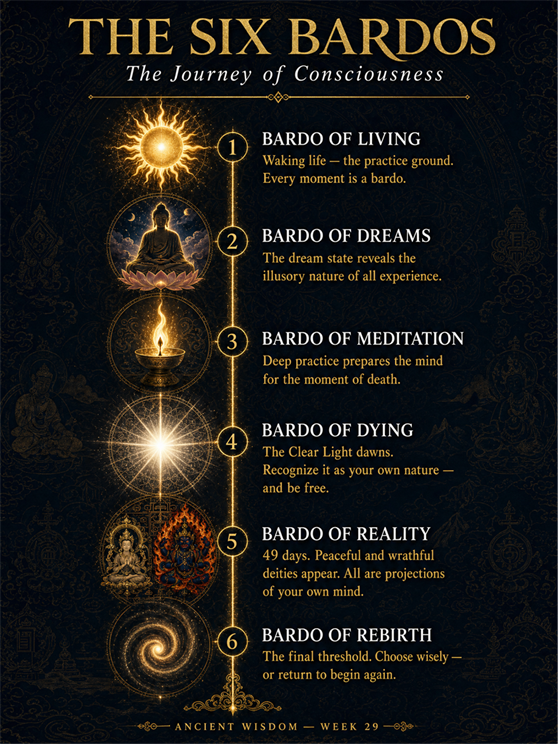
1. The Bardo of Living
The intermediate state of living exists between physical birth to death, providing a sense of permanence yet, according to Tibetan teachings, it is equally a dream. Every moment we experience, when we are awake in life, is considered an intermediate state of existence; transitioning from the past moment to the future moment.
2. The Bardo of Dreams
When individuals enter sleep, they then experience an intermediate state through dreams. During our dream periods, our minds create an entire world around us consisting of people and monsters that we perceive as reality until we wake up. The Tibetan practice of “Dream Yoga” allows individuals to develop the ability to recognize that this world of dreams is not real, to prevent them from experiencing the illusions created by death.
3. The Bardo of Meditation
The intermediate state of meditation is characterized by a state of deep concentration resulting from meditation. In this state, we learn how to quiet the noise from our minds and rest in the state of pure awareness, which prepares us for the ultimate dissolution of the ego.
4. The Bardo of the Moment of Death
During the death process, the individual’s physical body is gradually dismantled. The elements of the body, represented as earth, water, fire and air, all dissolve into space, and, ultimately, at the final moment of death, the ego dissolves and is replaced by the Clear Light of the Dharmata. The Clear Light of the Dharmata represents the unlimited luminosity of true self. For those who recognize the Clear Light without experiencing fear, instant liberation is achieved.
5. The Bardo of Reality
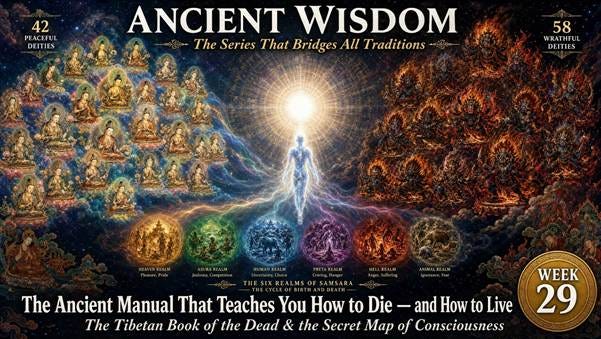
If an individual does not recognize the Clear Light of the Dharmata, which is usually caused by fear created by the ego, then the individual experiences the Intermediate State of Reality for a period of 49 days, during which time they are bombarded with visions. Initially, there will be encounters with 42 Peaceful Deities, characterized by brilliance. This is followed by 58 Wrathful Deities who create terror and demonic fear in the mind of the deceased. The Tibetan teachings again warn individuals not to fear these beings because they are projections created by the deceased’s own mind.
6. The Bardo of Rebirth
For those who still do not recognize their own true nature and fall victim to the winds of karma, their consciousness will be drawn to the darkness of the seductive lights of the six realms of samsara in pursuit of finding a physical body so that escape can occur from the intense nature of the intermediate state.
The Ultimate Lesson: Recognition
The Bardo Thodol serves as an excellent example of the bridge between many of the traditions that we have looked at throughout this series. It parallels the alchemical transformation of the soul, the shamanic journey to the underworld, the Gnostic ascent into heavenly realms, and the Jungian confrontation with the Shadow.
However, its essential message is the most uncomplicated: All that you experience, be it in your life, your dreams, or after your death, is a reflection of your own mind.
When the terrifying and wrathful deities appear in the Bardo, they are just a projection of the anger, guilt, and fear that you have been keeping within yourself. When the peaceful deities appear, they represent your own natural compassion and wisdom. If you run away from the demons, they will pursue you. But if you look at them as manifestations of your own mind, they will be transformed into the Clear Light of your own awareness.
This is why the Bardo Thodol is a guide for living. You don’t have to wait until after you die to practice the teachings of the Bardo Thodol. Every time you feel a feeling of anger, jealousy, or anxiety, you are living in the Bardo. You have a choice. You can be carried away by that emotion and think it has a solid reality, or you can see that emotion for what it is: a temporary projection of your own mind. When you know that, then you can stay in the Clear Light of your own awareness.
The Journey Culminates
For 29 weeks, we have traveled across time and geography, exploring the greatest spiritual traditions of human history. We have sat with Hermeticists in Egypt, shamans in Siberia, Kabbalists in Spain, and Zen masters in Japan.
We have discovered that despite their different languages and symbols, they were all pointing to the exact same truth: the divine is not outside of you. It is within you.
Next week, we reach the Season 1 Finale of Ancient Wisdom. We will synthesize everything we have learned into a single, unified framework.
And for those who are ready to stop reading about these traditions and start living them, I will be making a major announcement. The Ancient Origins Academy is finally opening its doors.
The bardo of reading is ending. The bardo of practice is about to begin.
By Dr Ioannis Syrigos
Recommended Reading
The Tibetan Book of the Dead translated by Gyurme Dorje
The Tibetan Book of Living and Dying by Sogyal Rinpoche
Are you ready to take the next step on your journey? The Ancient Origins Academy is opening its doors next week. Prepare to transform ancient wisdom into lived experience.
Learning to live fearlessly and to die peacefully (without fear) takes much practice. I was only beginning my Buddhist practice when my significant other was diagnosed with esophageal cancer in 2002 (he died in 2004), but Soygal Rinpoche's "The Tibetan Book of Living and Dying" helped e to help Brent have a good death (one without fear) and it has helped me learn to live (and die someday) without fear.