


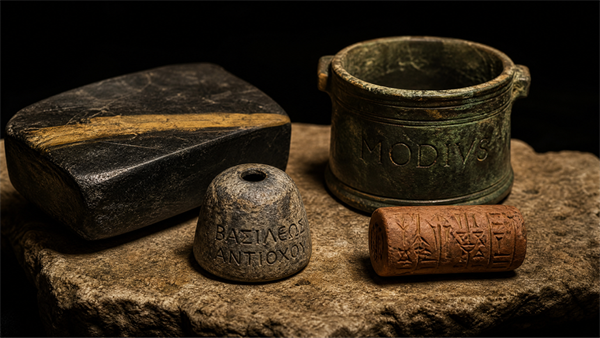
The ancient fraud detection toolkit: a Lydian touchstone for testing gold, a Hellenistic lead weight, a Roman bronze modius grain measure, and a Mesopotamian cylinder seal.
To many, financial fraud, scams, and counterfeit products are considered modern dilemmas brought upon by complicated global supply chains and anonymity made possible by technology. In truth, however, the combat between dishonest merchants and enforcers of market integrity is a story as old as civilization. Thousands of years prior to barcoding, consumer protection agencies, and blockchain technology, ancient societies were in constant struggle to fight against fraudsters. From the bazaars of Babylon to worldwide shipping systems of the Roman Empire, the ancient authorities established extensive quality control, weight standards, and official inspections for the economies to remain stable.
Ancient “detectives of fraud” acknowledged a very important fact that is still valid nowadays: trust is the vital currency of every economy. Without any method to ensure the genuineness of gold, amount of grain, and source of olive oil traded from different regions, the long-distance trade would be impossible.
By examining the physical evidence left behind, we can reconstruct the fascinating history of how ancient civilizations fought back against deception and forgery.
The Birth of the Immutable Ledger: Mesopotamian Cylinder Seals
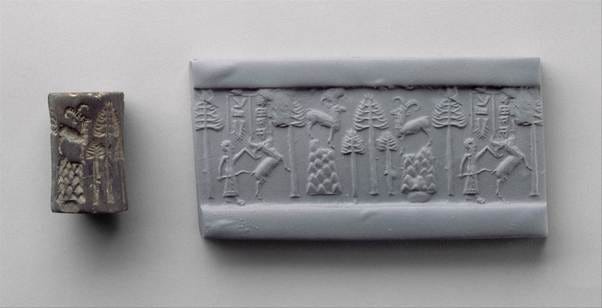
An Akkadian cylinder seal (left) and its modern clay impression (right), depicting a hunting scene. Mesopotamia, ca. 2250–2150 BCE. The Metropolitan Museum of Art, New York. Gift of Nanette B. Kelekian, in memory of Charles Dikran and Beatrice Kelekian, 1999. Public Domain.
In the ancient Near East, the first protection against fraud was cylinder seals. First found in Mesopotamia at approximately 4000 BCE, this small stone cylinder that was carved was used as a signature, a corporate stamp, and a security device.
When a contract, loan, or receipt was written on a clay tablet, the parties would roll their distinct cylinder seal over the wet clay leaving an unbroken raised impression leaving it near impossible to forge. As soon as the clay was baked in the oven, the contract became permanent. In order to guarantee further protection against modification, scribes would sometimes wrap the primary tablet in a thin clay bulla and seal it once more. In the event of a dispute, the envelope could be opened in front of a judge to show the unaltered original document within. This process is similar to modern cryptographic hashing in that any manipulation of the external envelope would be obvious.
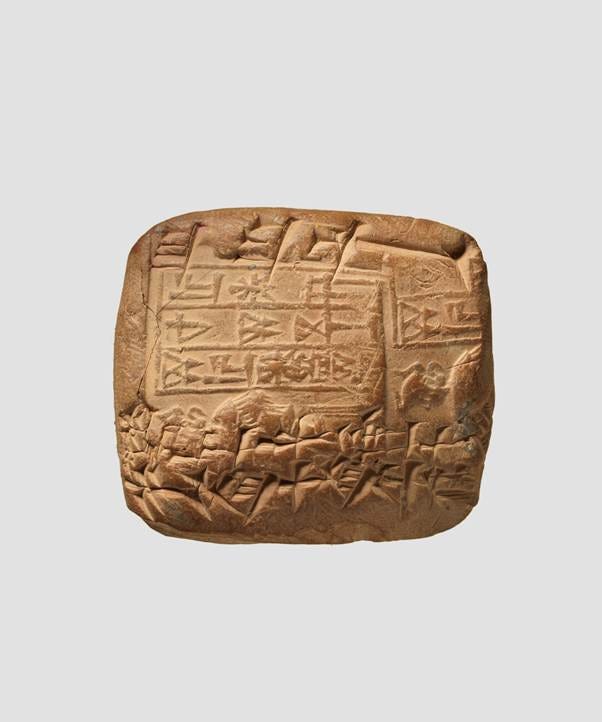
A cuneiform clay tablet impressed with a cylinder seal, recording a receipt of glue - a routine commercial transaction authenticated by an official seal impression. Neo-Sumerian (Ur III period), ca. 2049 BCE. The Metropolitan Museum of Art, New York. Purchase, 1986. Public Domain.
The seals were not only used by the elite but rather by everyone in society to authenticate trade and protect assets. The Code of Hammurabi, enacted in Babylon in 1750 BCE, makes mention of fraud and the repercussions for it indicating that merchants using false weights and shepherds reporting false returns on entrusted livestock must suffer serious consequences for their misdeeds. The reliance upon these physical tokens of identification illustrates the fact that the ancient Mesopotamians knew the dangers inherent with forgery.
The Quest for Standardization: Weights and Measures
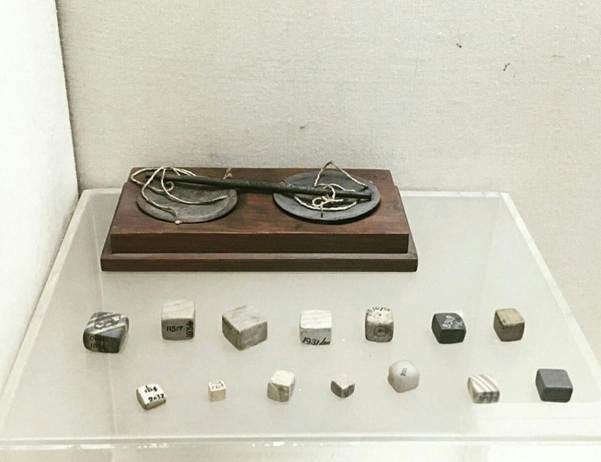
Standardized cubical stone weights from the Indus Valley Civilization (c. 2600–1900 BCE), displayed alongside a balance scale at the National Museum, New Delhi. These weights followed a precise binary ratio system consistent across hundreds of miles of trade routes. Photograph courtesy of the National Museum, New Delhi.
A cornerstone of any functional market is a standardized system of weights and measures. Without it, every transaction is an opportunity for deception. The Indus Valley Civilization (c. 2600–1900 BCE) provides one of the earliest and most impressive examples of rigorous standardization. Excavations at sites like Harappa and Mohenjo-Daro have uncovered numerous cubical stone weights made of chert. These weights followed a precise binary and decimal system, allowing for highly accurate measurements. The uniformity of these weights across a vast geographical area suggests a centralized authority dedicated to maintaining market fairness and preventing the shortchanging of customers.
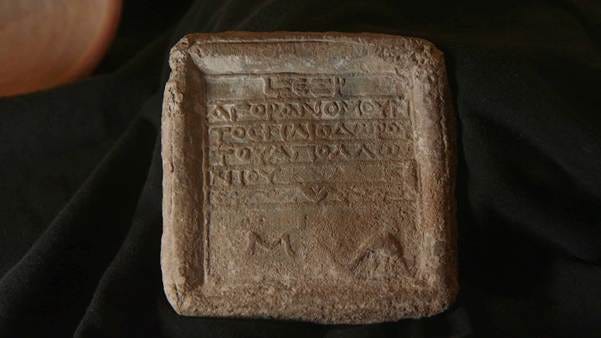
A 2,150-year-old Hellenistic lead weight inscribed with the name of the agoranomos (market inspector) “Heliodorus son of Apollonius,” seized by the Israel Antiquities Authority. The weight served as an official one-mina standard measure. Image: Israel Antiquities Authority / Greek Reporter.
In ancient Greece, the responsibility for preventing fraud fell to the agoranomos, a market inspector tasked with maintaining order and verifying weights and measures. A remarkable artifact recently seized by the Israel Antiquities Authority highlights this role: a 2,150-year-old lead weight from the Hellenistic period. Inscribed with the name “Heliodorus son of Apollonius, agoranomos,” this weight was a standard one-mina measure (equal to 100 Greek drachmas). The presence of the official’s name served as a guarantee of accuracy, and the penalties for using fraudulent weights were severe.
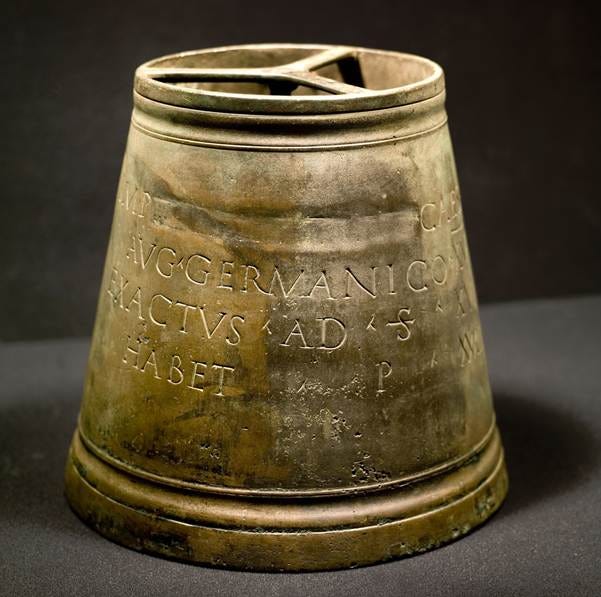
A Roman bronze modius (grain measure) inscribed with the name of Emperor Germanicus and a statement of its official capacity. 1st century AD. This vessel bears the inscription “AUG GERMANICO EXACTUS AD S HABET P,” confirming it was officially calibrated under imperial authority. Image: Google Arts & Culture / Museum collection.
The Roman Empire also recognized the critical importance of standardized measures. In the forum of Pompeii, the Mensa Ponderaria (public weights and measures table) allowed citizens to check the accuracy of the goods they purchased against official standards. Local magistrates, known as aediles, were responsible for enforcing these standards and punishing those who used “smaller measures” (quid minus mensura). Bronze grain measures, known as modii, often bore inscriptions acknowledging imperial regulation, ensuring that the vital grain supply was not compromised by dishonest merchants.
Testing the Incorruptible: Gold and the Touchstone
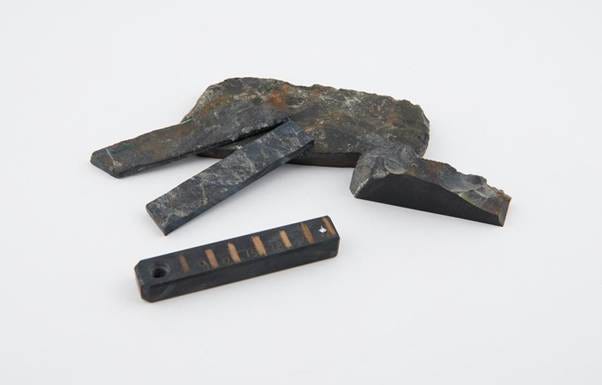
Stone samples suitable for use as touchstones for assaying gold, Czech Republic. The dark lydite stone (top) and a prepared touchstone with gold streak test marks (bottom) demonstrate the ancient method of colorimetric gold purity testing. Science Museum Group Collection. © The Board of Trustees of the Science Museum, London.
Gold has always been a target for counterfeiters and debasers due to its high value and relative softness. In the ancient world, distinguishing pure gold from an alloy of gold and silver or copper was a significant challenge. The solution came in the form of the touchstone, a simple yet highly effective assaying tool.
The touchstone, typically made of a dark, hard stone like slate or lydite (often called Lydian stone), allowed merchants to quickly test the purity of a gold sample. By rubbing the gold against the stone, it left a visible streak. The color and reflectivity of this streak were then compared to the streaks made by standard gold needles of known purity. This colorimetric method was relatively non-destructive and surprisingly accurate in the hands of an experienced assayer. The Lydians, who are credited with inventing the first gold and silver coinage (electrum) around the 6th century BCE, relied heavily on the touchstone to ensure the integrity of their currency.
When more precise verification was needed, ancient scientists stepped in. The most famous example is the story of Archimedes and the golden crown. According to the Roman architect Vitruvius, King Hiero II of Syracuse suspected that a goldsmith had embezzled some of the gold intended for a votive wreath, replacing it with cheaper silver. Archimedes was tasked with determining the wreath’s purity without damaging it. While the popular legend involves Archimedes discovering the principle of displacement in his bath, historians suggest he likely used a more precise method involving a balance scale suspended in water, utilizing his laws of buoyancy and the lever to detect the lighter density of the adulterated crown.
The Great Olive Oil Scams of Rome
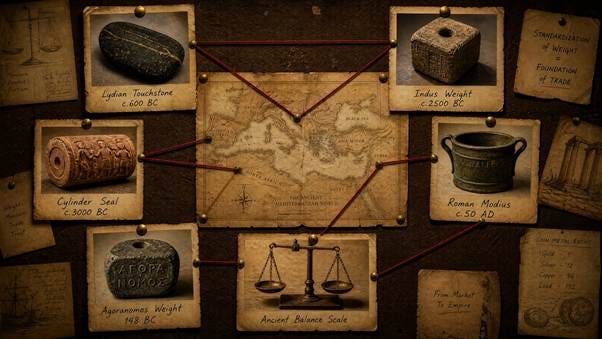
A conceptual investigator’s evidence board connecting the key artifacts and systems of ancient commercial oversight - from Mesopotamian cylinder seals to Roman amphorae labeling.
The sheer scale of the Roman Empire created unprecedented opportunities for logistical fraud. Olive oil, a vital commodity used for food, lighting, and bathing, was imported to Rome in massive quantities, primarily from Baetica (modern Andalusia, Spain). The evidence of this massive trade, and the rigorous quality control systems implemented to manage it, can be found at Monte Testaccio in Rome, an artificial hill composed entirely of an estimated 53 million broken olive oil amphorae.
These amphorae were not just containers; they were labelled as documents. They bore painted inscriptions known as tituli picti, which recorded the empty weight of the amphora, the weight of the oil inside, the names of the merchants, the origin of the oil, and the signatures of the officials who verified the contents. This detailed tracking system was designed to ensure accountability and prevent fraud within the annona, the state-run distribution system. The officials needed to guarantee that the oil was of the correct quality and that merchants were not shortchanging the state by underfilling the vessels or substituting inferior products.
Recent archaeological research has even uncovered potential evidence of “wine scams” in the Roman era, where producers may have added honey to wine to mimic the taste of highly prized, labor-intensive raisin wines like passum, deceiving consumers who believed they were purchasing a premium product.
Conclusion
The ancient fraud detectives may not have had access to mass spectrometry or digital ledgers, but their methods were remarkably sophisticated and effective for their time. From the unforgeable cylinder seals of Mesopotamia to the labeled amphorae of the Roman Empire, these early systems of quality control and inspection laid the foundation for the complex regulatory frameworks that govern our global economy today. The artifacts they left behind, touchstones, standardized weights, and official seals, serve as testaments to the struggle for fairness and integrity in the marketplace.
By Aris Manus
References
Collon, Dominique. Cylinder Seals in Ancient Mesopotamia. World History Encyclopedia, 2 September 2014. www.worldhistory.org/article/846/cylinder-seals-in-ancient-mesopotamia/
Ancient Origins Editorial Staff. “How Babylonian Fingerprints and Clay Seals Prefigured Modern Blockchain Technology.” Ancient Origins, 2018. www.ancient-origins.net/news-history-archaeology/ancient-blockchain-0022307
King, L.W. (trans.). The Code of Hammurabi. The Avalon Project, Yale Law School, 2008. www.avalon.law.yale.edu/ancient/hamframe.asp
Kenoyer, Jonathan Mark. “Uniqueness of the Ancient Indus Weight System.” Harappa.com, 2010. www.harappa.com/blog/uniqueness-ancient-indus-weight-system
Tsangin, Ido. “A Looted Hellenistic Weight.” Biblical Archaeology Review, Biblical Archaeology Society, 2025. www.biblicalarchaeology.org/daily/ancient-cultures/ancient-israel/a-looted-hellenistic-weight/
Smither, Philip. “Roman Weights and Measures.” Lucius’ Romans, University of Kent, 13 December 2017. www.blogs.kent.ac.uk/lucius-romans/2017/12/13/roman-weights-and-measures/
Moore, D.T., and W.A. Oddy. “Touchstones: Some Aspects of Their Nomenclature, Petrography and Provenance.” Journal of Archaeological Science, vol. 12, no. 3, 1985, pp. 169–176. See also: “Touchstone (assaying tool).” Wikipedia. www.en.wikipedia.org/wiki/Touchstone_(assaying_tool)
Decent Group Editorial. “How Did Ancient People Test the Purity of Gold? They Used a Touchstone.” Decent Group, 2022. www.decent-group.com/how-did-ancient-people-test-the-purity-of-gold-they-used-a-touchstone/
Rorres, Chris. “The Golden Crown: Introduction.” New York University Department of Mathematics, 2004. Citing Vitruvius, De Architectura, Book IX, Introduction, c. 15 BCE. www.math.nyu.edu/Archimedes/Crown/CrownIntro.html
Mattingly, David J., and John Salmon (eds.). Economies Beyond Agriculture in the Classical World. Routledge, 2001. See also: Remesal Rodríguez, José. “Monte Testaccio and the Roman Olive Oil Trade.” Journal of Roman Archaeology, 1998.
Broekaert, Wim. “Joining the Dots: Evidence for Brokerage in Roman Trade.” Ancient Society, vol. 42, 2012, pp. 247–284. Leuven University Press.
Trainor, Conor. “How I Uncovered a Potential Ancient Rome Wine Scam.” The Conversation, University College Dublin, June 2025. theconversation.com
