


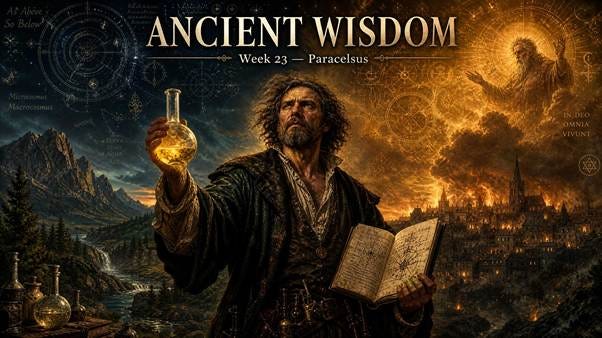
In 1527, Basel Switzerland was bustling with students, merchants, and horrified professors standing in the crowded Market Square. In the middle of the square was an eccentric doctor who had long hair and was standing with a large, leather-covered book, Avicenna’s Canon of Medicine, which for centuries had been the unquestionable authority of European Medicine.
Without any politeness or courtesy, the doctor hurled the valuable book into a flaming bonfire.
The doctor was called Paracelsus; a genius, an itinerant alchemist, and an intensely mystical individual. He burned the book because he believed that the medical academy had made a grave mistake in separating the body from the spirit and science from God.
He taught his angry colleagues that it was impossible to heal someone if they were to be viewed only as biological machines; they had to be treated as microcosms of the entire Universe. He said, “Your patients are your textbook, and your patients’ beds are your laboratory.”
This week, we will learn about the rebellious and radical wisdom of Paracelsus and how his philosophical theory of alchemy joined science and spirituality. His work encourages the reader to look at their individual wellness and growth in a different light; using the idea of their “inner doctor”.
Who Was Paracelsus?
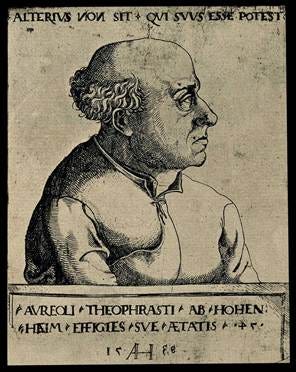
Paracelsus (meaning beyond Celsus), the name given to Theophrastus Bombast von Hohenheim, was born in a small village in Switzerland in 1493. His father, a physician and chemist, educated him, and after attending various universities throughout Europe, he found himself disillusioned by the reliance of academic medicine on ancient texts rather than on the observation of nature. Paracelsus strongly believed that the only way to become a physician was through direct experience. As a result, he began travelling extensively throughout Europe, the Middle East, and perhaps even Egypt. He was initially employed as an army surgeon but also spent time learning from folk healers, midwives, and executioners, and delved into the complex and often misunderstood esoteric traditions of alchemy and Hermeticism.
When Paracelsus returned to academia and took up a position at the University of Basel, he was unlike anything the university had seen before. He taught his classes in German rather than in Latin so that everyone could benefit from his insights. He was groundbreaking in his applications of chemical elements and minerals as therapeutic agents, establishing him as the father of toxicology; at the same time, his combative nature and vigorous critiques of the medical system made him unwelcome. Eventually, he was forced to flee Basel in the night. He continued his work as a wandering healer and writer until his death in Salzburg, Austria, in 1541.
The Three Principles of Paracelsus
Paracelsus was a profound spiritual philosopher. He believed that the universe was a living, breathing organism, and that human beings were intimately connected to the stars, the earth, and the divine.
1. As Above, So Below (The Microcosm and Macrocosm)
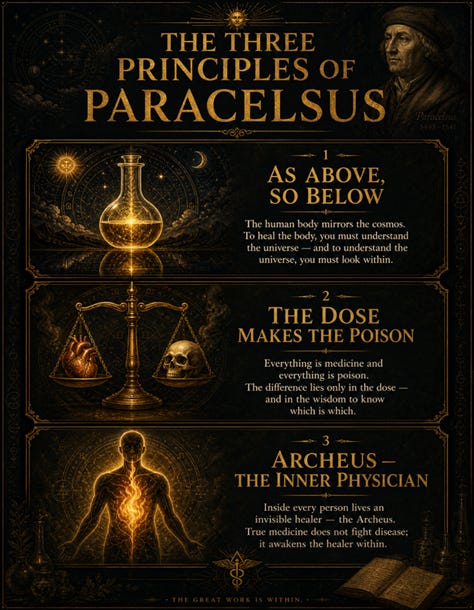
The concept of “As Above, So Below” is a reflection of the idea of microcosm and macrocosm, which are terms used to describe the relationship between two distinct levels of reality. Paracelsus, an influential figure from the Hermetic tradition, published his thoughts and works in the book “De Natura Rerum” in the early 1500s. He believed that the human being is a microcosm (a little version of the entire universe) and that every star or planet that exists in the sky corresponds to an element found in the human body. To understand the human body, you must first understand the universe. To truly understand the universe, you must look within yourself. In Paracelsus’ belief system, science and spirituality are not separate disciplines; they are two extremes of the same whole and can be viewed as one through the lens of a telescope.
2. The Dose Makes the Poison
Paracelsus’ assertion that “the dose makes the poison” has had lasting effects on the evolution of modern-day pharmacology and toxicology; however, it also has spiritual significance in the concept that “everything has a toxin associated with it.” Paracelsus wrote,
“All things are poison and nothing is without poison. The dose makes it so that a thing is not a poison.”
For instance, the goal of a practicing alchemist is to extract the medicinal properties of a plant or mineral that has an inherent toxic property. This can also be applied to our daily lives. Everything in our life has the potential to either support or hinder our growth as individuals. Our greatest weakness, pain, and darkness contain within them the necessary ingredients to help us grow if we learn to utilize them correctly.
3. Archeus: The Inner Physician
According to Paracelsus, healing does not occur when someone receives a dose of medicine from another person but rather from within. Paracelsus taught that every living thing possesses an unseen force called the Archeus (or the inner physician). The external herbs and minerals used in the practice of medicine merely provide support for the Archeus to function by removing any barriers that obstruct its efforts. Healing is not an external process; it is the awakening of the knowledge and skills that already exist in the individual.
Is it Important Today?
Humanity has created a dichotomy between Mind and Body with regard to our support systems - Body as machine being fixed, Mind as software that requires optimization and Soul as an afterthought.
Paracelsus teaches us that this idea of a separation between Body, Mind and Spirit is an illusion. You cannot fix one part of a system without fixing the entire system. When you feel anxious, stuck or unhealthy, you typically require more than just another treatment or productivity hack; you need to look at the overall ecosystem in which you live (e.g., environment, social network, belief system, connection to Source).
In addition, the concept of the Archeus Notion helps to empower people by telling them they already possess all the knowledge required to heal their life, fulfil their purpose and grow through the challenges in life. They do not require an external source (i.e., teacher, healer, guru, etc.) to heal themselves; only identify and remove the obstacles within that prevent you from utilizing the resources you already possess.
How to Practice Alchemical Wisdom
You can use Paracelsus’s alchemical philosophy in everyday life without having to go to a lab. You can do this in 3 ways:
1. Find the Medicine in the Poison
Take a look at something difficult or toxic in your life. Instead of trying to wipe it out completely, ask yourself this question, “What is the good that may be hiding within this?” How can I make this situation into something I can use for strength, resilience or deeper understanding? Remember, the dose makes the poison.
2. Treat the Whole, Not the Part
The next time that you feel physically exhausted or mentally drained, do not look at just the symptoms. Instead, try to step back and consider your entire life as if you are viewing it as a whole. Are you spending time in nature? Are your relationships healthy? Are you aligned to your deeper purpose? Treat your entire ecosystem and not just one isolated problem.
3. Trust the Inner Physician
Before asking anyone else for advice on a tough decision, sit down and take a few moments to reach out to your Archeus within. Trust that your Inner Physician knows the answer to your question and is the only one who does. You are not trying to force the solution; you are clearing away all of the mental and emotional debris so that your Inner Physician can work freely
The Great Work is Within
Paracelsus rejected the view that humans are insignificant, disconnected and powerless, therefore, he was a “rebel”. He saw the divine spark in the dirt, the stars, and the human heart, and he spent his life trying to teach others to see it too.
Real alchemy does not occur when the physical attributes of materials (i.e., lead and gold) are changed; real alchemy takes place when the material aspect of our human experiences (i.e., pain, confusion, etc.) are transformed into wisdom and compassion (i.e., spiritual gold); the laboratory in which this transformation occurs is already located within us.
Recommended Reading
Paracelsus: Essential Readings translated by Nicholas Goodrick-Clarke
The Hermetic and Alchemical Writings of Paracelsus translated by A.E. Waite
A Note from Dr. Syrigos
For 23 weeks, we have journeyed through the greatest philosophical and spiritual traditions in human history. We have explored the wisdom of emperors, mystics, shamans, and alchemists.
But reading about wisdom is only the first step. The true Great Work, as Paracelsus would say, is applying it.
Next week, in our Season 1 Finale, I will be making a major announcement. We are opening the doors to something entirely new, a way to take these ancient teachings off the page and turn them into lived experience.
The waitlist for the Ancient Origins Academy is opening soon. Keep an eye on your inbox next week.
Learned a lot about Paracelus and his work from your article. He was the real deal.