

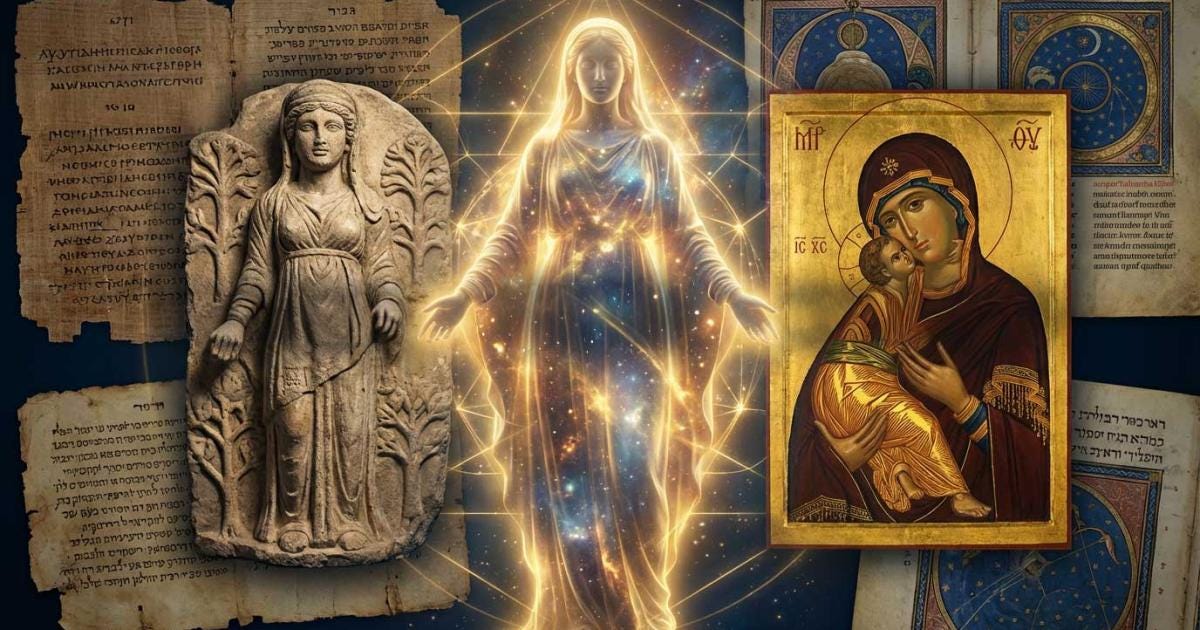
Long before Christian doctrine hardened into fixed creeds, before councils decided what could be remembered and what had to be erased, there existed a theological tension that never fully resolved. It concerned not Christ, nor God the Father, but a missing presence, a feminine principle that appeared repeatedly, was redefined, and then submerged. Its names changed, its functions shifted, but its structural role remained stubbornly intact.
This is not a simple story of “goddess worship” suppressed by monotheism. It is a story of persistence, of forms that survive by being re-coded, of the way religious systems keep what they cannot destroy by relocating it into safer containers. What disappears is not the function but the visibility. Over time, the feminine principle is pushed from deity to attribute, from authority to symbol, from cosmic actor to devotional figure. Yet the pattern remains.
In Gnostic texts, preserved in fragile Coptic codices found near Nag Hammadi, she is called Sophia, wisdom itself, luminous intelligence whose misaligned desire initiates a fractured world. In the religious landscape of the ancient Levant, she appears as Asherah, a goddess intimately linked to early Yahwistic worship before being systematically removed. In later Christian memory, stripped of overt divinity, her traces surface again in figures like Mary and Margaret, women associated with purity, wisdom, descent, restoration, and intercession.
This article does not argue that these figures are historically identical, or that later Christianity secretly “worshipped” a goddess in disguise. It documents continuity of structure. A pattern of reappearance that survives suppression. What was known before it was hidden, and why does it continue to surface now?
