

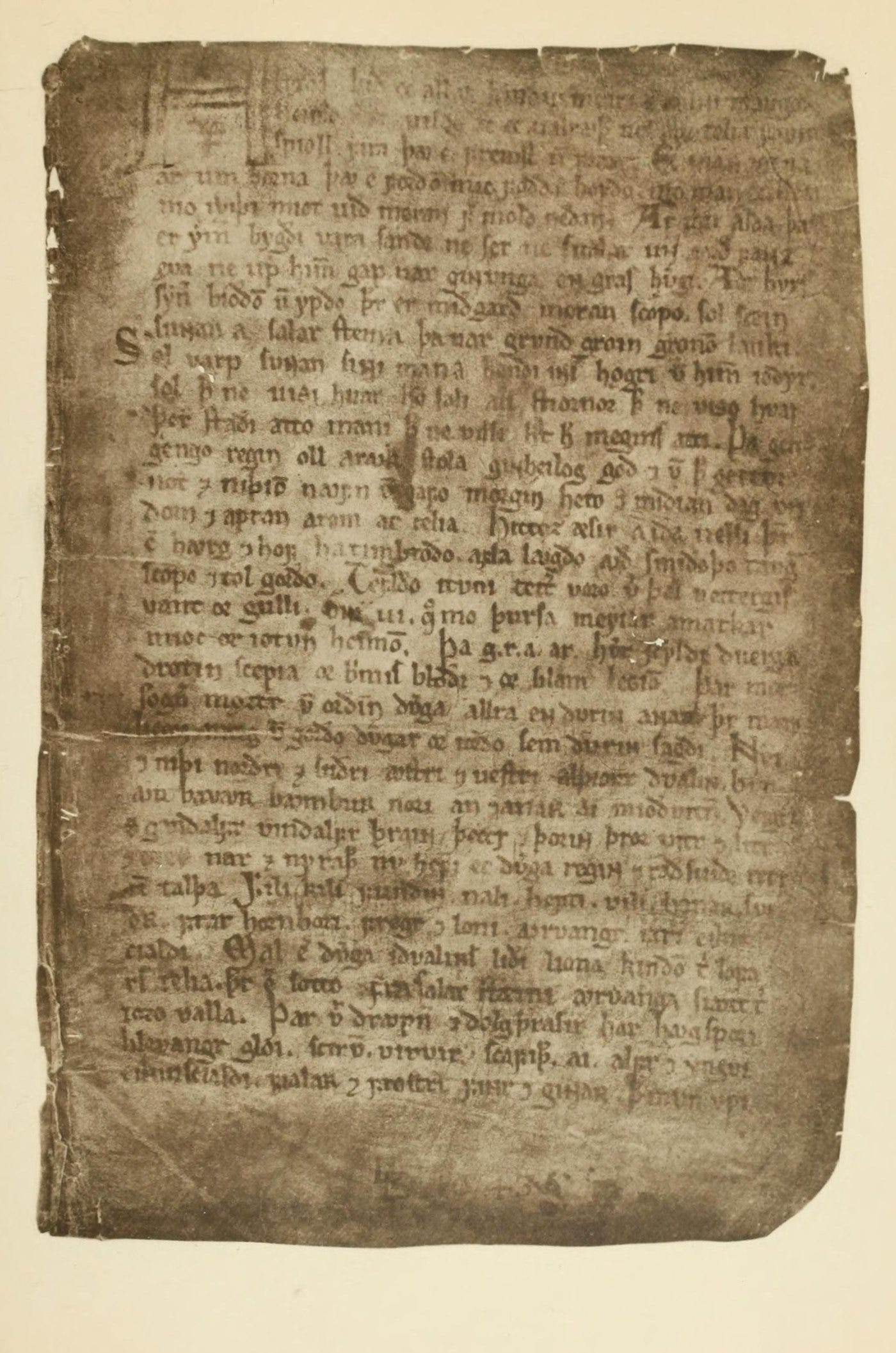
Skálholt, southern Iceland, 1643. Brynjólfur Sveinsson, bishop of the old southern see, marked the books he owned. On the first leaf of one small vellum volume he wrote two letters and a year: LL, 1643. The letters stand for Lupus Loricatus, the armored wolf. It was a Latin joke on his own name. In Icelandic a brynja is a mail shirt and an úlfur is a wolf.
The bishop did not know who had made the book. He guessed Sæmundr the Learned, a priest of the 1100s, and called it Sæmundar Edda. Scholars dropped that guess long ago, though the name still turns up. The book was copied in Iceland around 1270 by a scribe no one can name.
In 1662 the bishop sent it to King Frederick III of Denmark as a gift. That gift gave the book its name. It became the Codex Regius, the King’s Book, Konungsbók in Icelandic. In the Royal Library in Copenhagen it took the shelfmark GKS 2365 4to. It stayed there for more than three centuries.
The book is modest to look at. Today it has 45 leaves of vellum and it holds the poems scholars call the Poetic Edda, arranged with some care. Poems about the gods come first. Poems about heroes follow, in rough story order…

