

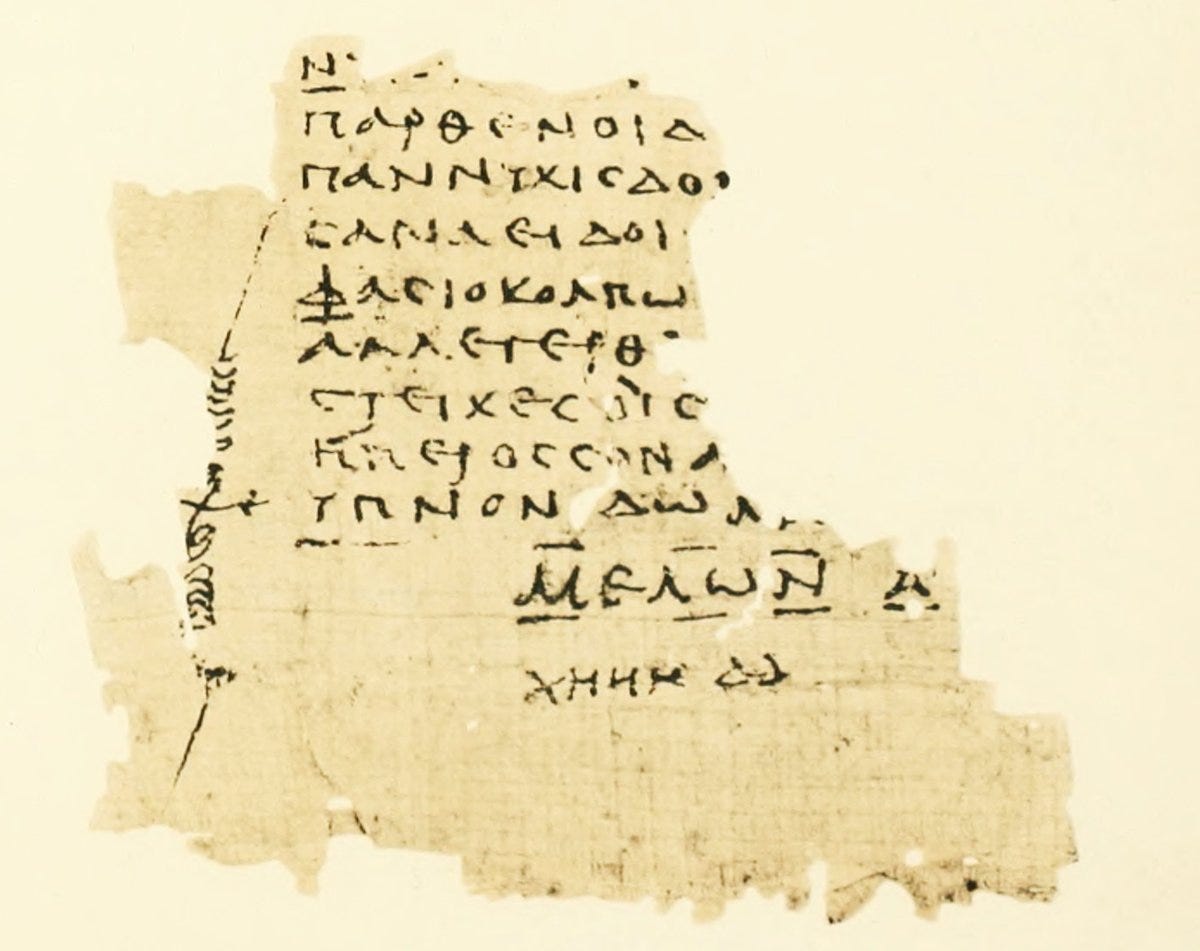
Much of what is known about Oxyrhynchus came out of its garbage. For centuries its Greek speaking residents threw old letters, tax forms, school exercises and worn out books onto heaps beyond the edge of town, where the dry Egyptian sand slowly covered them over.
The town sat on a branch of the Nile south of Memphis, and its name meant the City of the Sharp-nosed Fish. Very little of it stands today, since one column is all that survives above ground of its colonnades, temples and a theater. Yet the mounds outside the old walls stayed largely untouched until the end of the nineteenth century.
Two young Oxford scholars, Bernard Grenfell and Arthur Hunt, began digging there in the 1890s on behalf of the Egypt Exploration Fund. What came out of the ground filled baskets and boxes, and then a publication series that is still running more than a century later. Some pieces carried poetry that no one had read since antiquity, while far more recorded the small business of daily life.
Those finds now sit in Oxford, in a collection belonging to the Egypt Exploration Society. The Oxford project that looks after them describes the papyri as a collection that “comprises thousands of texts on papyrus and parchment and is the largest of its kind in the world.” The number of fragments still waiting for an editor is much larger than that.
That backlog has suddenly become a talking point online, where artificial intelligence is the new hope. On November 1, 2026, Ethan Mollick posted on X that funded projects using AI to clear old translation backlogs “would be interesting.” He named the Oxyrhynchus Papyri as one of the “major repositories of untranslated ancient work” he had in mind.
Replies piled up quickly, and many of them took the idea further than Mollick did. Some replies pictured machines translating the whole archive quickly, while others pointed to the charred scrolls from Herculaneum, which software has started to read without unrolling them, and to research tools from Google DeepMind that restore damaged inscriptions.
The two sides of the debate draw on the same small set of results. Supporters say the tools already exist and only need money and data, and skeptics answer that a faded scrap of Greek is a very different problem from a chess board or a photograph, and that every reading still has to be checked by a trained papyrologist.
The question of how many of those scraps remain unread has a real answer, and so does the question of what software has actually managed to do with ancient writing, since both answers come from named projects with published figures. So can artificial intelligence really unlock the rubbish dumps of Oxyrhynchus, or is the hope running well ahead of the evidence?
