

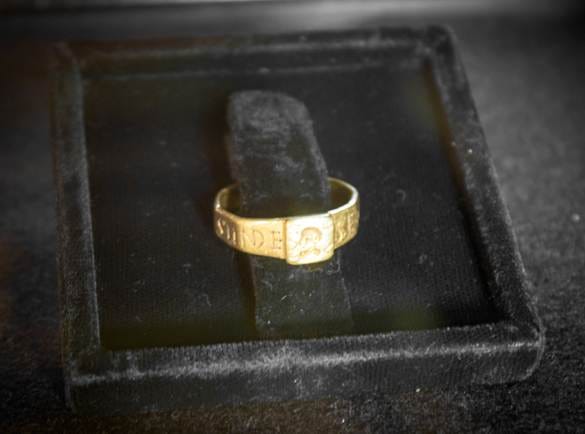
A Roman man lost a gold ring. Another man wore a ring bearing the name of the suspected thief. And then a curse asked a god to deny that thief his health.
Time forward to more than fifteen centuries later, and the story reached J. R. R. Tolkien.
That sequence sounds almost too perfect. It contains a stolen ring, an inscription, a curse, an ancient sanctuary, and the scholar who later created the most famous ring in modern literature. It is easy to understand why the object at The Vyne in Hampshire has been called a possible source for the One Ring.
The evidence proves that Tolkien studied the temple and its mysterious god, but it does not prove that this particular ring inspired his fiction. The real story though is more uncertain, and perhaps more interesting, than the legend that grew around it.
The Ring in the Field
Around 1785, a farmer ploughing near the abandoned Roman town of Silchester uncovered a large gold ring. It eventually entered the collection of the Chute family at The Vyne, where it remains today.
The ring is a bit unusual. It weighs about twelve grams and has a ten sided hoop attached to a square bezel. The bezel carries an engraved profile surrounded by the word VENVS. Around the hoop is a second Latin inscription: Seniciane vivas in Deo. It is normally understood as a wish that Senicianus should live in God.
Now, what is weird, is that Venus belongs to the older Roman religious world, while the phrase on the band is associated with early Christianity. The National Trust dates the ring to roughly AD 350 to 450, a period when both traditions existed beside one another in Britain.
But the name Senicianus would eventually pull the ring into a much darker story.
A Curse One Hundred Miles Away
At Lydney Park in Gloucestershire, archaeologists found a thin sheet of lead at a Roman sanctuary dedicated to the god Nodens. The writing records the anger of a man named Silvianus. His ring was gone, and he believed someone called Senicianus was responsible.
The message asks Nodens to deny health to anyone named Senicianus until the ring is returned to the temple. Silvianus promises the god half the value of the missing object.
But this was not a private diary entry. It appears to be an appeal to supernatural justice! In a world without modern police or insurance, a victim could hand a grievance to a god and ask for punishment. Convenient, isn’t it?
Once antiquarians noticed the same name on the Lydney tablet and the Silchester ring, an irresistible story formed. Senicianus had stolen the ring, worn it despite the curse, and lost it near Silchester. The object in Hampshire was therefore the very treasure named on the tablet in Gloucestershire.

Tolkien Enters the Story
The connection to Tolkien is real, but narrower than the popular version suggests.
Archaeologist Mortimer Wheeler worked at Lydney Park and asked Tolkien, then an Oxford scholar of language, to investigate the name Nodens. Tolkien contributed a specialist note to the excavation report published in 1932. His task was linguistic, and he examined the name of the god and its possible roots.
This places Tolkien directly inside the scholarly history of the Lydney site. He knew about the sanctuary, the inscriptions, and the strange world surrounding Nodens. Later accounts also suggest that Wheeler discussed the possible ring connection with him.
The timing though encouraged speculation. Tolkien was developing the stories that became The Hobbit during the same general period. A cursed gold ring connected to a place called Dwarf Hill seems almost designed to invite comparison with Middle Earth, isn’t it?
Did It Inspire the One Ring?
No surviving letter, notebook, or statement from Tolkien identifies the Senicianus ring as his inspiration. The National Trust now warns that the object has previously been wrongly presented as the source of The Lord of the Rings.
There is also uncertainty at the beginning of the story. The National Trust considers a direct connection between the ring and the curse tablet unlikely. The two objects were found far apart, and Senicianus was not a unique name. The ring itself names Senicianus, not Silvianus, which creates another difficulty if it was the stolen object described at Lydney.
Tolkien unquestionably studied Nodens and the Lydney material. He may have encountered the dramatic story that antiquarians built around the gold ring. That story could have then joined the many myths, languages, objects, and legends that nourished his imagination. Yet the claim cannot be demonstrated, although it makes sense.
The Ring Controversy Still Alive
The object does not need Tolkien to be remarkable. It survives from a moment when Roman Britain was changing, old gods remained present, and Christian language was becoming more visible. Its inscriptions preserve that complicated world in a single piece of gold.
The curse tablet is equally human. It records loss, suspicion, anger, and the hope that a divine power might succeed where ordinary justice had failed. Whether or not the two objects belonged to the same quarrel, each reveals how people tried to protect property and make sense of misfortune.
The Tolkien connection adds one final layer. It shows how an ancient artifact can acquire a second life through modern storytelling. A ring found in a field became connected to a curse found at a temple, then to a scholar studying an unfamiliar god, and finally to a literary legend known around the world.
It is possible that this ring helped inspire Tolkien. Whether we will know for sure or not, we do not know. What we can say though with confidence is that the story surrounding it has become powerful enough to resemble one of his own: an object passes through time, gathers meanings, and becomes far larger than the person who first wore it.
Top Image: The Ring of Senicianus, a late Roman gold signet ring found near Silchester. Its inscription asks that Senicianus live in God. Source: Photograph by Simon Q, via Wikimedia Commons. CC BY 2.0.
By Aris Manus
References
National Trust Collections. Ring of Senicianus, inventory 719789. https://www.nationaltrustcollections.org.uk/object/719789
Roman Inscriptions of Britain. RIB 306, Curse upon Senicianus. https://romaninscriptionsofbritain.org/inscriptions/306
BBC News. J. R. R. Tolkien ring goes on display at The Vyne exhibition. https://www.bbc.com/news/uk-england-hampshire-22008746
The Guardian. The Hobbit ring that may have inspired Tolkien put on show. https://www.theguardian.com/books/2013/apr/02/hobbit-tolkien-ring-exhibition


