

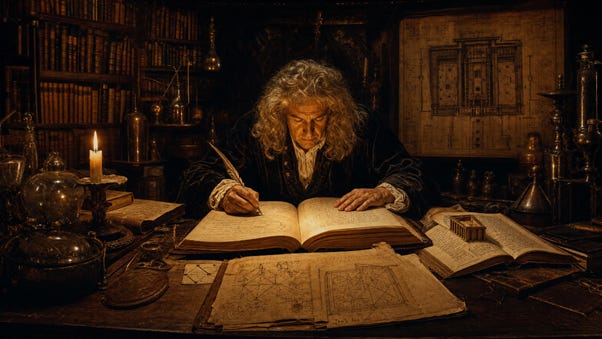
When the gavel fell at Sotheby’s London auction house in 1936, the academic world braced for a revelation. Up for sale were the “Portsmouth Papers”, a massive cache of unpublished manuscripts written by Sir Isaac Newton, the undisputed father of modern physics. Scholars expected to find the discarded drafts of Principia Mathematica, early sketches of calculus, or perhaps unrecorded optical experiments.
Instead, they found madness. Or rather, they found a man who had spent his entire life searching for something far more profound than gravity.
Of the 329 lots auctioned that day, more than a third were entirely alchemical and theological in nature. They contained over a million words, more than Newton ever published on science, detailing his obsessive quest to decode biblical prophecy, his secret denial of the Holy Trinity, and his decades-long attempt to reconstruct the architectural blueprints of the Temple of Solomon.
John Maynard Keynes, the legendary economist who purchased many of these manuscripts, was stunned by what he read. He later delivered a lecture to the Royal Society that shattered the myth of the rational scientist:
“Newton was not the first of the age of reason,” Keynes declared. “He was the last of the magicians, the last of the Babylonians and Sumerians, the last great mind which looked out on the visible and intellectual world with the same eyes as those who began to build our intellectual inheritance rather less than 10,000 years ago.”
The man who defined the laws of motion did not view the universe as a cold, mechanical clock. He viewed it as a divine cryptogram. And for his entire life, Newton was secretly trying to build the key to unlock it, a conceptual “God Engine” that would reveal the mind of the Creator.
