


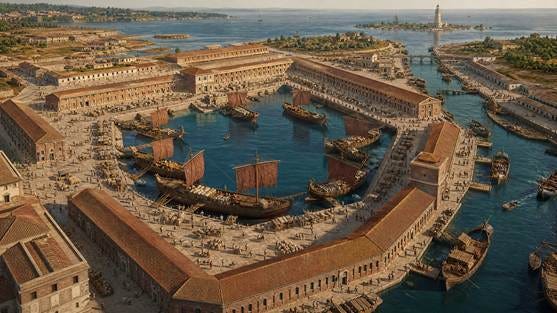
Portus at its height in the 2nd century AD - grain ships, warehouses, and the Trajanic hexagonal basin. AI-generated reconstruction based on archaeological data from the Portus Project (Simon Keay, British School at Rome / University of Southampton). Reference plans: Keay et al., 2005, Portus: An Archaeological Survey of the Port of Imperial Rome.
Consider a city with a million residents. If you took away electricity, refrigeration, freight rail systems and gasoline engines, how long would it take that city to starve?
For the ancient Romans, the answer used to be a matter of weeks. By the 2nd century AD, Rome was an uneasy giant with a voracious appetite that outstripped the agricultural productivity of the entire Italian peninsula. Rome consumed around 650 million pounds of wheat yearly just to stay alive. With no continuous, massive influx of grain, a famine would kill the city due to riots and political unrest.
In order to solve such an impossible issue, the Romans did not create new technology; they developed a new type of logistics for states. They transformed the entire Mediterranean Sea into a conveyor belt. They put up such huge artificial harbors that they sometimes even looked like big towns. They also designed warehouses that “breathe.” They formed a state-supported supply chain called Annona to transport grains grown in North Africa straight to the bakeries in Rome.
Nevertheless, the system was not as effortless as it seems. This was a very unstable, risky gamble that could work well only due to the exploitation of dockworkers, sailors, millers, and slaves.
If you want to understand how the Roman Empire actually worked, you have to look past the marble temples and the legions. You have to follow the grain.
