


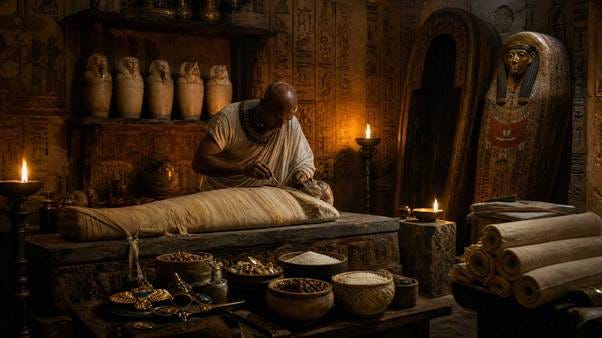
Inside an ancient Egyptian embalming workshop, where eternity was a booming business.
Somewhere in the Valley of the Kings, a family is bargaining with a man who has a mild scent of cedar oil and natron. The family head has just died. He was not a pharaoh; he was just a scribe, a medium-ranked official who lived a life hoping for good eternal life. The widow of the heads is now in the embalming section, watching the wooden model of the dead man, and the man who is doing the embalming is explaining things to her. The pricing of the different types of embalming is tremendous.
This has been occurring throughout ancient Egypt for thousands of years. Mummification was not just for rulers but a worker’s trade. Ancient Egyptians believed that a body is very important for a person to go to afterlife. If the person does not have a body, then the soul has no other place to go to during the afterlife.
What did that payment actually look like? How much did the linen cost? What did the embalmers charge? Who could afford the gold amulets, and what happened to those who couldn’t? The answers, drawn from ancient records, recent archaeological discoveries, and the painstaking work of Egyptologists, are more specific, and more surprising, than most people realize.
The Three Tiers of Eternity
The Greek historian Herodotus, writing in the 5th century BC, was the first to document the commercial structure of Egyptian mummification in any detail. In Book II of his Histories, he described how embalmers operated much like modern funeral directors, presenting families with a choice of packages based on their financial means. The embalmers, he wrote, showed “wooden models of corpses made like reality by painting” and asked which method the family desired. Having agreed on a price, the family left, and the work began.
The Elite Package was the most expensive and most complete. The brain was extracted through the nostrils using a crooked iron hook. The embalmers then made an incision in the flank with a sharp Nubian stone and removed the entire contents of the abdomen. The cavity was washed with palm wine and then with bruised aromatics, before being filled with pure ground myrrh, cassia, and other spices — frankincense notably excluded. The body was then packed in natron for exactly 70 days. After washing, it was wrapped head to foot in fine linen bandages smeared with gum. The result was returned to the family, who enclosed it in a painted wooden coffin shaped like a human figure.
The Middle-Class Option was cheaper and considerably less invasive. Embalmers filled a syringe with cedar oil and injected it into the abdomen without making any incision. The body was sealed and left in natron for the prescribed period. When the cedar oil was finally drained, it brought out the liquefied internal organs with it. The natron had dissolved the flesh in the meantime, leaving only skin and bones. The family received what remained, and that was that.
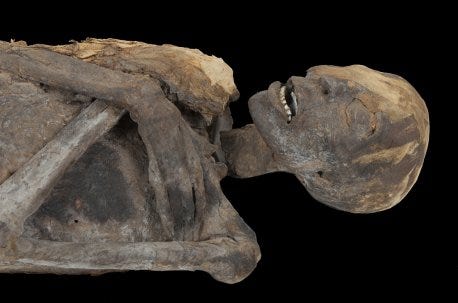
An unwrapped ancient Egyptian female mummy with remnants of linen bandaging, Yale Peabody Museum. The quality of preservation depended heavily on how much a family could afford to spend. (Photo: Yale Peabody Museum)
The Budget Burial was blunt. The intestines were cleared with a purge. The body was placed in natron for 70 days. It was then returned to the family. No wrapping, no spices, no ceremony beyond what the family could arrange themselves.
Modern research has complicated Herodotus’s account in interesting ways. Researchers analyzing mummies through CT scanning found that contrary to Herodotus’s descriptions, the trans-abdominal incision was common across social classes — not exclusively reserved for the elite. The cedar oil enema, meanwhile, left little physical evidence in the mummies they examined. Herodotus was writing as an outsider, and embalmers were famously secretive about their methods. What he documented was likely the commercial pitch, not the full technical reality.
The Currency of Death
The main issue of figuring out what all of the previous things look like in terms of cost rests on understanding the currency used. The currency used in New Kingdom Egypt (approximately 1550–1070 BC) was the deben, which was a weight of copper weighing approximately 91 grams. The value of one deben was approximately the cost of two loaves of bread. For five deben, one could buy a goat, a pair of sandals, or a woven linen shirt. A skilled craftsman at Deir el-Medina earned pay of approximately 5 to 7.5 deben per month in grain and goods.
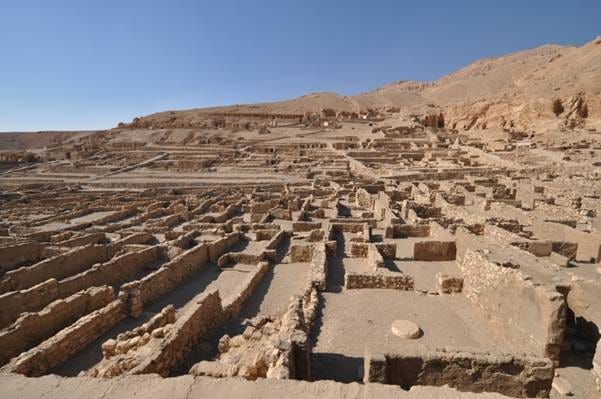
The ruins of Deir el-Medina, the craftsmen’s village that produced the Valley of the Kings tombs. The ostraca and papyri found here contain the most detailed surviving price records for ancient Egyptian funerary goods. (Photo: World History Encyclopedia)
The records at Deir el-Medina, the village where the craftsmen who built the tombs for the kings of Egypt lived, provide the best record for funeral goods prices. Egyptologist Kathlyn M. Cooney was able to analyze 168 different prices recorded from this village, thus making it truly a display of the extreme variability of prices reflecting stratified social levels.
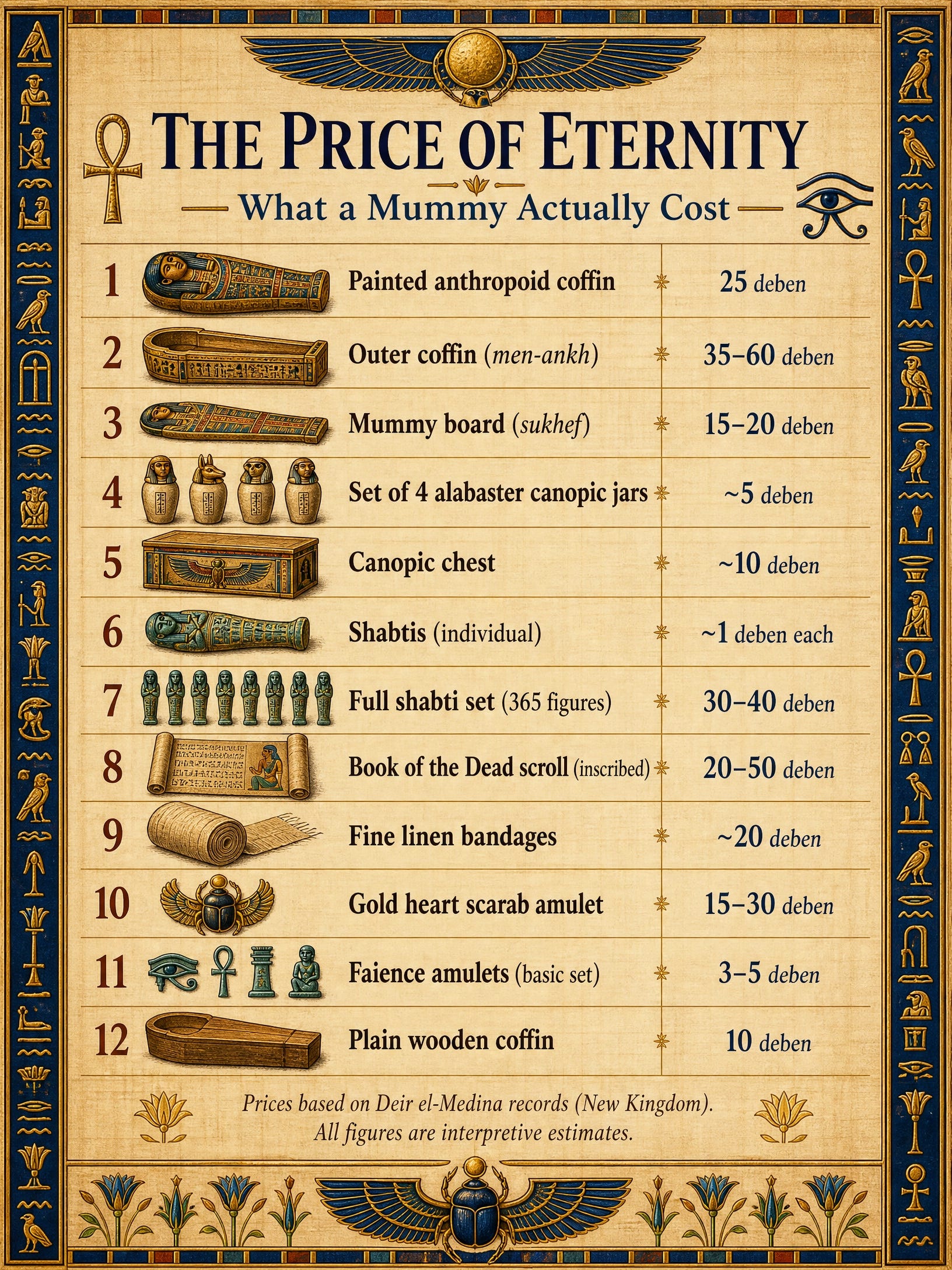
Approximate costs of key funerary items based on Deir el-Medina records (New Kingdom). All figures are interpretive estimates. (Image: Interpretive infographic based on Cooney, 2008)
A blank roll of papyrus was relatively cheap, about one-fifth of a worker’s monthly salary. But a papyrus inscribed with funerary texts could cost the equivalent of half a year’s income for a skilled artisan. For a full set of decorated coffins, a worker might pay more than his entire annual wage. As Egyptologist Edward Wente noted, a decent tomb and burial tended to be more important economically than high living. The ancient Egyptians saved for death the way modern people save for retirement, except the stakes felt considerably higher.
The Interpretive Funerary Invoice
Based on the Deir el-Medina records, Herodotus’s accounts, and the research of Kathlyn M. Cooney, we can reconstruct an approximate itemized invoice for each tier of mummification. The following visual is clearly labeled as interpretive, prices fluctuated across centuries, regions, and individual negotiations, and no single “price list” survives from antiquity.
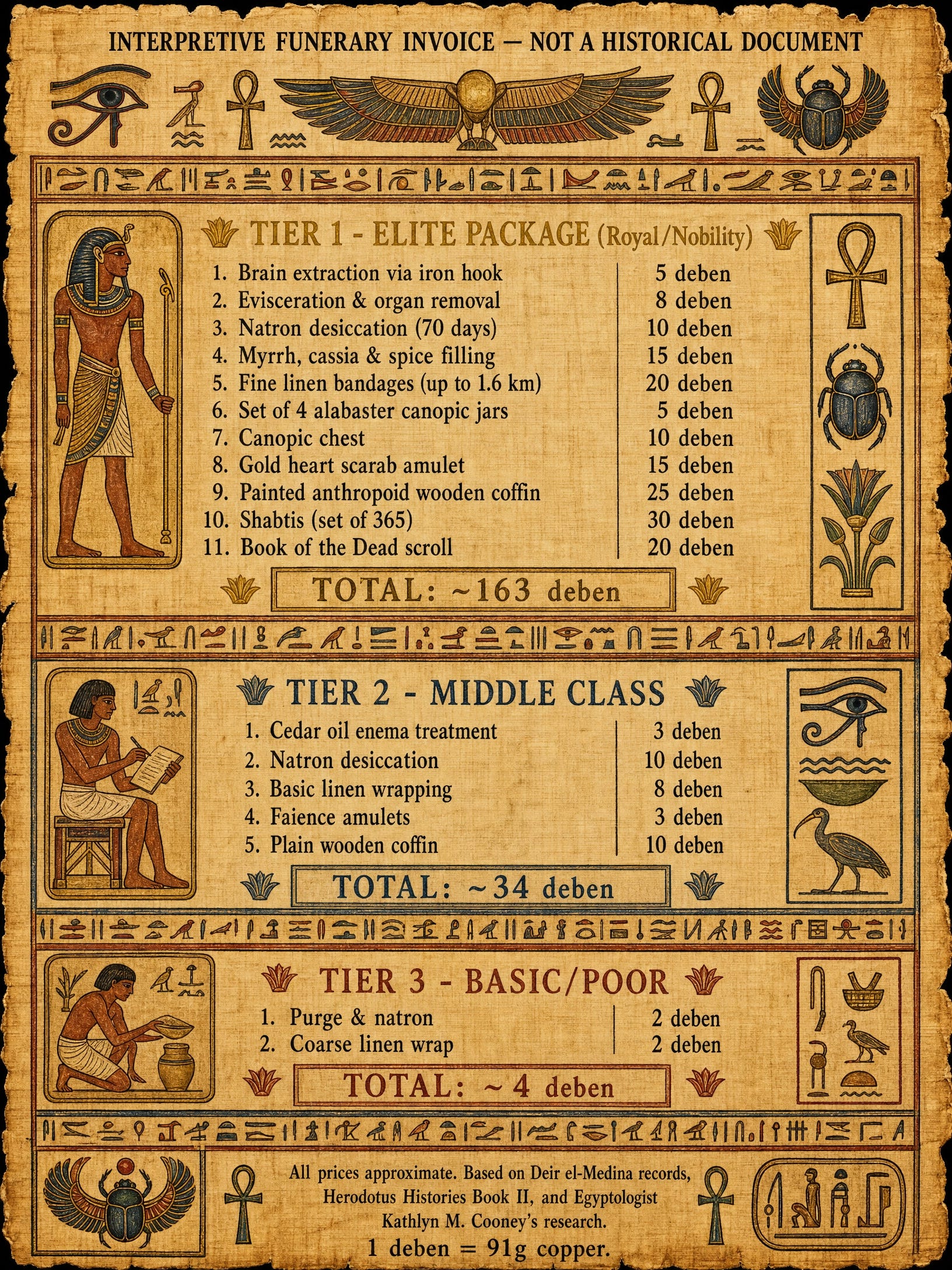
An interpretive itemized invoice showing the estimated costs of the three tiers of ancient Egyptian mummification based on Deir el-Medina records.
The gap between tiers is striking. An elite burial could easily cost 150 to 200 deben or more, the equivalent of two to three years of a skilled craftsman’s wages, before accounting for the tomb itself. A middle-class burial might run 30 to 50 deben. The budget option, stripped of almost everything, cost a fraction of that. And for the truly destitute, there was no mummification at all: the body was washed and placed directly in the desert sand, where the dry heat would do the work of natron for free.
The Coffin: The Single Biggest Expense
For most families, the coffin was the most visible and most expensive single item in the funerary budget. A painted anthropoid coffin, shaped like a human figure, covered in hieroglyphic texts and images of protective deities, was a masterwork of craftsmanship that could take weeks to produce. The wealthiest could afford nested sets: an inner coffin, an outer coffin, and a stone sarcophagus, each layer adding both cost and spiritual protection.
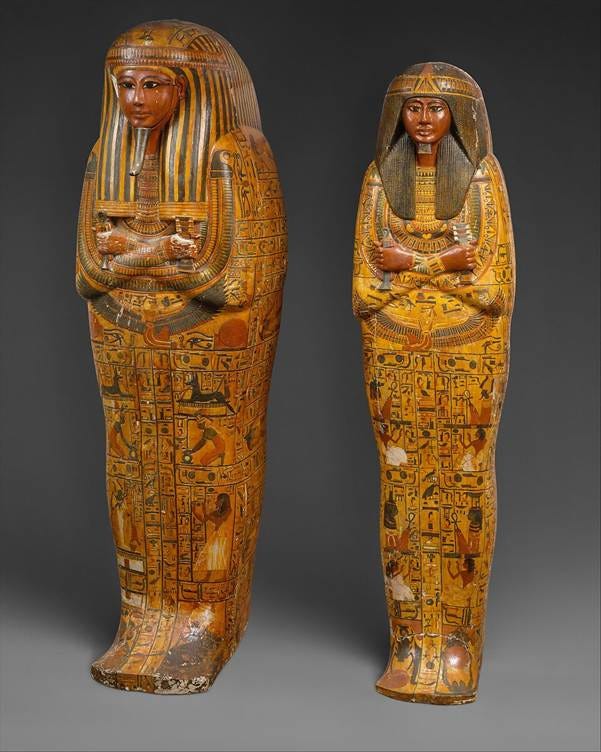
The nested anthropoid coffins of Khonsu, New Kingdom, Ramesside Period. A set like this represented the equivalent of months of a craftsman’s wages — and was considered essential spiritual armor for the journey through the underworld. (Photo: The Metropolitan Museum of Art)
The sarcophagus of Tetet, shown below, illustrates the sheer investment the elite were willing to make. Stone sarcophagi of this quality required quarrying, transport, and months of skilled carving, costs that dwarfed even the most expensive wooden coffins.
The Embalmer’s Workshop
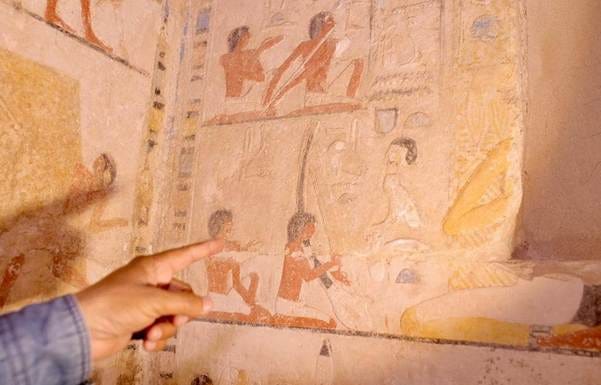
The embalming workshop discovered at Saqqara, dating to the 26th Dynasty. Its drainage channels, ventilation systems, and labeled ceramic vessels gave researchers the first direct physical evidence of how a professional embalming operation was organized. (Photo: Archaeological Mission)
Although the embalmers worked with priests, they were not priests in that sense of the word. An embalmer (wt) was a highly skilled craftsman whose trade secrets were handed down from father to son. As Diodorus Siculus remarks in the 1st century BC, “They were treated with all forms of respect and honor, being in company with priests and going into the temples freely”.
The embalming workshop, or wabet, was usually positioned close to the necropolis. The finding of an embalming workshop of the 26th Dynasty at Saqqara, which was well preserved, announced in 2020 and analyzed in a paper published by Nature in 2023, gave the first physical evidence of this workplace. They established the presence of drainage channels for fluids, aeration systems, and a large incense burner. Some jars had inscription in hieratic, which said how to use various items (e.g., “put on his head,” “bandage or embalm with it,” “dry antiu”).
More revealing was the information resulted from analysis of the residual materials of the jars. Mahmoud Bahgat of the National Research Center in Cairo and Philipp Stockhammer from Ludwig Maximilian University Munich found aromatic plants, including juniper oil, cypress oil, cedar oil, pistacia resin, animal fat, beeswax, and bitumen among many other substances used in embalming.
The Supply Chain of Eternity
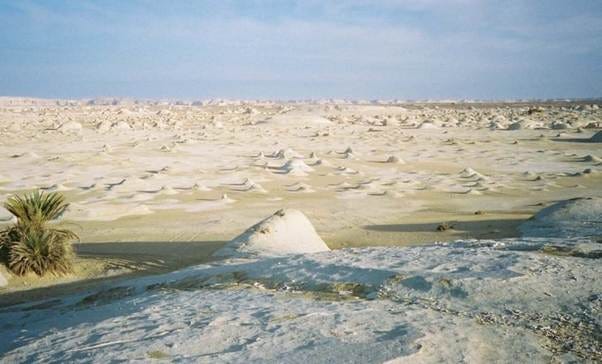
The Wadi Natrun, source of the natron salt that was the foundation of the mummification process. Natron was one of the few embalming ingredients that was locally sourced, almost everything else had to be imported. (Photo: Wadi Natrun)
Not every ingredient that led to mummification was indigenous. Natron, a critical desiccant, was mined from the Wadi Natrun in the Egyptian desert. However, the oils and resins that imbued the elite mummies with fragrance and preservation properties originated far out of the Nile Valley.
Myrrh and frankincense were derived from the Horn of Africa and Arabian Peninsula via, and cedar oil originated from the cedar forests of Lebanon. The resin from pistacia travelled from the eastern Mediterranean. The dammar resin found at Saqqara, which was used for the protective covering on the body, was probably from tropics of southeastern Asia and made its way to Egypt through different intermediaries in the Indian Ocean and land routes.
This implies that the global supply chain had a direct effect on price. Garry Shaw pointed out…that, “less wealthy individuals had limited access to these costly imported resins, especially in the volumes necessary to create a cocoon around.” In contrast, less affluent individuals devised creative alternatives. A mummy from the Chau Chak Wing Museum in Sydney was discovered to have had a painted mud shell surrounding it under the wrappings instead of resin used by more affluent people.
What the Poor Got Instead
The economics of ancient Egyptian death were, at their core, deeply unequal. The same religious beliefs applied to everyone — every soul faced the judgment of Osiris, every heart was weighed against the feather of Ma’at — but the material preparations available to the poor were a pale shadow of what the wealthy could afford.
For those who could not afford mummification at all, the desert itself was the embalmer. Bodies buried in shallow sand graves in the predynastic period were naturally desiccated by the heat and aridity, and some of these natural mummies are among the best-preserved in the world. The irony was not lost on later Egyptians: the poorest burials sometimes produced the most durable results.
For those who could afford the basic package, the 70-day natron treatment provided at least some preservation. But without the linen, the amulets, the coffin, and the inscribed spells, the soul had far less protection on its journey through the underworld. The Book of the Dead was not just a religious text — it was a practical guide, and owning a copy was a form of spiritual insurance that cost money.
The Priests and the Maintenance Fees
If there was an expense, it was not concluded with the burial. The family often paid ka-priests who were mortuary priests with the duty of making daily offerings at the tomb. This was arranged in contracts, which were funded by endowments. After the food was ritually consumed by the spirit of the deceased, it went to the ka-priest as part of his payment. So, in effect, it was a perpetual care fee.
These arrangements could fail. Tombs were sometimes robbed, endowments sometimes ran out, and families sometimes forgot. The ancient Egyptians were very aware of this risk, and that is why they often had tomb inscriptions asking people who passed by to make the offering formula even if there was no food. As one scholar remarked, “The dead became dependent upon the generosity of the living.”
Final Thoughts
The economics of ancient Egyptian mummification tell us something profound about the civilization that produced them. A culture that invested this much, financially, logistically, and spiritually, in the preparation of the dead was not morbid. It was, in its own way, deeply optimistic. The afterlife was real, it was attainable, and it was worth saving for.
The elite spent the equivalent of years of wages on coffins, amulets, and imported resins. The middle class made careful compromises. The poor did what they could. And the embalmers, the amulet-makers, the linen merchants, and the ka-priests all built their livelihoods on the universal human desire to survive death.
The ancient Egyptian funeral industry was, in the end, the world’s first and most enduring luxury market. The product? It was eternity. And the price was whatever you could afford.
Top Image: Inside an ancient Egyptian embalming workshop, where eternity was a booming business.
By Aris Manus
References
Herodotus. The Histories, Book II. Translated by A. D. Godley. Cambridge: Harvard University Press, 1920. Available at: https://www.livius.org/sources/content/herodotus/mummification/
Cooney, Kathlyn M. “How Much Did a Coffin Cost? The Social and Economic Aspects of Funerary Arts in Ancient Egypt.” In To Live Forever: Egyptian Treasures from the Brooklyn Museum. Brooklyn Museum, 2008. Available at: http://karacooney.squarespace.com/s/Cooney-offprint-To-Live-Forever_color_Bleiberg.pdf
Rageot, Maxime, et al. “Biomolecular analyses enable new insights into ancient Egyptian embalming.” Nature 614 (2023): 287–293. https://www.nature.com/articles/s41586-022-05663-4
Wente, Edward F. “Funerary Beliefs of the Ancient Egyptians.” Expedition Magazine 24, no. 2 (1982). University of Pennsylvania Museum. https://www.penn.museum/sites/expedition/funerary-beliefs-of-the-ancient-egyptians/
Wade, Andrew D., and Andrew J. Nelson. “Evisceration and excerebration in the Egyptian mummification tradition.” Journal of Archaeological Science 40, no. 12 (2013): 4198–4206. Referenced in: Tia Ghose, “New Analysis Sheds Light on Ancient Egyptian Mummification,” Christian Science Monitor, March 22, 2013. https://www.csmonitor.com/layout/set/amphtml/Science/2013/0322/New-analysis-sheds-light-on-ancient-Egyptian-mummification
Shaw, Garry. “Ancient Egyptians who could not afford expensive embalming resin may have used mud instead.” The Art Newspaper, February 3, 2021. https://www.theartnewspaper.com/news/ancient-egyptians-who-could-not-afford-expensive-embalming-resin-may-have-used-mud-instead
Ionescu, Diana. “Ancient Egyptian Funeral Home Catered to All Budgets.” Connecting Directors, July 7, 2020. https://connectingdirectors.com/56993-ancient-egyptian-funeral-home-catered-to-all-budgets
Arnold, Michael. “The Magic Amulets of Ancient Egyptian Mummies For Eternal Life.” The Collector, October 20, 2020. https://www.thecollector.com/egyptian-magic-amulets-and-mummies/
Diodorus Siculus. Library of History, Book I. Translated by C. H. Oldfather. Available at: http://penelope.uchicago.edu/thayer/e/roman/texts/diodorus_siculus/1d*.html
Those souls embalmed by the desert are probably laughing at those that spent a fortune for the same afterlife!?