

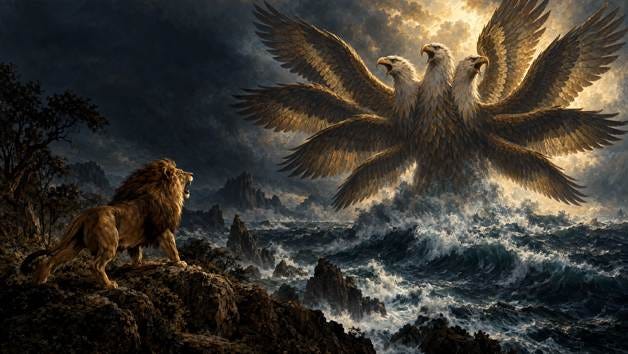
Could a dream written nearly two millennia ago be a prediction of the future? The question returns whenever readers encounter the eagle in 4 Ezra: a creature rising from the sea with twelve feathered wings and three heads, ruling the earth before a lion comes from the forest to pronounce its end.
On the second night, the seer Ezra dreams of an eagle rising from the sea. It has twelve feathered wings and three heads. It commands the earth, orders its own wings to keep watch in turn, and rules through a sequence of short-lived powers. Then the dream changes. A roaring lion comes out of the wood, addresses the eagle in a human voice, and pronounces its end.
The scene belongs to the Eagle Vision in 4 Ezra 11–12, the Jewish apocalypse that appears as 2 Esdras 3–14 in many English Apocrypha editions.
That setting makes the future question more interesting. Does the vision speak only to its first historical moment, or does its account of rule, rivalry and judgment reveal a pattern readers recognise in later ages?
The text itself eventually interprets the eagle, the wings and the lion. Before that explanation arrives, however, the dream slows the reader down. Every wing that rises, every head that wakes and every command issued from the eagle’s body helps build a vision of authority that is sprawling, violent and ultimately unstable.

