


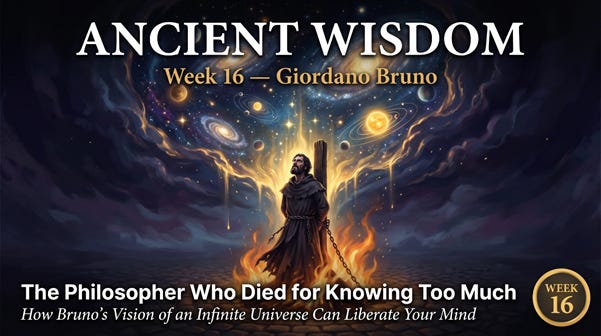
Throughout the history of religion, many of its most notable figures were either prophets who preached to large groups of people and kings who constructed beautiful temples and reformers who took on empires. However, among these, one of the greatest spiritual thinkers of 16th-century Europe would be an Italian philosopher, a mystic and a cosmologist named Giordano Bruno. Although he existed at a time in history where the world was still bound by Church doctrine and the Earth-centric cosmology of Aristotle, Bruno’s understanding of our universe was so radically different than anything that had come before him, that he was unable to accept the Church’s explanations for the universe. He did not just seek to explain the physical world around him (the stars, for example), but rather to uncover mankind’s place in the universe (what role do we play?) and provide a means to find that answer (how do we know?).
As a result of this quest, Bruno produced some of the most innovative ideas in human history, in connecting the ancient mystical view of the universe and the emerging scientific worldview. This week we will travel back in time to 16th Century Europe, where we will meet Bruno and learn about his philosophy of the universe, which was based on his observations of the stars, and the search for man’s place in it. Through this process of careful observation and thought of the cosmos, Bruno came to know God, and from this knowledge came the possibility of intellectual and spiritual freedom.
The Problem Bruno Didn’t Want to Ignore
Most of the spiritual leaders of Bruno’s time viewed God as being far away, like a king who ruled over a closed universe and Heaven as a physical location outside of the stars. Bruno began with a vastly larger subject than what most people during his time were willing to address. One that most of Bruno’s contemporaries spent most of their lives avoiding: that of the incomprehensible beauty and terror of the concept of infinity.
It gives us comfort to believe that the Earth is at the centre of the universe, that we, as humans, are the primary reason for the creation of the universe, and that the universe has a definite boundary. We crave security, safety, and a feeling of being special. We want to limit the universe’s size so that we can comprehend and control it. People educated in Bruno’s time still believed that the stars were lights that were glued to a crystal sphere and turned around our privileged planet.
It is therefore not surprising that in his cosmology, Bruno begins by asserting that the universe is infinite, and that the Earth is only one of countless planets in the universe.
At first glance, his philosophy may seem quite unsettling. Bruno did not intend to make humanity feel insignificant; he simply stated the facts.
Bruno is not saying that life cannot be meaningful. He is saying that the meaning of life cannot be found in the illusion of being at the centre of a small, closed container. The limits we set for ourselves, whether they are cosmological, religious, or personal, are only an illusion. The universe will not conform to our desire for an orderly and logical structure. The Earth is constantly moving, the sun is merely another star, and the cosmos is without an ending and without any centre.
Life is not objective. It is the product of our subjective view of a constantly changing, infinite universe. Yet our need for stability and a position of authority continues to deprive us of enlightenment and cause us to suffer. Bruno did not create the theory of the infinite universe; he simply accepted that there is such a thing as infinity and he just dealt with it ...
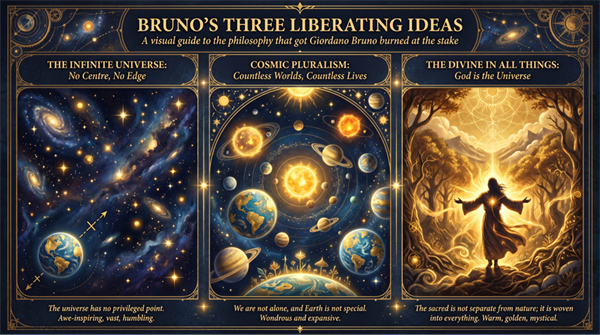
Bruno’s Three Liberating Ideas: A Radical Diagnosis
Bruno’s cosmological philosophy, sometimes referred to as Bruno’s great discovery, is a means of identifying our ignorance, as well as explaining how we can free our minds from ignorance.
The first concept is The Infinite Universe.
The traditional view of the universe before Bruno held that the universe was bounded by an edge, the sphere of fixed stars. Bruno contended that God created the universe, and therefore the universe must also be infinite, with neither a centre nor an outer ring. God, being infinite in nature, means the universe He created will also be without limits. As Bruno explained, there are no “up” or “down” directions in space. Neither is Earth in the centre of the universe, nor is the sun. Every point in space, therefore, is the centre of the universe.
The second concept is Cosmic Pluralism.
Looking at the stars through the lens of infinity, Bruno discovered that the stars are, in fact, other suns, just like our sun. Since our sun has planets orbiting it, Bruno concluded that these stars must also have planets orbiting them. Additionally, Bruno proposed the hypothesis that many of these other worlds may also contain forms of life. Thus, we are not alone in this vast universe, nor is our planet the only one that can support living beings.
The third concept is The Divine in All Things (Pantheism).
Bruno’s greatest insight regards God’s immanence in our universe. He does not teach us of a God that is separate from us or aloof and judgemental. Rather, he offers a view of an animated, dynamic Universe. The Universe is immortal; therefore, God cannot be outside of it. God is the Universe, the vital force that gives life to all existence. The Divine is part of the Universe and all of its contents. The Divine has been animated into the very fabric of creation (including you).
Why Bruno’s Teaching Still Feels So Modern
In the past, how people viewed the stars was greatly affected by modern civilization. People are now confronted with feelings of insignificance, existential dread and cultural conflict at far greater levels than any other civilization in recorded history. Crowning the evolution of modern civilization, society teaches individuals that only through strict adherence to rigid dogmas, tribal identities or control can one have “certainty” within themselves.
Yet it is apparent that individuals’ minds are constantly searching for something complete and thus never at peace in an ever-changing universe.
The way people continue to relate to the teachings of Bruno is an example of how universality and interconnectedness of existence affect how people experience suffering from life’s struggles. This is especially true when we observe how people respond when confronted with a different worldview; they defend their own beliefs aggressively in an attempt to establish their worldview as the absolute “centre” of truth.
This response is typically triggered by the vastness and complexity of the present-day world, where people become overwhelmed with feelings of insignificance and revert to narrow-minded, tribal thinking.
People establish a rigid identity for themselves as being “special” or “chosen” only to discover that the reality of diversity and complexity of the world challenges this illusion.
Bruno recognised this pattern. Individuals do not just live through life; they cling to, distance themselves from and require that the universe conforms to their small human-centric expectations.
Thus, Bruno’s teachings have not only cosmological implications but also psychological, practical and contemporary relevance.
Three Practices for an Infinite Mind
Bruno’s philosophy is powerful not because of the things that a practitioner believes but because of the things that they practice. If Bruno were alive today he would encourage everyone to not only view his infinite universe, but also act on his observations. Here are three suggestions that you may find useful in starting to put these concepts into practice:
1. The “No Centre” Reflection
Everyday, you should try and notice when it is assumed that you are the one that has the only correct perspective. This can happen during a disagreement with someone else, when you are judging another culture, as well as believing what should happen in your life.
Whenever you want to say out loud that you are in the middle of everything, stop yourself before responding and consider a very easy question to answer: “If the universe doesn’t have a centre, how can I say my perspective is the middle of everything, when I have an infinite number of possible valid perspectives?”
By taking time to think like this, you emulate Bruno’s cosmological transformation; you “de-centre” your ego and permit the existence of many true perspectives. The purpose of this practice is not to discredit or devalue your experiences; it is to increase your knowledge base. When the illusion of centrality is visible, it loses a degree of its power over you.
2. The Plurality of Worlds Practice
Everyday spend some time thinking about the large range of experiences of people in the world. The reality of Bruno’s “worlds” is not only limited to the physical planets, but also includes the inner realities (worlds) of the different types of people with whom you interact.
Regardless of which person you meet on any given day, take a moment and consider the following question, “Am I willing to recognize that this person has their own unique and equally complex ‘world’ (inner reality), just as mine is?”
Acknowledging the reality that there are so many unique “worlds” around us is one of Bruno’s most insightful teachings: humanity experiences conflict with itself, and with others, when we refuse to acknowledge the existence of many “worlds.” When we take the time to acknowledge and contemplate the countless “worlds” around us, we will begin to diminish the illusion that our “world” is the only “world” that exists, and therefore we will be able to respond to others with greater equanimity, less reactivity, and more compassion.
3. Seeing the Divine in the Ordinary
Bruno’s search is an exploration and insight not only about the way in which we view our life from an intellectual perspective, but also our view of the physical world.
This week, when you perform your daily tasks, select a single moment when you are experiencing boredom or disconnection from your surroundings. Attempt to observe the tree, stone, or even the most mundane object before you, with the understanding that the object is in truth the same infinite energy from where the stars receive their power.
Let go of the habit of thinking that you must only find what is “sacred” to you in designated “sacred” spaces. This is a Bruno’s perspective because we are all a part of an infinite living universe and so the divinity of our world is overflowing into every aspect of our immediate world, all around us and in the present.
So, every time you make the conscious effort to break away from your mundane thought processes and begin to express your awe and respect for the “ordinary” this is how we come into contact with the infinite, and this is a key element of Bruno’s pantheism. To acknowledge reverence is not simply a “feeling” but it is a disciplined, conscious act of seeing the “sacred” in everything.
The Freedom Bruno Achieved
While Bruno does indeed have many promises to offer, like a universe of infinite wonder, he does not make this promise to be safe (as his own life proved).
What he does offer, however, is an opportunity for the mind to experience total liberation. You will continue to be challenged due to your increased understanding, however you will no longer have to go through life under the oppression of closed-mindedness.
You may even have times in your life when you feel insignificant; in the same sense, it does not mean you must create an identity out of that fear. You will continue to be a part of a culture that demands conformity to its norms, therefore, you do not need to succumb to the intellectual slavery represented by that culture.
You will also exist within a constantly changing universe; therefore, there is no need for you to wait for everyone else to accept your opinion before you allow yourself to think independently.
It has been more than four centuries since Bruno was executed in Campo de’ Fiori, and yet there are elements in his philosophy that are still relevant today. Humans continue to experience closed-mindedness; however, the structure of the universe and all things within it will always be an endless and expanding thing.
The man who died for being too wise did not die due to being obstinate; he recognized that the security provided by a closed universe had no power over the innate nature of humankind to pursue infinite truth.
The true challenge of Bruno’s thought and philosophy lies therein, and therein also lies the promise.
The philosophy of Giordano Bruno begins with the incredibly vast concept of infinity yet it does not stop there. The ultimate goal is for an individual to possess the ability to live a life filled with the intellectual courage required to use the universe’s endless capability to be remarkably connected to it. In an age where most of society seeks to build walls to segment themselves and their surroundings, Bruno has provided an opportunity that is worth far more than walls:
The freedom to not rely on any structure in order to find a connection to your place in the cosmos.
Therefore, if you can achieve a sense of freedom from the need for a structure, then you will create an endless kingdom of your own.
By Dr Ioannis Syrigos
Recommended Reading
Giordano Bruno and the Hermetic Tradition by Frances A. Yates
Cause, Principle and Unity: And Essays on Magic by Giordano Bruno
This happened in the 1600s as I remember. That was getting close to the Thousand years of darkness mentioned in Revelations. Anyone criticizing the Pope or church was subject to prison,torture or death.