

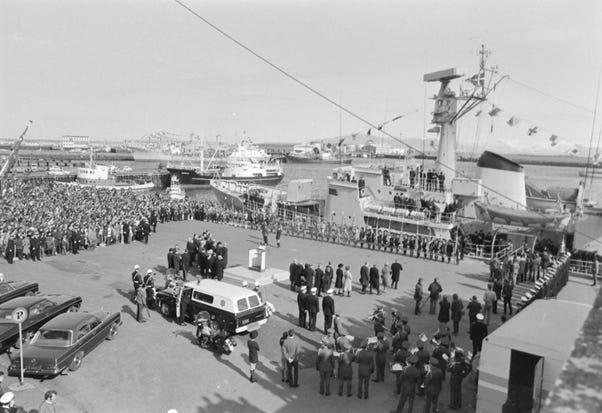
In 1971, a Danish naval ship returned two medieval manuscripts that Iceland had pursued for decades. The harbour erupted in celebration. Yet one of the books at the center of the ceremony, the manuscript that preserves much of the Poetic Edda, was already missing a crucial section of its text.
The morning a nation waited for books
On 21 April 1971, a Danish naval inspection ship, Vædderen, tied up at Miðbakki in Reykjavík harbour. Three uniformed officers stepped ashore with three plain brown-paper parcels: one small and two large.
The crowd had not come for a monarch, a military victory, or a visiting celebrity. It was there for the parcels.
According to Morgunblaðið, about 15,000 people gathered at the harbour. Even primary schools closed for the occasion; children lined the route with Icelandic and Danish flags, and radio and television carried the arrival across the country. In Reykjavík, Prime Minister Jóhann Hafstein captured the moment in a line that has lasted almost as long as the photographs:
“What is it that you now come to bring us? It is two books!”
This line worked, because these were not just books. They were two of the most potent surviving vessels of Iceland’s medieval memory:
Flateyjarbók and the Codex Regius of the Poetic Edda, known in Icelandic as Konungsbók, or “the King’s Book.”
What was inside the parcels?
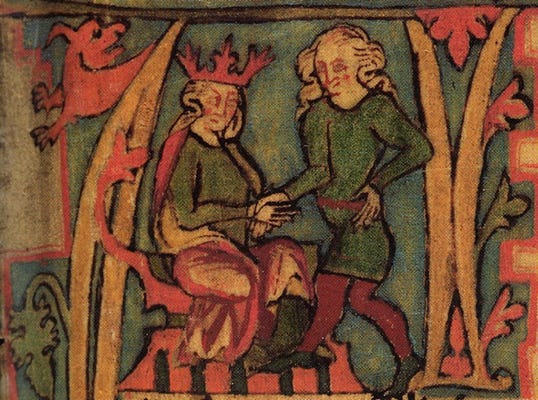
Flateyjarbók, copied in the late 14th century and later expanded, is the largest of Iceland’s medieval vellum manuscripts. Its core is a lavish collection of Norwegian kings’ sagas, but it also preserves the Saga of the Greenlanders, one of the earliest surviving written accounts of Norse journeys to Vinland.
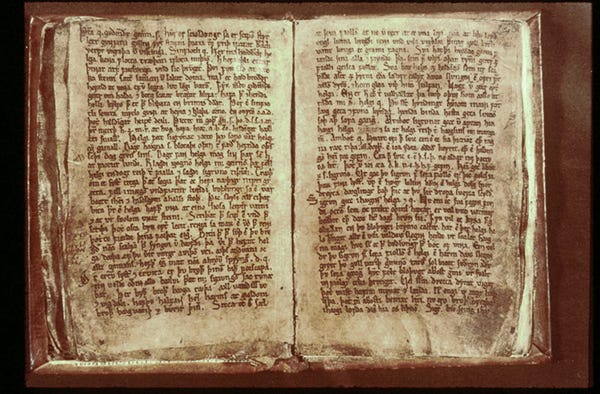
The other manuscript carried a different kind of weight. It was copied in Iceland in the 13th century, the Codex Regius is the principal medieval witness for the poems now grouped as the Poetic Edda. Without it, much of what modern readers think of as Norse myth would be thinner, stranger, or simply gone. The manuscript preserves poems about Odin, Thor, Loki, cosmic disaster, legendary heroes, and the tragic world of Sigurd the dragon-slayer. For many of its poems, it is the only surviving medieval copy.
At four that afternoon, the ceremony moved to Háskólabíó, the university cinema. The Iceland Symphony Orchestra opened with Carl Nielsen’s Saga-Dream. Denmark’s education minister, Helge Larsen, handed over the two volumes of Flateyjarbók to Gylfi Þ. Gíslason, Iceland’s education minister, saying: “Vær så god, Flatøbogen”, “Here you are, the Flatey Book.” The Codex Regius followed immediately. Of course the audience rose and applauded for a long time.
Why were Iceland’s manuscripts in Copenhagen?
The answer lies in a 17th-century chain of gifts. The Codex Regius came into the hands of Brynjólfur Sveinsson, Bishop of Skálholt, in 1643. In 1662, he sent it to King Frederick III of Denmark. Flateyjarbók followed a similar route: Jón Finnsson of Flatey gave it to Brynjólfur in 1647, and the bishop sent it to the king in 1656.
At the time, Iceland was under the Danish crown. A gift to the king entered the royal collection in Copenhagen. For more than three centuries, the two manuscripts remained there.
When Iceland became a republic in 1944, and the question arised: should works written in Icelandic, in Iceland, and central to Icelandic history remain in Denmark? Denmark passed legislation on the manuscripts in 1961, but opposition led to a court fight. The Danish Supreme Court settled the case on 19 March 1971. A treaty between the two countries followed on 1 April, clearing the way for the April ceremony.
But, there was an important twist. The normal rule for transfer covered works written or translated by Icelanders and chiefly concerned with Iceland. By that definition, the University of Copenhagen notes, neither the Codex Regius nor Flateyjarbók would have qualified. They returned under a special clause, an exception written for the two manuscripts everyone recognized as exceptional.
A homecoming that took 26 years
The harbour celebration was only the opening move. Transfers continued until 1997. The University of Copenhagen records 1,666 manuscripts from the Arnamagnæan Collection and 141 manuscripts from the Royal Library sent to Reykjavík; the final two arrived in June 1997.
The result was not a simple winner-takes-all division. Around 1,400 manuscripts and fragments remain in Copenhagen, about half of Icelandic provenance. The two Árni Magnússon institutes in Copenhagen and Reykjavík continue to cooperate over a collection whose history belongs to both countries.
The mystery inside the King’s Book
The cheering crowd on the quay could not see the most unsettling fact about the Codex Regius through its brown wrapping: the manuscript is incomplete.
The surviving book has 45 vellum leaves, but it once had a further quire, normally counted as eight leaves, or 16 written sides. The gap falls after Sigrdrífumál, in the middle of the heroic material surrounding Sigurd. The text resumes with a fragment so damaged by the loss that its conventional title announces the problem: Brot af Sigurðarkviðu, “the broken-off poem of Sigurd.”
No one knows when the missing quire disappeared, who removed it, or what exactly stood on every lost line. Related prose narratives and other poetic witnesses can illuminate parts of the story, but they cannot restore the vanished gathering leaf by leaf.
That is the paradox at the heart of the 1971 homecoming. Iceland celebrated the return of a manuscript that safeguards some of the most familiar voices in Norse myth, Hávamál, Lokasenna, Þrymskviða, while the book itself carries a conspicuous wound.
The question though that remains: What happened in the missing leaves, and how much of their lost world can still be recovered?
By Aris Manus
References
• Government of Iceland, “Einsdæmi í mannkynssögunni” (25 August 2020). Harbour arrival, crowd account, school closures, flags, and live broadcast.
• Árni Magnússon Institute for Icelandic Studies, “Flateyjarbók” (Icelandic). Manuscript history, contents, 1647/1656 transfers, and the 1971 handover wording.
• University of Copenhagen, “Transfer to Iceland”. Special clause for the Codex Regius and Flateyjarbók, transfer totals, and collection context.
• Morgunblaðið, 22 April 1971, front page. Contemporary report of the Háskólabíó ceremony, Saga-Dream, and sustained applause.
• Árni Magnússon Institute for Icelandic Studies, “The History of the Árni Magnússon Collection”. Legislation, court settlement, treaty, ceremony, and the remaining manuscripts in Copenhagen.
• The Codex Regius of the Poetic Edda — Konungsbók eddukvæða GKS 2365 4to, Editiones Arnamagnæanæ Electronicæ, 2024; see also the digital manuscript record at Handrit.is. Scholarly edition and digitized record for the codex and its missing quire.
• Wikimedia Commons, “Codex Regius of Eddaic Poems”. Public-domain image used in the article.
• Wikimedia Commons, “Flateyjarbok Haraldr Halfdan”. Public-domain medieval illumination used in the article.


that was a very interesting article. would love more articles on medieval manuscripts.